Friday, 31 July 2020

16mm Layout With Gravity Incline

It is always fun to find links, especially with romantic times and places.

Here is a 16mm layout with plenty of contours and gradients, based on a Welsh slate quarry. Hunslet locomotive is by Wrightscale. We now invite you to go even further afield.

What, indeed could be more exotic than nineteenth century Paris? For centuries, the British have looked forward to fun or study in Paris. If they couldn’t make it there, they would import a few French chefs, Paris fashions or racy French novels. So here is a little bit of Paris which you could put on to your 16mm scale layout.

This print of Louis-Napoleon Bonaparte (1808-73) is taken from a photograph by Appert: courtesy MD Wright. LNB is a character I have tried to sketch in a former blog. He had a plentiful back-story. He considered himself to be semi-royal, and as the heir to Napoléon Bonaparte (1769-1821). The youth of Louis-Napoléon was spent in various parts of Europe and in circumstances varying from Army to prison. After a daring escape from captivity, he turned up in Paris just as the Second Republic was foundering. (The first Republic was post Revolutionary France.) In 1852, he took power and was elected leader for life in an in-out-simple-majority type plebiscite. Just like a certain other in-out referendum the result was always contested .

In honour of his uncle Napoléon, he called his administration (1852-1870) the Second Empire and himself Emperor Napoléon III. This empire ceased with humiliating defeat in the Franco-Prussian War and he ended as he began, in exile.

It is said that the French tried to forget about him, which is not entirely true. In school textbooks he was held up as something between Macbeth, tragically flawed, and a warning about the effects of fornication and substance abuse. Jean Paul Sartre sets Hell in a room furnished in Second Empire style. No-one is entirely useless - he can always serve as a bad example. At the same time, Louis-Napoléon Bonaparte has his defenders. The turmoil since the Revolution had not done much for general living standards. There is some truth in what George Orwell wrote. A revolution merely transfers wealth from one group to another. There is no overall increase in assets themselves.

In other countries, the pie was increasing so everyone in theory could have a larger slice.These16mm models of a 19th century prototype show how freight could be moved. In early 19th century Britain, energy production, agriculture and industry all increased. Gradually, the population became better off. A widening network of railways shifting ever increasing volumes of freight. helped growth on its way. Up to 1850, France was somewhat behind Britain in this respect. During the Second Empire, the pie did increase. The Belle Époque, that explosion of wealth and general living standards was helped by the reforms of 1853-70. Education was reformed. Mechanisation crept into everything. The railways which had been but a pious hope began to be built.  There were improvements in agriculture.

To a hungry person, the arts are little more than a mirror or a lamp, but when the belly is full, they are important. A range of French arts flourished. Being something of an iconoclast, NIII suggested a Salon des Réfusés. Artists such as Manet and Pissaro could show their works and shake painting etc out of its complacent rut.

Most importantly for the Decauville story and through it the whole history of 60cm/2’ gauge railways, NIII authorised the rebuilding of Paris. Decauville and others were inspired by the 2’ railways of Wales, they in turn inspired the engineers of Britain and thus were built the lovely prototypes of the Lynton and Barnstaple, Clay Cross, Snailbeach etc.

This picture shows what we think of as a timeless scene. MD Wright has photographed tourists standing on a bridge leading to the Ile de Paris, with Notre Dame Cathedral in the background. Before 1853, the scene would have been different. The cathedral would have been hidden by slums, freqently threatened by the river in flood. The broad avenues and golden stone represent a tremendous effort. Napoléon III planned a peaceful and rational Paris, one where the mutinous under-classes could no longer build barricades, where Law and Order would reign supreme, where homes were airy and hygienic and large new hospitals could be built. It started on the back of the proverbial envelope, using coloured crayons. Wide avenues would spread from the centre. The old city walls, the old bulwarks, would become boulevards, providing concentric ring roads and linking the new railway terminuses.

One such plan was proposed for London just after the Second World War but was never built. What made the difference in Paris?

Enter Georges Eugène Haussmann. His weaknesses were to prove his strengths. He suffered from asthma, so he approved of green spaces. He had a genuine civil-service mentality, so he was not out to make money for himself. He was pig-headed, so he was blessed by certainty. NIII was prepared to back him.

An army of labourers more-or-less levelled the old Paris, evicting thousands. This (slightly later) picture shows the quarries at the Decauville premisses just outside Paris supplying stone. Before rebuilding, they created a network of sewers and gas pipes below ground and fresh water supplies above. Vast new parks were allocated. Then Paris was rebuilt, largely as five to six storey blocks of mansion flats, with handy attics for artists. There was no real provision for labourers and servants; their accommodation was simply moved from the centre to the outskirts.

For anyone wealthy, the new clean, tidy Paris became the ideal holiday destination. Thanks to improved transport, all the joys of French regional cooking were available. Art, theatre, fashion, music and dance which had received extensive state encouragement sice the renaissance finally had worthy showplace. Thanks to all the gas lighting and the quick routes for emergency services, Paris was safe. The other attraction were the girls drawn into Paris, at a safe distance from disapproving relatives. One 20th century journalist doing fearless research at the celebrated nightclub, the Moulin Rouge, discovered to his pained surprise that ‘not a single girl was from Paris.’ What is true now was true then. Parisians considered that how foreigners met and what they got up to was their own business – as long as rents etc were paid. The tourists loved it. On the one hand, they could boast of their adventures in Paris, on the other, police and hospitals were always close by.

We haven’t forgotten Decauville. His family occupied a farm at Petit-Bourg, Evry on the Seine just south of Paris. They did well because they had specialised in sugar-beet. The pastry chefs of Paris could buy everything they produced.  They were doubly fortunate. The farm sloped down to the river and its upper levels were made of building-grade limestone.

The whole new Paris presupposed quality building stone. Sewers were lined with it, the new mansion blocks were lined with it. The Decauville family had the next best thing to a gold-mine, as long as they could transport the products of their quarry to the barges waiting on the Seine. The balanced or gravity incline was used in Germany at the end of the 18th century. Rammelsburg in the Harz had parallel track. As they went down, the laden carts pulled up the empties. A more modern version of this existed at the Decauville farm, possibly as early as the 1840s.

Thanks to kind Roger Bailly, we are able to present a detail from an engraving, by the celebrated Victor Rose. It suggests that by 1880, the ‘plan incliné’ was transporting hardcore rather than top quality stone. It shows the sophistication of the quarry railway as well as the amount of material which had been extracted. One balanced incline leads to another. At least 20 tipper wagons are visible though relatively few labourers. Investment improves productivity which improves salaries, that virtuous circle which characterises France of teh later 19th century.

Decauville portable railway was the felicitous child of the agricultural and quarrying sides of the Decauville enterprise. If he hadn’t had track available, he would not have invented his agricultural railway. The agricultural railway gave rise to military railway. The genius of Prosper Péchot created essential refinements and the German Army improved on it yet again. And all thanks to Haussmann and his patron Napoléon III.

Here is a challenge for 16mm modellers. Add interest and contours to your layout by creating a balanced incline on your railway. As the laden wagons go down, they can pull the 'empties' back up to your quarry or farm. In the illustration of the Decauville quarry, a chain on a pivot links the up with the down train.TAs mentioned before, there ae many and varied prototypes. The pastoral 16mm scene below features a Wrightscale Wren pushing some empties along the level.  It could be just coming to the base of an incline. It pushes its empties to join the waiting train of empties. When a train is ready to descend, they are pulled up. It would be fun!

Wednesday, 15 July 2020

16mm WDLR stock


We read with interest Steve Thornhill’s article in the latest issue of Sixteen Millimetres Today (Issue 175 pp 42 to 45). We are delighted that he shares our interest in this strange yet strangely logical prototype. Various books have been written on the topic - more later.
The Baldwin Gas Mechanical was a locomotive used on 60cm gauge railways during the First World War. Photo taken at Froissy upper Somme by Malcolm Wright
We admire his go-ahead pioneer attitude. All he had was Mamod track and his ‘occasions’ box. And of course, an idea! From the basic bogie, he then created a series of wagons fulfilling several different purposes. Some were simple push-along ‘trucks’ some were more elaborate bolster wagons - bolster wagon consisting of two bogies linked by a chain. This flexible arrangement could take anything from a load of prefabricated track to a gun. 
The story of the Steve Thornhil wagons reflects the story of the originals. They too were ingenious improvisations. In the First World War, the British Expeditionary Force did not go to France with any portable railway equipment. They imagined that, like Napoleon, they would be powering through Northern Europe so fast that no railway building could keep up . Only the beastly trenches of the Opposition were stopping them!
In the meantime, they had to dig trenches of their own and staff them. Once armies were camped out in this way, supply became an issue. At first, they relied on their Allies to provide them with the necessities  – and didn’t ask too many questions as to how they were doing it. They didn’t reflect on how the German armies were supplying their own trenches.  Perhaps, as they struggled through the mud with rations on their backs, they assumed that the French and Germans were doing the same. But not for long …
This 'official' War Department bogie bolster arrangement could be used for timber, lengths of prefabricated track, you name it. Wrightscale 16mm bogie bolster kit
Various forms of supply were tried. They requisitioned horses and mules in their millions. Lorries, buses and taxis were tried. There were always problems. The life of the horse at the Front was tragically short. The primitive tyres of their lorries cut the French country roads to ribbons. For want of handy peasants, they used their own soldiers. But of course, if an army of humans is used to supply an army then that army in turn requires an army ….. Same went for the horses.
The men on the ground quickly spotted the problems and equally rapidly looked for solutions. Like Steve Thornhill, they found some good ideas and then looked in the ‘spares’ box to replicate them. The Imperial War Museum, whose archive is now available for genuine research, has some photographs which immortalise the creations of the men on the ground.
As early as winter 1914, experiments began. These first home-made narrow gauge tracks tended to be a practical way to address the most pressing problem – how to get supplies from a siding on a standard gauge, or metre gauge railway to the trenches. The counties of northern France were quite rich in metre gauge railways which supplemented the standard gauge network. Some of the tracks were quite ingenious, and that is before we discuss the rolling stock!
Around Ypres, in the northern section of the line, track was improvised from wooden stakes joined together. Sheets of metal bashed out of ration tins were used to plate the parts which received most wear. They even had points on these proto-railways. This has incredible modelling potential – Steve Thornhill and fellow enthusiastd please note. For the record, they used biscuit tins, the large size ….
An 'official' War Department bogie which as you see also doubles as a push truck, if a wooden platform is added. It has a metal frame and brakes and is rated at 5 tonnes. Wrightscale 16mm WD bogie
On these ran the ‘push-wagons’ so-called because they were designed for pushing by human power. It is to be noted that their descendants, Class A wagons with removable sides were rated at a maximum load of 3 tons 12 hundredweight – well over 3 metric tonnes. Simply by putting the load on rails made humans more productive than military general service road-wagons each hauled by two mules. The limiting factor was the quality of the rail.
A contemporaryphotograph of a heavily used road (the route supplying Verdun during the siege of 1916) shows that the army being transported is equalled by the army repairing the road. Collection MD Wright
The wagon which inspired Steve Thornhill was the so-called Calais-pattern push-truck. The drawing he refers to is the excellent one by Peter Foley. (page 171 of WDLR Companion). The ‘Calais truck' was still being used in 1918, though running on 16 pound per yard (approximately7kg per metre) rail rather than on timber baulks.
Other wondrous creations are recorded. What could not be made was scrounged, mainly 9 pound/yard or 16 pound/yard railway, from French agricultural and light industrial workings. Thanks to the Decauville company, almost every farm, brickworks or quarry had some. With good will and rough-and-ready engineering, much could be achieved.
The would-be modeller can refer to Imperial War Museum negative Q1453 for a picture of a man-hauled trolley, Q 7906, a Lartigue-type monorail, Q 33416, a Wilson-type monorail operating in a trench and to my special favourite, Q 4380. This is the Scotch Express, probably posed for the occasion. This wonderful construction was made from motor-car parts. The radiator is clearly visible and the locomotive is (possibly) running on the inner rims of the car wheels.
A trench, even a replica trench, requires wood, corrugated iron and plenty of labour. Photographed by MD Wright at Apedale 2014

Though the Imperial War Museum photos date from the Somme campaign and later (July to October 1916 on to November 1918), we can be confident that our boys had improvised labour saving devices long before then.
For those who are keen on vehicles repurposed from motor cars, there were some ‘official’ prime movers – the Crewe tractors. The Crewe works of the London and North Western Railways converted Model T Ford cars for military use, both on roads and on rail. 132 were provided for the  War Department programme, though not officially for War Department Light Railways. Another 6 one-ton Ford lorries were, it is believed, built for the war in East Africa.
By 1915, a tremendous tonnage was being moved out to the trenches. In the reminiscences of Ian Hay, some well-established regiments had built homes from home and many modern conveniences in timber. Piccadilly Circus and the Fleet, not to forget Tipperary, had been mapped on to the fields of the Somme. By early 1916, the British were quietly imitating the French, who had an immensely sophisticated trench railway, first developed by Prosper Péchot of the French artillery. To begin with, they were given a branch-line. A month into the Battle of the Somme they were forced into their own War Department Light Railways programme.
A century after the First World War, a bogie wagon designed by Colonel Péchot of the French artillery shows its metal, still able to carry ten tonnes of freight. Taken at Apedale by MD Wright
As the story goes, Top Brass had tried to support the Somme offensive by transporting supplies and ammunition by lorry. These machines were so thirsty that there was no fuel for buses at home. As the Home Front was vital for making the ammunition, this could not be tolerated. In fact, General Haig was already sympathetic to the concept of Field Railways and the Home Front was a welcome excuse for making trench railways official. Sir Eric Geddes and the War Department Light Railways were approved by the highest authorities..
In fact, as the photographic evidence shows, a proper railway of bogie trucks running on 60cm prefabricated track pre-existed the War Department Light Railways. On the other hand, the rough creations of the resourceful military workshops were still being used at the end of the War.

All self-respecting horses stayed well back from the action. These ones charged the enemy in Spring 1918. Photo copyright MD Wright

The First Hundred Thousand Ian Hay. A contemporary account, republished many times since
Col Péchot:P Tracks To The Trenches by Sarah Wright Birse Press
WDLR Companion by  Colonel David W. Ronald and Roy C. Link. It has a treasury of contemporary photographs, drawings by Peter Foley and it has illustrations refurbished from the sketches which appear in WJK Davies
WDLR Album compiled by Roy C Link (both RCLpublications)
Light Track to Arras
Light Railways of the First World War by WJK Davies

Ahhh... any excuse to show the BGM once more


Wednesday, 10 June 2020

The Decauville Company and young Péchot


Due to a technical problem, this post is not illustrated. We are working to resolve this.
Followers of Wrightscale always like a little background to our models.
In my last post, I began the story of French 60 cm railways. As you know, many years of fascination with the life and works of Prosper Péchot (1842-1928) resulted in my book, Colonel Péchot: Tracks To The Trenches. He was the father of 60cm military narrow gauge, but his achievement was only possible because of his near contemporary, Paul Decauville (1846-1922). The two underwent the same experiences and were both awarded the Légion d’Honneur for contributions to narrow gauge railways. Though friends in 1870s, in later life, they became frenemies. The railway ran through their most formative years.
It is interesting to trace the influence of Belle Epoque France (1870s to 1900s) on the development of narrow gauge.
The technology began elsewhere. The Germans first recognised the labour-saving potential. In Freiburg Cathedral, there is a detail in a stained glass window showing a miner pushing a hund, a sort of proto rail truck. It dates from 1350. We can clearly see how a single person could be made more productive. As Germans spread through Europe, it has been argued, they took their mining techniques with them. This spread a form of prosperity which did not depend on an underclass of slaves. Good for the Germans!
It has been argued, not unfairly, that the dark European slavery culture delayed the development of proper railways.
By Tudorbethan times, however, the English had need of German ideas.  The population was growing but the tree cover was not. Coal was a handy replacement for firewood, especially in London. Coal-ships could sail from the staithes of the north round to the port of London with much needed fuel. Railways carrying horse-drawn trains were developed to get the coal from mine to port. These railways were standardised on the old Roman wagon-width 4’ 8 ½ “  – what we now call ‘standard gauge.’ Over the years, standard gauge coal-fuelled locomotives were developed. Railways that were not built either to standard or broad gauge 7’ were basically outlawed.
The Methodist Welsh had non-standard ideas. Northern Wales did not have coal but it had an increasingly valuable resource – slate. As cities grew and thatch products – reeds, straw and heather – became harder to come by, slate provided a handy, hygienic alternative. Even better, it did not require constant maintenance, thus landlords could retain more rent. Railways were the obvious route from mine to the coast and then on to the expanding cities; the Welsh didn’t see why they should always be standard gauge.  The Great Little Trains of Wales were born as commercial necessities, firstly as horse-drawn narrow gauge railways.
It took the genius of Colonel Stephen and his like to put mechanical power on to railways. There were problems. Steam-powered locomotives worked best on straight, level track but it cost fabulous sums to build railways to these standards, far more than would be economic for a mine or quarry. If a steam loco was put on tortuous narrow gauge track negotiating steep gradients, it would soon topple over, if it had not already been derailed by its train.
The Spooner family and a team of like-minded engineers addressed these problems. They had their own laboratory for experiments, the Festiniog Railway which took slate from various quarries down to Portmadoc (Port built by Alexander Madocks). With the help of various friends, political and financial, they managed to push through the required Act of Parliament in 1863. A 1’ 11 ½ “ gauge railway could be built on existing tracks (well, sort of) from Portmadoc up the Dwyryd river.
The Princess and Mountaineer (delivered 1863) were the first steam locomotives, joined by ‘The Prince’ and Palmerston. They were all to an 0-4-0 T design with square water tanks. In the first years, many modifications had to be made as this was cutting-edge technology. Fortunately, the slate quarries paid well and so there was the money available. A photo of a heavily modified ‘Prince’ dates from the 1890s. Even the name-plate was altered.
The very short wheelbase of the early locos was a source of problems. If the wheelbase was lengthened, then there was a risk of fouling on the curves of tight radius. How about an articulated locomotive?
Thus was born Little Wonder, 1869, using patents by Robert Francis Fairlie (1831-1885).
We shall now take a ferry across the Channel to see what is happening in France which was, at the time recovering from the Franco Prussian War 1870-1.
For the young Prosper Péchot, the war had been grim. His family had suffered. His beloved uncle who had spent the war year in captivity was released, only to be killed during the battles of the Paris Commune, 1871. His brother was recovering from wounds. His father endured the siege of Paris only to die soon after. He finished his military training with the determination to stop anything like this happening again.
Paul Decauville had also suffered. In 1870-71, he had been mobilised as a gunner, defending Paris. Because the city was encircled, this involved heavy work in the cold on starvation rations.  The privations of the siege finished off his old Dad, leaving Paul with a family of youngsters to rear. Fortunately, his old Dad also left him a farm and quarry, handily placed by the Seine. Using a gravity worked railway, they could transport building stone to waiting barges, so there was money to be made. The farm itself specialised in sugar beet.
Beet is a prolific but sensitive crop which rots quickly if bruised. The autumn of 1874 was unusually wet. There seemed no way that workers with wheelbarrows could haul tonnes of sugar beet away in the short harvest window. Then Paul Decauville put together stone, building techniques and beetroot to come up with a brilliant idea. A railway is a bit like a roofer’s ladder. A roof which cannot support the weight of a human, can do so, if the weight of the human is distributed by a ladder.  If the barrows were rail-mounted, they too could transport substantial weight over soft mud.
Dacauville had rails, thanks to his quarry, and he had the labour. All they needed to do was to make a few lengths of prefabricated track and adapt some existing wagons. The rack was laid where required, the beet carted away and the track relaid in the next field. By 1876, he was marketing a commercial version of the porteur Decauville. They were soon a rich family.
Once he was a qualified Gunner – the artillerie had been his first choice when he was in officer training – the young Péchot became acquainted with le porteur Decauville. It was used in the military base just outside Rennes. In no time at all, he could see the possibilities. Instead of beetroot, he could imagine a portable railway carrying infinitely large guns and enough ammunition to reduce Germany to smithereens.
I exaggerate. He had realised that bigger guns were better. As the weight of a shell increases arithmetically so the payload of explosive increases geometrically. (Apologies to Malthus). What he wanted was a portable system which could carry guns with large barrels and serious quantities of ammunition.  Simple! All he had to do was to persuade the French Army.
Unfortunately, he was treading on a lot of well-polished boots. His campaign basically cost him his career. Fortunately, Paul Decauville understood what he was doing and also wanted to ensure that France would win the next French-German war.
He put his money and his Cred behind the Army officer.
Decauville knew well that his porteur was not original. At least one French portable railway had been patented before his. The quarries of Wales were also of interest. We know that both he and Péchot  had read articles in the specialist literature and that Decauville paid a visit to the Festiniog railway.
He thought about the problems of putting steam power on to narrow gauge track and came up with two solutions. One was a stationary engine which could haul along a train. He was, after all, an agent for Fowler’s agricultural machinery – a contemporary engraving shows steam ploughing on the Decauville estate. Another power source was compressed air which seemed to promise so much.
At some point in the late 1870s, Péchot and Decauville became personally acquainted. When Péchot came to Staff College, he became a regular visitor at the Decauville works. They were very different men. Decauville was a proud supporter of the French Republic and felt that Monarchists, Provincials and Reactionaries had stabbed the nation in the back by submitting to the Treaty of Frankfurt. This had ended the Franco-Prussian War on terms most unfavourable to the French. The new Parliament, filled wth said monarchists, reactionaries etc, had driven the Parisians into declaring a Commune and were therefore directly responsible for the bloodshed that ensued.
We know that Péchot could not agree with all this – which made him a reactionary. In later life he was to suffer greatly during the backlash after the Dreyfuss Affair.
At the time, though, the two men made common cause. Péchot wanted the Army to adopt narrow gauge. Paul Decauville wanted to sell it to them. Between 1880-82, Prosper Péchot was allowed to develop and test a military version of  prefabricated track, at the expense of Paul Decauville's company.
In 1882, as was customary before students graduated from Staff College, Péchot submitted a thesis. The title was by the standards of the time unexceptionable ‘how to wrest the fortified city pf Metz out of German hands.’ (Sorry, Germans, but this was the late 19th century.) The consequences were, quite literally, explosive.
We’ll leave off the Péchot story for a while. Our next post will be about locomotives and wagons that Malcolm has built, all 2’/60cm gauge and all of which can be related to Péchot’s work.
Further reading: Colonel Péchot, Tracks To The Trenches
The Spooner Album produced by the Festiniog Railway Group
Early Wooden Railways MJT Lewis 

Monday, 18 May 2020

Colonel Péchot and the Decauville Company


As you know, many years of fascination with the life and works of Prosper Péchot (1842-1928) resulted in my book, Colonel Péchot: Tracks To The Trenches. His near contemporary, Paul Decauville (1846-1922) lived through the same experience of war and peace in France. The two were closely linked and were both awarded the Légion d’Honneur for contributions to narrow gauge railways. In later life, they were frenemies. The railway ran through their most formative years, though the two men reacted to their childhood in different ways.
Prosper Péchot in 1907, after he had been awarded his Légion d'Honneur. Courtesy Raymond Péchot
Here are what I feel are significant events in their lives. Decauville was born into a prosperous farming family near Evry south of Paris. Péchot was born to a bourgeois family in Rennes. His father was a well-regarded surgeon and his mother came from a family of merchants. In those days, Rennes was still out on a limb, a long stage-coach drive from Paris, but during Péchot’s early years his father got a job in the Metropolis. He thus learned at first hand the benefits of connectivity. If you wonder why there aren’t many railway related pictures here, the reason is simple. There were very few railways in France at the time – in industrial areas of the northeast, and the eastern Massif Centrale.
Paul Decauville in later life. Courtesy Roger Bailly
In 1848, there was revolution throughout Europe, not least in France. The then monarch was Louis Philippe, a so-called regent on behalf of a small Royal child. At the hint of trouble, he fled. France declared a Second Republic - the first republic had of course been after the French Revolution. It came in with high ideals. ‘The government will be by the people for the people. With liberty, fraternity and equality as its first principles, the people will be its standard and guide’ (my translation). Sisterhood was not mentioned and universal suffrage did not include women. 
A new provisional government moved against the most irksome laws: press censorship, laws against free assembly and restrictions on who could join the National Guard were all removed. Almost immediately, they arranged an election open to all Frenchmen aged over 21. From 200,000 voters, the franchise leapt to over 9 million. Anyone over 25 with a deposit (indemnité parlementaire) of 25 francs could stand for election. These were heady days indeed! No-one in fact protested. Though both Péchot and Decauville were both very young, their families well remembered the national excitement.
Unfortunately, by early 1849, disillusionment soon set in. A newly formed socialist government was voted in but were not able to satisfy the expectations which had been raised. There were many unemployed who noisily demanded employment.
The government started National Workshops. Two large building projects were needed, the railway stations at Saint Lazaire and at Montparnasse. These were a splendid idea – both to relieve poverty and improve the national infrastructure – the railways of France were lagging far behind those of Britain and Germany. 
Railway under construction. This one, running across Britanny, was not built for several more years. Courtesy Raymond Péchot
These national workshops would be run like the Army with officers, platoons etc. Unfortunately, this army was overwhelmed by the army of unemployed – 10,000 at least. Rather than face a riot, the officers employed the  tactics of any sensible administrator. They employed the most likely people at the agreed wage of 2 francs daily and put the others on furlough at 1.5 francs.
The prospect of free money attracted more and more people – men I should say. New projects were started, but still the army of men wanting jobs rose. They started paying them less, but though the mood grew angry, the workers continued to turn up. Meanwhile, the Provinces were indignant that Paris was receiving immense subsidies. In June, The National Workshops were disbanded. The young workers were given the choice – join the regular army or resign. The older ones were offered work in the Provinces (to even the poorest Parisian, this was tantamount to exile) or to resign.
The socialists also passed an excellent and enlightened law restricting the working day to 10 hours. They calculated that not only would this be good for those already in work but would create new employment. In the 21st century, the French reduced the official working week to 35 hours with something of the same aim. In both case something of the same resulted. The nominal working week may have been reduced but employers resorted to various shifts to ensure that they didn’t have to employ new people.
At the end of June, there was a mass demonstration. The government put it down with troops and there were quite a few deaths. For the Péchot family, the most vivid memory was the Archbishop of Paris, killed as he tried to separate the troops of the Republic from the protesters. Most of the nation, even the Decauvilles, considered the socialist experiment a mistake which had left most of the population poorer. Between summer 1849 and 1851, the new laws were rescinded or reframed and the new Republic lost its credibility.
Louis Napoléon Bonapart, Napoléon III 1852-70 Courtesy MD Wright
Cometh the hour, cometh the man. Louis Napoléon, nephew of  the famous Bonaparte, was by training an artillery officer but had been trying to get involved with French politics since 1830, attempted coups included. Although an unspent conviction hung over him, he headed up a Bonapartist party and gathered up support over all the ‘anti-socials’ over the months that followed.  Thanks to his manoeuvrings, there was a plebiscite in December 1851 to make him president for life. This election did not take place under completely free and fair conditions. The Second Empire under Napoléon III officially began in 1852. By luck and adroit concessions, it lasted until 1870. The Empire enjoyed years of prosperity, helped by expansion of the railways bringing trade and connectivity.
The railways, by design, were to radiate from Paris in an orderly fashion. In 1852, there were short networks around Lyon, Marseille, Paris itself and to some extent in the north. As boys, Péchot and Decauville rejoiced as city after city were connected to Paris. In 1854 it was Balfort in eastern France. In the same year, it was Lyon, in 1856 Marseille. Connecting western France was more difficult as the probable traffic was less. Rouen, further down the Seine, mid 1840s, was fairly simple but a line from Orléans to Bordeaux was in doubt. The free market were never going to go to the expense.The government had to permit the Paris-Orléans to build a second route to Lyon, rivalling the one already built by the Paris-Lyon-Marseille. They threw in a few other goodies which had nothing to   do with western France. Despicable! Unfortunately for the Péchots, the line to Brittany was considered ‘uncommercial’ and the Ouest Company which was supposed to build it was not very profitable. Various inducementswere made. Paris even had to finance an Etat/State line to cover the least attractive routes.
Quaint 2-2-2 of the Ouest Company assured the Paris Rouen route in the late 1840s

 A number of ventures abroad seemed to go the way of Emperor LNB, until he tangled with Prussia. The ensuing Franco-Prussian War was by general admission a defining moment for all the French, not least Decauville and Péchot. Eastern France was overrun by Prussia and her allies, the French regular army either imprisoned or penned in neutral Switzerland, LNB was ousted and France declared a Republic.  All was not lost. Paris was heavily defended by a series of forts and moves to create a Citizen Army were successful. Every able-bodied Parisian was enlisted in the garde nationale and paid 1.5 francs a day. A corresponding garde mobile was to be formed in unoccupied France. Then and later, there were parallels with the national workshops which would come back to bite the administration. The young Paul Decauville was a proud member of the garde nationale, Prosper Péchot a brevet lieutenant commanding the garde mobile in western France.
Unfortunately, the Germans had the experienced soldiers, the railways and the industry of France. Efforts to create new armies in western France were hampered by the lack of resources, not least railways.
Decauville was to vividly remember the problems of carrying ammunition to the guns defending Paris. Péchot was to remember his experience transhipping arms from railway wagons to horse-drawn carts and then back again, depending on the position of the enemy. Both were determined to find better transport for the future.
On January 17th 1871, in a ceremony held in he Hall of Mirrors at Versailles, the Germans created a new Emperor - Kaiser Wilhelm 1, aka King of Prussia. In February, the French sought an armistice which was ratified by a new Parliament in March. Peace terms were a humiliation, a huge transfer of money to Germany, the loss of territory and 1.6million inhabitants. The Germans kindly allowed those who wanted to leave to do so – with what they could carry – so there was a refugee problem as well.
The battle of St Privat 1870. One of the humiliations of the French defea was that their troops had to fight civilians in 1871. Illustration courtesy Raymond Péchot
To make matters worse, the new Parliament cancelled the wages of the garde nationale. Paris had been one of the few regions to have voted against the Peace with Germany, now the inhabitants were being pauperised. There followed the Paris Commune. From 3rd April onwards, there was violence. The Germans, having no doubt a sense of humour, allowed the release of no less than 150,000 French troops. These were forced into battle against the Commune who resisted fiercely. Estimates of the dead vary between six and seventeen thousand
From this unpromising beginning was born the Third Republic and the Belle Epoque. In the period, between the Franco-Prussian War and the Paris Exhibition of 1889, Paul Decauville turned a small family enterprise into a portable railway system which became famous, and imitated, around the world.  Prosper Péchot invented a military version which was capable of moving millions of tonnes of freight. Neither man would have been so driven if it had not been for the experience of youth.
To be continued...
To be continued - the creation of the Péchot wagon

Tuesday, 28 April 2020

Slow 16mm Modelling


A wonderful aspect of railway modelling is that you are creating your own organisation. A model has a physical presence, it has boundaries and it does something. It looks to you to be the boss. You are the head maquetteur. I’ve borrowed from the French (maquette can mean layout). Don't the French create a term with such style and panache?
A model 16mm Wrightscale Wren on our layout. This is whjat modellingis all about!
It those heady early days of planning, levelling and the all-important discussions with friends, the role of the boss is pretty clear. The boss leads from the front, makes compromises, sacrifices and whatever it takes to get things done.
As boss as your own little world, there are a plethora of decisions to be made. Before beginning, there is the story behind the model – or in business-speak the Company Objective. Something all-inclusive such as ‘layout which is not too complicated to run and can accommodate a maximum of rolling stock’ seems like a good idea. As the market-place is already crowded with Busy Great Western Railway Stations At A Time Just After Reorganisation, a little more imagination is required.
The Boss eventually settles on a scenario which takes account of the rolling stock he/she truly loves. In Malcolm’s case, this includes model Wrens circa 1922, a Glyn Valley Baldwin, a Quarry Hunslet or so, slate trucks, passenger wagons etc. It must also accommodate  the rolling stock friends bring. ‘1920s rural branchline serving a quarry would do’ It would take the loco’s and wagons which friends bring – they have come down the branchline to make a special delivery.
16mm Wrightscale Wren doing what she does best, pushing a train of skips. Photographed in a friend's garden
The idea has then to be fitted into the space available.  Should the track feature a turning circle, fiddle yard or an American Triangle? All are solutions to the modeller’s perennial problem. Prime mover and train progress into the layout and then majestically progress out again. They can procede into a concealed fiddle-yard to be reconfigured and turned around. They can go round in a circle and reappear; this is most fun if parts of the circle are artfully concealed. Best of all for the radio-controlled loco or layout boasting reliable electrical switching is the American triangle. A lot of hands-free fun can, in principle be had turning the train around.
Layout design by MD Wright showing station building, carriage and engine sheds and a bridge over a stream. The track is complicated but not overly so.
Depending on the space available, most maquetteurs go for some combination of these. Here the ingenuity and resource of the boss can really show itself. As we are no longer children, happy to play on the carpet, the layout has to make concessions to creaky old bones. There have to be elevated sections of track. In theory, this was easy for the Wrights as our garden slopes; all that is required is a little gentle terracing so we thought!  It is an interesting fact, probably not obvious until earth-moving starts that one cubic metre of normal soil ie mix of sandy, clay and stony earth, weighs roughly two tonnes. Measured in builder’s buckets filled to the brim, this is perhaps twenty such buckets – measured in buckets that can be carried by an amateur, considerably more. The boss has to have personal strength and be able to use a variety of ways to exhort, bribe and cajole the workforce.
At last, the plan starts to take shape. The maquetteur must become a details nerd. A train, especially its locomotive can cope with rough track, sinuous track or gradients but not all three at once. Careful planning, not to say yet more earthmoving is required.
Truly, going from being a dreamer to boss of a fully fledged working layout requires time, talent and treasure, to say nothing of energy.    
The successful boss is known for his/her stamina.
We all love the stories in our specialist journals of the maquetteur who rises at 5am to be at railway gathering. This and the get-together afterwards may last until midnight or after. He or she is perfectly coherent throughout even when all others go from enthusiastic to incoherent to forgetting where they left their car keys.
Boss and workforce beside elevated section of a turning circle.
This is what it takes to make and run a railway which is fun for self and all the group.
The trouble comes when the railway is up-and-running. A year of group meetings are in the calendar and a comfy ‘garage nook’ has been set up for repairs, storage and fiddling.
What now? The weekend comes when the maquetteur charges into the garden at 7am, eager to get stuck in. In these days of lock- down, it could happen any day of the week.  The only problem is what to do. The boss has to realise that the layout has reached a new stage. It is a matter of same-old same-old rather than the former headlong rush of challenges.
The moment of change has arrived. The boss has hit all the key performance indicators. Now is the time to slow down. The wise maquetteur recognises a limited number of projects to be carried forward. Roughly half our craft can do this instinctively. The others can face a problem. The pulsing, relentless energy which got the layout built is still there. It was great before – shouldn’t it be used to go forward? Well, no, sometimes it has to be reined in. It is time to get in touch with your inner weekender.
16mm water tanker built by Jim Hawkesworth on Wrightscale WD bogies.Why is it about to appear on a rural peacetime branchline? If you've got what it takes, you will have an answer.
The weekender is one who will stand there, sometimes thinking, or sometimes just sitting. The boss, especially one who has a group of friends dotted about the layout may even be bored. He/she is getting to grips with the subtle underlying reality of the mature organisation. It can’t be expressed in a few slogans. It needs a series of pictures, even stories. It comes out quietly, even shyly. Overmuch activity frightens it away. The posh name, I suppose, is The Strategy.
Now that the layout is coming of age, the boss has to consider maintenanc and improvements. Action must onlybe taken if the improvements they enter the spirit of the existing outfit, or makes a train day even more fun. A great layout empowers others.
Happy steaming!
16mm indoor layout created by the late Henry Holdsworth. Photo courtesy Jim Hawkesworth

Monday, 13 April 2020

Living History: Building The Baldwin Gas Mechanical


Building a 16mm Baldwin Gas Mechanical (BGM) can help to bring history to life. There are many reasons why we should get to know this extraordinary locomotive a bit better.It was a First World War locomotive which was then repurposed for peace so touches on many other stories. Malcolm and I admit that this old rogue of an engine inspires love and fascination. Many others have agreed. 
Wrightscale 16mm model of a Baldwin Gas Mechanical 50hp
Here we are, still producing them after thirty years. A batch is under way.
The Baldwin Locomotive Works of Philadelphia were first approached in 1916 by the French Army. They were looking for an engine which did not emit a pillar of fire by night and of smoke by day, giving itself away to enemy gunners. Motor vehicle technology fitted this bill. The USA was a world leader in MVT, the Philadelphia-Michigan area a leader within the USA. Henry Ford and many others were just up the road at the time.
Although not yet officially a combatant nation, the USA was definitely open for business. The Baldwin Works were able to offer the French a design with possibilities – the Russian Army had been there first. Rodney Weaver wrote an instructive article in the Industrial Railway Record 1977 Issue 71 pp 45 to 47. With a few alterations to existing designs, the company came up with a locomotive that suited.
The French ordered the 50 h.p. version, six hundred in all, bearing the Maker’s Numbers 1001 to 1600.
On April 2, 1917, President Wilson went before a special joint session of Congress and asked for a declaration of war against Germany, stating: “The world must be made safe for democracy.” On April 4, the Senate voted 82 to 6 to declare war. ... In early 1917, the U.S. Army had just 133,000 members. Numbers quickly rose into the millions.
The American Expeditionary Force AEF were now looking for a locomotive suitable for trench warfare. They also liked the BGM and ordered Maker’s Nos 7000 to 7126. They also ordered a 35 h.p. variant, numbered 8001 to 8065.
Under the bonnet of a Wrightscale 16mm BGM Photo courtesy MD Wright
Building the model brings some of the style and experience of building the original. A few compromises have been made - unlike the prototype, the model runs on battery power or 12 volt AC.
Baldwin had a huge erecting shop where large numbers of locomotives were built at one time – unlike the cramped little sheds of Britain and France. When Malcolm batch-builds, a large number of components will be on the bench at one time. They are interchangeable – at least to begin with.
One of the works halls of the Baldwin Locomotive Works of Philadelphia. Photo courtesy of Raymond PECHOT
Baldwin were looking for economy in design. Rather than a chassis on to which was built a superstructure, the frames would do for both. Hence the massive frames which to some seem weird and to others quite unorthodox. The frame which appears below is laser cut from steel; cutting the original was done without the benefit of computerand laser-technology. All the same, many methods are similar. 
Just like the workers of that factory in Philadelphia, Malcolm breaks down the job into sub-assemblies. First come the frames and the frames feature throughout the build. Central and essential to the build, the frames must be fitted squarely or all goes wrong afterwards. In other locomotives  chassis and superstructure could be assembled separately. This meant that, in theory at least, the superstructure and plate-work could be square and satisfactory. Less remedial action would have to be taken …. Well, that’s the theory.
A frame and two sorts of connecting rod, laser ct form steel. A pair of each are necessary for each BGM. Photo courtesy MD Wright
Rest the frames on a flat surface at the correct distance apart. Now raise them on blocks, still keeping them parallel. Now fit the buffer beams. It is most convenient to make jigs – prepared blocks which hold the frames at a suitable height. On the model, the buffer beams have to be marked, predrilled and countersunk before final fit. We suspect that this would have been the case on the prototype. They could not trust the parts to have been made with millimetre accuracy. Now turn the assembly over so that the frames are resting on their upper surface. Check again that the assembly is square. Any faults will start to show up; now and not later is the time to adjust!
    If all is well, solder in a cross-tie.  Again, a scaled-up version would have been fitted to the prototype. Only then could the chassis be considered rigid and square.

The next job is fitting the axle-boxes. Making sure that these small parts are in place and running smoothly is essential and fitting this early is the best policy. First job – turn the frame so that the wheel-slots are facing upwards. Second job is to clean up the axle-box castings. You are aiming for an easy running-fit between axle-box and the cut-out on the frame. Fit the four axle-boxes.
Cranks and axle-box castings. There are four of them, viewed from different angles

Now push a spare axle-rod through the front two axle boxes. It should fit squarely. Any compensatory work should be done now and not later! Check the back two in a similar way.
In the prototype, springing was fitted between the axle boxes and the frame, hence the castings. Personally speaking, I love these chunky white metal cylindrical springs on the model, all part of the character of the locomotive. These springs are added at a later stage which Malcolm calls ‘detailing’. He dryly adds ‘with a lot of effort, working springs could be made to fit’. In theory, they could improve the running of the loco on a model track. He has designed in a rare compromise on the model.  On a 21st century layout, heroic compensation is not needed. In the conditions of World War One, it was essential. One side of the track might disappear into a shell-hole at any point. The one comfort for the driver and crew was ‘Oh well, if it hadn’t landed near us, it might have been on top of us’  
At the detailing stage, other non-working items are added – the brakes. They are not actually needed on an electrically driven model. ‘Stop’ means ‘Stop’.
But I digress. We have reached the point when one pair of gear boxes is in its appointed place on the frames. Repeat with the other pair, making sure that the temporary axle runs smoothly. If an axle box jams, once again, rub it gently up and down the steel until the white metal has been polished to a smooth-running fit. In the presence of steel, white-metal becomes, very slightly, a lubricant. Make use of this phenomenon sparingly!
A prototype Baldwin Gas Mechanical, only partly restored, on the rack at Apedale, Staffs. The axle-box niches can be clearly seen. Photo courtesy Jim Hawkesworth
Now the wheel-sets can be fitted. Again, you may need to lightly polish the working areas, this time with an abrasive pad. Your aim is to have both wheel-sets in, rotating freely.
In the model, Loctite or similar engineering glue are used to keep the axle-boxes in place. On the prototype, of course, the axle boxes were sprung.
The integrated chassis-cum-superstructure is taking shape. In addition, you are entering into that Yankee ‘can-do’ mind-set. You think about what you are going to make and then you bash theory about a little until it fits!
Try to get hold of Rich Dunn’s ‘Narrow Gauge To No-man’s Land’ Benchmark Press and
Dr Christian Cénac’s  ‘La voie de 60’ Auto-édition


Wednesday, 25 March 2020

Lake Ohrid and the Péchot story


We are sorry not to meet our friends at the 16mm Peterborough AGM and Show. For the greater good, we are all staying at home. It is a chance to read, dream and plan expeditions we can undertake once travel restrictions are lifted. We start with a picture of the fascinating Péchot-Bourdon locomotive as it has several links with Lake Ohrid, links we discovered when researching our Péchot models and 'Colonel Péchot: Tracks To The Trenches'
Print of a Péchot-Bourdon locomotive, designed to run on portable track. Print courtesy Raymond Duton
It is an area we long to visit. Ohrid and its sister lake Prespa  are found in the Balkans peninsula, the vast peninsula which separates the Adriatic from the Black Sea. The Balkans are on the crossroads between Europe and Asia, so are generally interesting, but we’d like to focus on the Ohrid area.
Ohrid appeals to my Scottish soul because it has affinities with our own Loch Ness. The names of both lakes share the Scottish ‘huh’. Both lakes act as boundaries. Loch Ness lies along an ancient fault-line separating the eastern and western Scottish highlands while Lake Ohrid and Prespa are also in a borderland. They separate the worlds of Mediterranean Europe and the lands to the south. The lakes are survivors from a geotectonic depression which started perhaps five million years ago. The corrugations – rugged mountains and deep lakes of the Balkans - are the effect of the movement of vast tectonic plates which apply unimaginable pressures on the surface of the land.
Lake Ohrid is Europe’s oldest. How do we know that? Because of the variety of plants and animals which are found nowhere else. At the risk of boring you with Lake Ohrid facts, for its area, it is the most bio-diverse lake in the world. Species evolve at a certain rate, so the theory goes – it a bit like estimating the age of a hedgerow. So the unique waterweed and fishes are interesting in themselves but also suggest that Ohrid has been there for a million years. The lake never silts up. Although sediment is continually brought in by feeder streams, the restless earth sucks it away. They call it subduction.
Unfortunately, our own Loch Ness is rather short on aquatic life – too cold - so this method can’t be used to calculate its age but, naturally, being a good Scot, I believe that Loch Ness too conceals its own mysteries.
Lake Ohrid is the deepest lake of the Balkans. It is not the deepest lake in Europe - that distinction belongs to Loch Ness. Almost as beautiful and strange are the springs which constantly feed it. About 50% of its water comes in this way, from an underground system which links Prespa to Ohrid. This effect has a respectable scientific explanation; we are in karst country where water dissolves away rock to find underground channels. It disappears only to reappear miles away. From Celtic times, we Scots have found springs quite delightful, so allow me my little moment of wonder.
Southern Balkans, centred on Salonika/Thessaloniki circa 1920. Ohrid and Prespa are just west of Bitola. Courtesy Times Publishing
The water of lake Ohrid has two exits. The obvious one is the Black Drin River which flows through Albania to the Adriatic. There is another significant one that is  invisible. That is evaporation, which channels no less than 40% of the water away.
The lakes deserve to be better known – and the fact that they aren't, is a tragedy. They lie over the cultural and political fissures which divide the Balkans. At present, the western shores of Ohrid are Albanian, the eastern (roughly) in  the Republic of Macedonia (Former Yugoslavia. Lake Prespa is divided between RoM, Albania and Greece. Another block to them being better known is that they are also known as Ochrida and Presba.
This should not in itself be a problem. Lake Geneva, aka Lac Leman, has French shores and Swiss shores. Everyone gets along. People live on the French side and commute to the Swiss side. Tourists can enjoy both. Alas, tourists can’t easily take a boat and sail from one side of Ohrid to the other. Modern maps, so we are told, don’t even show both sides of the lake, which seems to float off into a misty neverland as you look from the shore.
Close-up of the area shows Presba/Presba and Ochrida/Ohrid. Salonika is to the south-east with Lake Lake Dojran due north of it. Snaking red national boundaries are very obvious. Courtesy Times Publishing
Its human history goes back millennia. From nearby, pottery has been found that is over seven THOUSAND years old. The decorations are as fine as anything produced by a modern artist. Tourists should also be inspired by ‘To The Lake: A Balkan Journey’ by Kapka Kassabova. As she puts it very kindly, history is still being made here - ancient tensions have still not been resolved.
Our maps, courtesy of Times Publishing, show the lakes circa 1920.
Another reason to visit is that Ohrid played a pivotal role in the Péchot story. True to character, it lay in a disputed no-man’s-land between the Allied Macedonian Front and the Bulgarian sector of the Central Powers. In every Front, generals attempted the breakthrough and on every Front, the usual result was stalemate. The German Spring Offensives of March/April 1918 came the nearest to punching through the British Front, but never quite succeded. After four years of war, the concept of breakthrough had acquired a mythical status. The Russian Front, it was true, had crumbled, but this was because of pressure from home rather than a knockout military blow.
It was here, in the unpromising and rugged Balkan terrain, that the stalemate was broken by the one true military breakthrough of the First World War. Yet the battle of Monastir is hardly remembered because the place has changed its name. Monastir has vanished from the map
(A bit of backstory) In 1915, the Bulgarians entered the War on the side of the Central Powers. Their incentive was Serbian territory. The Allies formed the Macedonian Front to oppose them. The British frontline, somewhat unwisely, followed the valley of the Struma river and its tributary the Strumitza. Their main enemies were mosquitoes carrying malaria which caused many more casualties than the Bulgarians. The French and Serbs were to their west, on a Front running from from Lake Dohran/Dojran to Prespa and Ohrid. It was, to put it mildly, rough ground. But there were no mosquitoes and the Serbs were almost in home territory. One big disadvantage was the lack of transport. There were few railways anyway and the north-south links had been cut by the Bulgarians.
Various designs of portable prefabricated track were used by both sides in the first world war. If they could, they used captured material, as these jumbled tracks suggest. Photo Malcolm Wright
 In 1916, the Serbian-French were fighting south of the little railway town of Florina, in the valley of the Echisu/Ekhisu, in the southern headwaters of the Varna river. Over the next couple of years they pushed their way north along the track of the railway towards Monastir (modern Bitola) to the south of Ohrid. How did they transport the big guns, and more importantly, the ammunition?
The traditional way was by mule, 70kg per mule, quite inadequate for modern warfare. The iron road had to return; a 60cm portable railway with its freight-carrying capacity. General Franchet d’Esperey, field commander, asked for daily reports on progress of the line down the Ekhisu valley, so highly did he esteem the value of 60cm. The final assault on Monastir/Bitola could not take place until 60cm was in place. By September 15th 1918, all was ready.
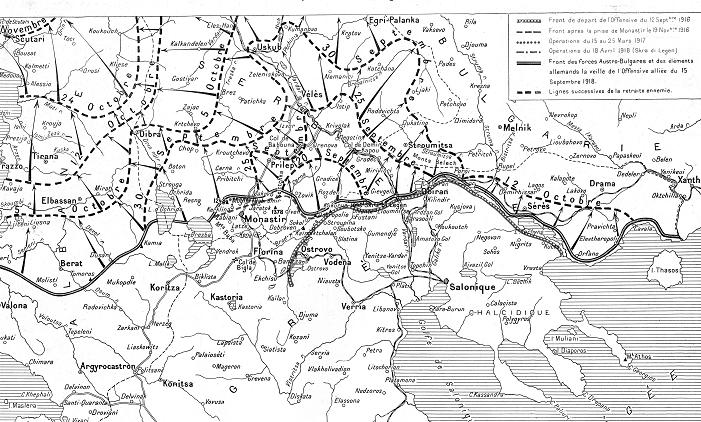
The battle for Monastir/Bitola was savage, involving trains, guns, planes and old-fashioned cavalry charges. The breakthrough happened in the Cerna river valley. By September 20th, the hole in the Bulgarian defences was 25 km deep, by the 25th, well over 50 km. At the most northerly point of the breakthrough, Serbs were entering Istip (Ishtip). It was a classic breakthrough, the attackers making their way through the weak point and fanning outwards. The map is like a refractive pattern,  waves making their way through a weak point in a barrier and then spreading out.
The Balkan Front (double line) 15thSeptember 1918, centred on Monastir/Bitola, Ohrid and Prespa lying to the west.The broken lines show the stages of the breakthrough, successively 20th, 25th, 30th September and then 5th and 12th October. Illustration magazine Courtesy Malcolm Wright
The northern shore of Lake Ohrid was not taken until September 30th. By then the Bulgarian Government had agreed an Armistice with the French, valid from midnight. At this point, the British troops roused themselves and started thrashing the Bulgarians. Given the situation, this was not quite cricket.
After the Bulgarian Armistice, it was only a matter of time before the collapse of the other Central Powers. In the words of Prosper Péchot’s proud son, all could be credited to his father’s railway inventions. Once the War was over, all the track and rolling stock were safely gathered into French military depots,
This area reappears in the Péchot story. During the Second World War, the Nazis confiscated all the French military material. Most was scrapped including almost all Péchot-Bourdon locomotives. Two survived the War, one being relocated to the Dresden area in what was then the DDR and one came to Pozega in what is now Serbia. This precious survivor spent more than 60 years a few kilometres north of Ohrid. This Serbian Péchot-Bourdon is in France for restoration – a treasure of history.
Rough country! After the breakthrough, French colonial troops take a Bulgarian position. Illustration magazine. Picture courtesy Malcolm Wright