Tuesday, 28 April 2020

Slow 16mm Modelling


A wonderful aspect of railway modelling is that you are creating your own organisation. A model has a physical presence, it has boundaries and it does something. It looks to you to be the boss. You are the head maquetteur. I’ve borrowed from the French (maquette can mean layout). Don't the French create a term with such style and panache?
A model 16mm Wrightscale Wren on our layout. This is whjat modellingis all about!
It those heady early days of planning, levelling and the all-important discussions with friends, the role of the boss is pretty clear. The boss leads from the front, makes compromises, sacrifices and whatever it takes to get things done.
As boss as your own little world, there are a plethora of decisions to be made. Before beginning, there is the story behind the model – or in business-speak the Company Objective. Something all-inclusive such as ‘layout which is not too complicated to run and can accommodate a maximum of rolling stock’ seems like a good idea. As the market-place is already crowded with Busy Great Western Railway Stations At A Time Just After Reorganisation, a little more imagination is required.
The Boss eventually settles on a scenario which takes account of the rolling stock he/she truly loves. In Malcolm’s case, this includes model Wrens circa 1922, a Glyn Valley Baldwin, a Quarry Hunslet or so, slate trucks, passenger wagons etc. It must also accommodate  the rolling stock friends bring. ‘1920s rural branchline serving a quarry would do’ It would take the loco’s and wagons which friends bring – they have come down the branchline to make a special delivery.
16mm Wrightscale Wren doing what she does best, pushing a train of skips. Photographed in a friend's garden
The idea has then to be fitted into the space available.  Should the track feature a turning circle, fiddle yard or an American Triangle? All are solutions to the modeller’s perennial problem. Prime mover and train progress into the layout and then majestically progress out again. They can procede into a concealed fiddle-yard to be reconfigured and turned around. They can go round in a circle and reappear; this is most fun if parts of the circle are artfully concealed. Best of all for the radio-controlled loco or layout boasting reliable electrical switching is the American triangle. A lot of hands-free fun can, in principle be had turning the train around.
Layout design by MD Wright showing station building, carriage and engine sheds and a bridge over a stream. The track is complicated but not overly so.
Depending on the space available, most maquetteurs go for some combination of these. Here the ingenuity and resource of the boss can really show itself. As we are no longer children, happy to play on the carpet, the layout has to make concessions to creaky old bones. There have to be elevated sections of track. In theory, this was easy for the Wrights as our garden slopes; all that is required is a little gentle terracing so we thought!  It is an interesting fact, probably not obvious until earth-moving starts that one cubic metre of normal soil ie mix of sandy, clay and stony earth, weighs roughly two tonnes. Measured in builder’s buckets filled to the brim, this is perhaps twenty such buckets – measured in buckets that can be carried by an amateur, considerably more. The boss has to have personal strength and be able to use a variety of ways to exhort, bribe and cajole the workforce.
At last, the plan starts to take shape. The maquetteur must become a details nerd. A train, especially its locomotive can cope with rough track, sinuous track or gradients but not all three at once. Careful planning, not to say yet more earthmoving is required.
Truly, going from being a dreamer to boss of a fully fledged working layout requires time, talent and treasure, to say nothing of energy.    
The successful boss is known for his/her stamina.
We all love the stories in our specialist journals of the maquetteur who rises at 5am to be at railway gathering. This and the get-together afterwards may last until midnight or after. He or she is perfectly coherent throughout even when all others go from enthusiastic to incoherent to forgetting where they left their car keys.
Boss and workforce beside elevated section of a turning circle.
This is what it takes to make and run a railway which is fun for self and all the group.
The trouble comes when the railway is up-and-running. A year of group meetings are in the calendar and a comfy ‘garage nook’ has been set up for repairs, storage and fiddling.
What now? The weekend comes when the maquetteur charges into the garden at 7am, eager to get stuck in. In these days of lock- down, it could happen any day of the week.  The only problem is what to do. The boss has to realise that the layout has reached a new stage. It is a matter of same-old same-old rather than the former headlong rush of challenges.
The moment of change has arrived. The boss has hit all the key performance indicators. Now is the time to slow down. The wise maquetteur recognises a limited number of projects to be carried forward. Roughly half our craft can do this instinctively. The others can face a problem. The pulsing, relentless energy which got the layout built is still there. It was great before – shouldn’t it be used to go forward? Well, no, sometimes it has to be reined in. It is time to get in touch with your inner weekender.
16mm water tanker built by Jim Hawkesworth on Wrightscale WD bogies.Why is it about to appear on a rural peacetime branchline? If you've got what it takes, you will have an answer.
The weekender is one who will stand there, sometimes thinking, or sometimes just sitting. The boss, especially one who has a group of friends dotted about the layout may even be bored. He/she is getting to grips with the subtle underlying reality of the mature organisation. It can’t be expressed in a few slogans. It needs a series of pictures, even stories. It comes out quietly, even shyly. Overmuch activity frightens it away. The posh name, I suppose, is The Strategy.
Now that the layout is coming of age, the boss has to consider maintenanc and improvements. Action must onlybe taken if the improvements they enter the spirit of the existing outfit, or makes a train day even more fun. A great layout empowers others.
Happy steaming!
16mm indoor layout created by the late Henry Holdsworth. Photo courtesy Jim Hawkesworth

Monday, 13 April 2020

Living History: Building The Baldwin Gas Mechanical


Building a 16mm Baldwin Gas Mechanical (BGM) can help to bring history to life. There are many reasons why we should get to know this extraordinary locomotive a bit better.It was a First World War locomotive which was then repurposed for peace so touches on many other stories. Malcolm and I admit that this old rogue of an engine inspires love and fascination. Many others have agreed. 
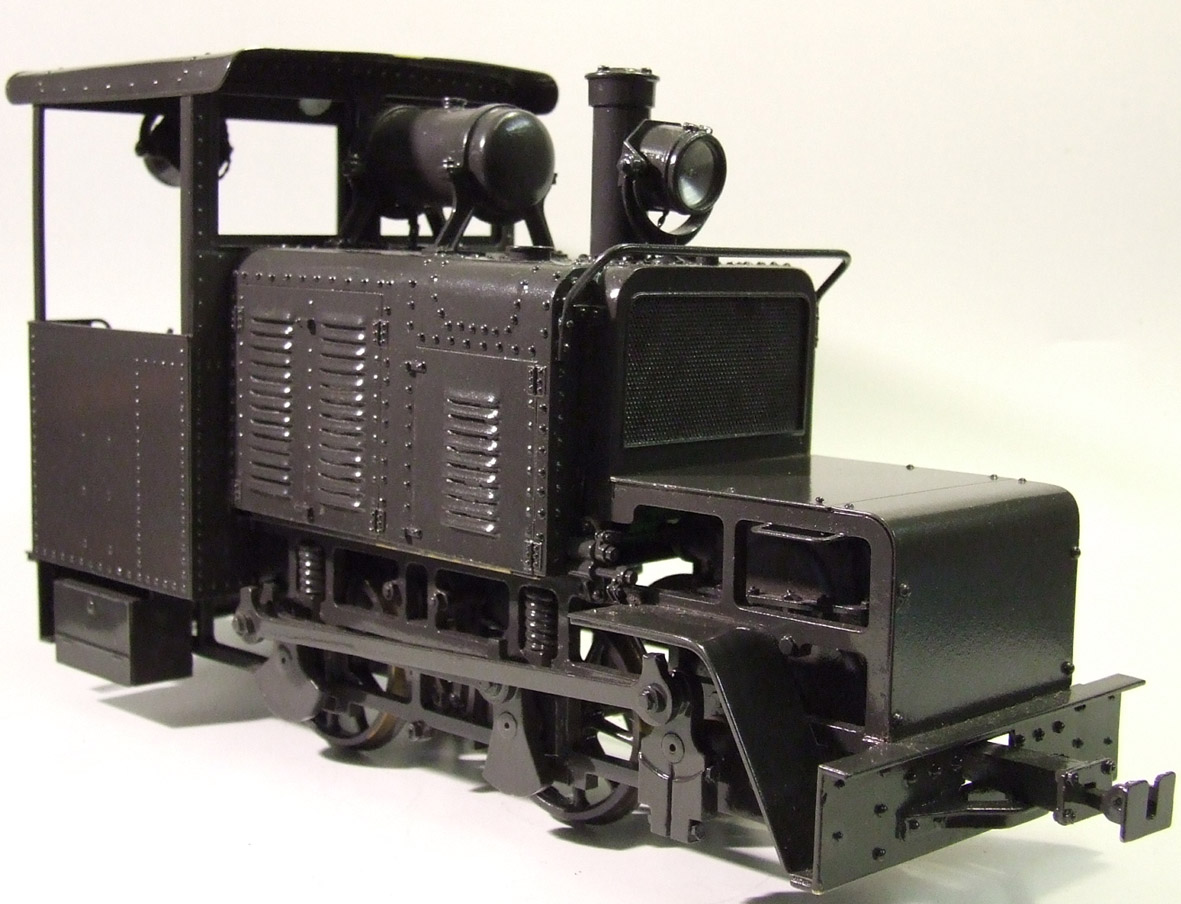
Wrightscale 16mm model of a Baldwin Gas Mechanical 50hp
Here we are, still producing them after thirty years. A batch is under way.
The Baldwin Locomotive Works of Philadelphia were first approached in 1916 by the French Army. They were looking for an engine which did not emit a pillar of fire by night and of smoke by day, giving itself away to enemy gunners. Motor vehicle technology fitted this bill. The USA was a world leader in MVT, the Philadelphia-Michigan area a leader within the USA. Henry Ford and many others were just up the road at the time.
Although not yet officially a combatant nation, the USA was definitely open for business. The Baldwin Works were able to offer the French a design with possibilities – the Russian Army had been there first. Rodney Weaver wrote an instructive article in the Industrial Railway Record 1977 Issue 71 pp 45 to 47. With a few alterations to existing designs, the company came up with a locomotive that suited.
The French ordered the 50 h.p. version, six hundred in all, bearing the Maker’s Numbers 1001 to 1600.
On April 2, 1917, President Wilson went before a special joint session of Congress and asked for a declaration of war against Germany, stating: “The world must be made safe for democracy.” On April 4, the Senate voted 82 to 6 to declare war. ... In early 1917, the U.S. Army had just 133,000 members. Numbers quickly rose into the millions.
The American Expeditionary Force AEF were now looking for a locomotive suitable for trench warfare. They also liked the BGM and ordered Maker’s Nos 7000 to 7126. They also ordered a 35 h.p. variant, numbered 8001 to 8065.
Under the bonnet of a Wrightscale 16mm BGM Photo courtesy MD Wright
Building the model brings some of the style and experience of building the original. A few compromises have been made - unlike the prototype, the model runs on battery power or 12 volt AC.
Baldwin had a huge erecting shop where large numbers of locomotives were built at one time – unlike the cramped little sheds of Britain and France. When Malcolm batch-builds, a large number of components will be on the bench at one time. They are interchangeable – at least to begin with.
One of the works halls of the Baldwin Locomotive Works of Philadelphia. Photo courtesy of Raymond PECHOT
Baldwin were looking for economy in design. Rather than a chassis on to which was built a superstructure, the frames would do for both. Hence the massive frames which to some seem weird and to others quite unorthodox. The frame which appears below is laser cut from steel; cutting the original was done without the benefit of computerand laser-technology. All the same, many methods are similar. 
Just like the workers of that factory in Philadelphia, Malcolm breaks down the job into sub-assemblies. First come the frames and the frames feature throughout the build. Central and essential to the build, the frames must be fitted squarely or all goes wrong afterwards. In other locomotives  chassis and superstructure could be assembled separately. This meant that, in theory at least, the superstructure and plate-work could be square and satisfactory. Less remedial action would have to be taken …. Well, that’s the theory.
A frame and two sorts of connecting rod, laser ct form steel. A pair of each are necessary for each BGM. Photo courtesy MD Wright
Rest the frames on a flat surface at the correct distance apart. Now raise them on blocks, still keeping them parallel. Now fit the buffer beams. It is most convenient to make jigs – prepared blocks which hold the frames at a suitable height. On the model, the buffer beams have to be marked, predrilled and countersunk before final fit. We suspect that this would have been the case on the prototype. They could not trust the parts to have been made with millimetre accuracy. Now turn the assembly over so that the frames are resting on their upper surface. Check again that the assembly is square. Any faults will start to show up; now and not later is the time to adjust!
    If all is well, solder in a cross-tie.  Again, a scaled-up version would have been fitted to the prototype. Only then could the chassis be considered rigid and square.

The next job is fitting the axle-boxes. Making sure that these small parts are in place and running smoothly is essential and fitting this early is the best policy. First job – turn the frame so that the wheel-slots are facing upwards. Second job is to clean up the axle-box castings. You are aiming for an easy running-fit between axle-box and the cut-out on the frame. Fit the four axle-boxes.
Cranks and axle-box castings. There are four of them, viewed from different angles

Now push a spare axle-rod through the front two axle boxes. It should fit squarely. Any compensatory work should be done now and not later! Check the back two in a similar way.
In the prototype, springing was fitted between the axle boxes and the frame, hence the castings. Personally speaking, I love these chunky white metal cylindrical springs on the model, all part of the character of the locomotive. These springs are added at a later stage which Malcolm calls ‘detailing’. He dryly adds ‘with a lot of effort, working springs could be made to fit’. In theory, they could improve the running of the loco on a model track. He has designed in a rare compromise on the model.  On a 21st century layout, heroic compensation is not needed. In the conditions of World War One, it was essential. One side of the track might disappear into a shell-hole at any point. The one comfort for the driver and crew was ‘Oh well, if it hadn’t landed near us, it might have been on top of us’  
At the detailing stage, other non-working items are added – the brakes. They are not actually needed on an electrically driven model. ‘Stop’ means ‘Stop’.
But I digress. We have reached the point when one pair of gear boxes is in its appointed place on the frames. Repeat with the other pair, making sure that the temporary axle runs smoothly. If an axle box jams, once again, rub it gently up and down the steel until the white metal has been polished to a smooth-running fit. In the presence of steel, white-metal becomes, very slightly, a lubricant. Make use of this phenomenon sparingly!
A prototype Baldwin Gas Mechanical, only partly restored, on the rack at Apedale, Staffs. The axle-box niches can be clearly seen. Photo courtesy Jim Hawkesworth
Now the wheel-sets can be fitted. Again, you may need to lightly polish the working areas, this time with an abrasive pad. Your aim is to have both wheel-sets in, rotating freely.
In the model, Loctite or similar engineering glue are used to keep the axle-boxes in place. On the prototype, of course, the axle boxes were sprung.
The integrated chassis-cum-superstructure is taking shape. In addition, you are entering into that Yankee ‘can-do’ mind-set. You think about what you are going to make and then you bash theory about a little until it fits!
Try to get hold of Rich Dunn’s ‘Narrow Gauge To No-man’s Land’ Benchmark Press and
Dr Christian Cénac’s  ‘La voie de 60’ Auto-édition


Wednesday, 25 March 2020

Lake Ohrid and the Péchot story


We are sorry not to meet our friends at the 16mm Peterborough AGM and Show. For the greater good, we are all staying at home. It is a chance to read, dream and plan expeditions we can undertake once travel restrictions are lifted. We start with a picture of the fascinating Péchot-Bourdon locomotive as it has several links with Lake Ohrid, links we discovered when researching our Péchot models and 'Colonel Péchot: Tracks To The Trenches'
Print of a Péchot-Bourdon locomotive, designed to run on portable track. Print courtesy Raymond Duton
It is an area we long to visit. Ohrid and its sister lake Prespa  are found in the Balkans peninsula, the vast peninsula which separates the Adriatic from the Black Sea. The Balkans are on the crossroads between Europe and Asia, so are generally interesting, but we’d like to focus on the Ohrid area.
Ohrid appeals to my Scottish soul because it has affinities with our own Loch Ness. The names of both lakes share the Scottish ‘huh’. Both lakes act as boundaries. Loch Ness lies along an ancient fault-line separating the eastern and western Scottish highlands while Lake Ohrid and Prespa are also in a borderland. They separate the worlds of Mediterranean Europe and the lands to the south. The lakes are survivors from a geotectonic depression which started perhaps five million years ago. The corrugations – rugged mountains and deep lakes of the Balkans - are the effect of the movement of vast tectonic plates which apply unimaginable pressures on the surface of the land.
Lake Ohrid is Europe’s oldest. How do we know that? Because of the variety of plants and animals which are found nowhere else. At the risk of boring you with Lake Ohrid facts, for its area, it is the most bio-diverse lake in the world. Species evolve at a certain rate, so the theory goes – it a bit like estimating the age of a hedgerow. So the unique waterweed and fishes are interesting in themselves but also suggest that Ohrid has been there for a million years. The lake never silts up. Although sediment is continually brought in by feeder streams, the restless earth sucks it away. They call it subduction.
Unfortunately, our own Loch Ness is rather short on aquatic life – too cold - so this method can’t be used to calculate its age but, naturally, being a good Scot, I believe that Loch Ness too conceals its own mysteries.
Lake Ohrid is the deepest lake of the Balkans. It is not the deepest lake in Europe - that distinction belongs to Loch Ness. Almost as beautiful and strange are the springs which constantly feed it. About 50% of its water comes in this way, from an underground system which links Prespa to Ohrid. This effect has a respectable scientific explanation; we are in karst country where water dissolves away rock to find underground channels. It disappears only to reappear miles away. From Celtic times, we Scots have found springs quite delightful, so allow me my little moment of wonder.
Southern Balkans, centred on Salonika/Thessaloniki circa 1920. Ohrid and Prespa are just west of Bitola. Courtesy Times Publishing
The water of lake Ohrid has two exits. The obvious one is the Black Drin River which flows through Albania to the Adriatic. There is another significant one that is  invisible. That is evaporation, which channels no less than 40% of the water away.
The lakes deserve to be better known – and the fact that they aren't, is a tragedy. They lie over the cultural and political fissures which divide the Balkans. At present, the western shores of Ohrid are Albanian, the eastern (roughly) in  the Republic of Macedonia (Former Yugoslavia. Lake Prespa is divided between RoM, Albania and Greece. Another block to them being better known is that they are also known as Ochrida and Presba.
This should not in itself be a problem. Lake Geneva, aka Lac Leman, has French shores and Swiss shores. Everyone gets along. People live on the French side and commute to the Swiss side. Tourists can enjoy both. Alas, tourists can’t easily take a boat and sail from one side of Ohrid to the other. Modern maps, so we are told, don’t even show both sides of the lake, which seems to float off into a misty neverland as you look from the shore.
Close-up of the area shows Presba/Presba and Ochrida/Ohrid. Salonika is to the south-east with Lake Lake Dojran due north of it. Snaking red national boundaries are very obvious. Courtesy Times Publishing
Its human history goes back millennia. From nearby, pottery has been found that is over seven THOUSAND years old. The decorations are as fine as anything produced by a modern artist. Tourists should also be inspired by ‘To The Lake: A Balkan Journey’ by Kapka Kassabova. As she puts it very kindly, history is still being made here - ancient tensions have still not been resolved.
Our maps, courtesy of Times Publishing, show the lakes circa 1920.
Another reason to visit is that Ohrid played a pivotal role in the Péchot story. True to character, it lay in a disputed no-man’s-land between the Allied Macedonian Front and the Bulgarian sector of the Central Powers. In every Front, generals attempted the breakthrough and on every Front, the usual result was stalemate. The German Spring Offensives of March/April 1918 came the nearest to punching through the British Front, but never quite succeded. After four years of war, the concept of breakthrough had acquired a mythical status. The Russian Front, it was true, had crumbled, but this was because of pressure from home rather than a knockout military blow.
It was here, in the unpromising and rugged Balkan terrain, that the stalemate was broken by the one true military breakthrough of the First World War. Yet the battle of Monastir is hardly remembered because the place has changed its name. Monastir has vanished from the map
(A bit of backstory) In 1915, the Bulgarians entered the War on the side of the Central Powers. Their incentive was Serbian territory. The Allies formed the Macedonian Front to oppose them. The British frontline, somewhat unwisely, followed the valley of the Struma river and its tributary the Strumitza. Their main enemies were mosquitoes carrying malaria which caused many more casualties than the Bulgarians. The French and Serbs were to their west, on a Front running from from Lake Dohran/Dojran to Prespa and Ohrid. It was, to put it mildly, rough ground. But there were no mosquitoes and the Serbs were almost in home territory. One big disadvantage was the lack of transport. There were few railways anyway and the north-south links had been cut by the Bulgarians.
Various designs of portable prefabricated track were used by both sides in the first world war. If they could, they used captured material, as these jumbled tracks suggest. Photo Malcolm Wright
 In 1916, the Serbian-French were fighting south of the little railway town of Florina, in the valley of the Echisu/Ekhisu, in the southern headwaters of the Varna river. Over the next couple of years they pushed their way north along the track of the railway towards Monastir (modern Bitola) to the south of Ohrid. How did they transport the big guns, and more importantly, the ammunition?
The traditional way was by mule, 70kg per mule, quite inadequate for modern warfare. The iron road had to return; a 60cm portable railway with its freight-carrying capacity. General Franchet d’Esperey, field commander, asked for daily reports on progress of the line down the Ekhisu valley, so highly did he esteem the value of 60cm. The final assault on Monastir/Bitola could not take place until 60cm was in place. By September 15th 1918, all was ready.
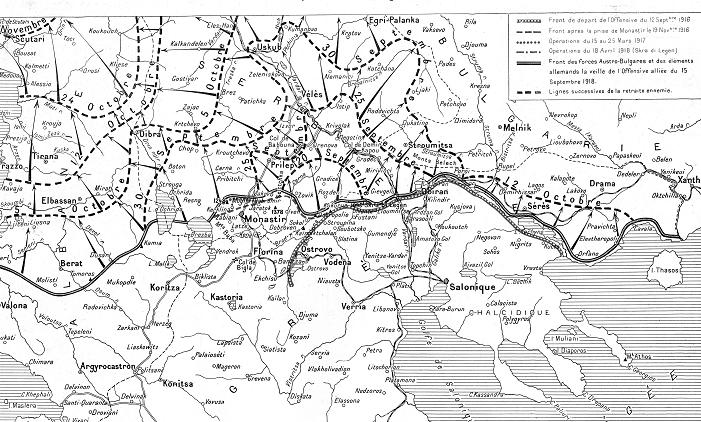
The battle for Monastir/Bitola was savage, involving trains, guns, planes and old-fashioned cavalry charges. The breakthrough happened in the Cerna river valley. By September 20th, the hole in the Bulgarian defences was 25 km deep, by the 25th, well over 50 km. At the most northerly point of the breakthrough, Serbs were entering Istip (Ishtip). It was a classic breakthrough, the attackers making their way through the weak point and fanning outwards. The map is like a refractive pattern,  waves making their way through a weak point in a barrier and then spreading out.
The Balkan Front (double line) 15thSeptember 1918, centred on Monastir/Bitola, Ohrid and Prespa lying to the west.The broken lines show the stages of the breakthrough, successively 20th, 25th, 30th September and then 5th and 12th October. Illustration magazine Courtesy Malcolm Wright
The northern shore of Lake Ohrid was not taken until September 30th. By then the Bulgarian Government had agreed an Armistice with the French, valid from midnight. At this point, the British troops roused themselves and started thrashing the Bulgarians. Given the situation, this was not quite cricket.
After the Bulgarian Armistice, it was only a matter of time before the collapse of the other Central Powers. In the words of Prosper Péchot’s proud son, all could be credited to his father’s railway inventions. Once the War was over, all the track and rolling stock were safely gathered into French military depots,
This area reappears in the Péchot story. During the Second World War, the Nazis confiscated all the French military material. Most was scrapped including almost all Péchot-Bourdon locomotives. Two survived the War, one being relocated to the Dresden area in what was then the DDR and one came to Pozega in what is now Serbia. This precious survivor spent more than 60 years a few kilometres north of Ohrid. This Serbian Péchot-Bourdon is in France for restoration – a treasure of history.
Rough country! After the breakthrough, French colonial troops take a Bulgarian position. Illustration magazine. Picture courtesy Malcolm Wright

Saturday, 7 March 2020

Wrightscale WD or Péchot kits


Our model kits include Welsh narrow gauge items, the Péchot wagon and British War Department bogies.
Wrightscale 16mm Péchot wagon detail
You may be wondering which to choose from these apparently disparate items. The designs are all connected, but before you buy, you may like to know the 'why?' and 'wherefore?' of each.
As we British are proud to relate, we were pioneers in railway development. The Welsh corner of Britain was particularly inventive, especially in narrow gauge. It was a combination of geology and ingenuity. Northern Wales has an abundance of slate, known for millennia as a good roofing material. What was produced in Wales had to stay in Wales until it could be exported and narrow gauge railways provided the missing link between the slate and the ports.
Detail of 16mm WD class D wagon on Wrightscale bogies
The Talyllyn, Corris and Festiniog railways were born this way, firstly with horse-drawn freight and then with locomotives. The Festiniog developed the well-loved Fairlie locomotive which pulled four-wheeled slate wagons down to Portmadog.
Wales had lessons for the French. They had compartmentalised ideas about railways. There were the ‘serious’ gauges – standard gauge and one metre – and light ones – very narrow gauges of 60 cm and less. From the mid-eighteen seventies, the Decauville company sold portable track in 40 and 50cm gauges. In the early eighteen eighties, they introduced a portable ‘military’ gauge but this tested the technology to the limit and was less than successful.
Four ton wagon typical of the narrow gauge freight wagons before the Péchot revolution. Photo courtesy MD Wright
Along came Prosper Péchot and combined the best of Welsh and Decauville then infused a spark of personal genius. He produced a sturdy portable system on which could run rugged and adaptable ten tonne bogie wagons. A significant number have survived to this day. Revolutionary features included: 60cm gauge; bogie-mounted wagons 6m by 1.7m (about 20’ by 5’8”); low centre of gravity for a wagon with a central well; adaptability ensured by stanchions; bogies which had compensatory as well as vertical springing; coupling attached to the bogies rather than to the wagon body; brake could be applied to every bogie wheel; a prominent brake-wheel at each end; ten tonne wagons with capacity for 8 tonnes of freight.
His design was copied and adapted; by 1918, there were thousands of kilometres of track on which ran tens of thousands of ten tonne bogie wagons. The bulk of this material was sold off as War surplus – some track, wagons and locomotives returning to the land where it all began, Wales.
Ten tonne bogie wagon of 1895 after the Péchot revolution. It still has the traditional couplings,  attached tothe wagon body. Drawing by Victor Rose. Courtesy MD Wright
Malcolm has celebrated the Péchot designs, both the originals and important adaptations.

Even while the French military were experimenting with Péchot designs, the German Army were looking on. By early 1888, they were beginning to produce their own versions. They moved from 72 and 75cm gauge to 60cm, from four wheeled wagons to ten tone bogie wagons and from horse drawn to locomotive haulage. Yes, German engineers and their ‘Pioneer’ railway troops were among the best for the time.
But no, they were quite capable of industrial espionage. Paul Decauville caught them at it, as he explained to the French Government. In 1907, when the sugar-works at Cramaille took delivery of a 60cm gauge railway by Aubineau, they were soon visited by ‘technicians’ from Orenstein and Koppel. In no time at all, O&K were selling suspiciously similar 60cm wagons. Eric Fresné goes so far to say ‘the O&K wagons were ‘furiously inspired’ by the Aubineau ones’. (’70 years de chemins de fer betteraviers’ p 113)
The German adapted the pirated design to produce their own Brigadewagen (military wagon). Although the important features were retained – 6m approx by 1.7, bogie mounted, brake to every bogie-wheel, coupling through sprung bogies, 8 tonne capacity etc, they made changes.  The bogies were lighter and the wagon body was a comparatively simple framework with wood instead of steel plate. The wagon bodies did not have the well and were more easily adapted than the all-steel Péchot design. For the standard Brigadewagen, the idea of stanchions was retained, though they were usually seen attached to wooden sides. The bogie couplings also provided the springing – an arrangement which was both economical and effective. Overall, they were cheaper to make. The bogies projected a generous 50cm beyond the wagon body, making the life of the Bremser (brakesman) safer and more comfortable.
Brigadewagen on a slope. Line drawing courtesy Eric Fresné
By the time the First World War started, the Germans had a considerable stock of material. The French had a couple of hundred Péchot wagons (modèle artillerie 88) which had been in service since 1888. Once the Western Front was established and hundreds of miles of trench had to be supplied, the French realised their need for more wagons. Most of what they ordered was of a lighter pattern, reminiscent of the Brigadewagen as well as the artillerie 88. It was known as the Decauville 15.
By 1916, the British, though initially sceptical, began to admit that 60cm had advantages. They produced their own War Department design, but with similar features to the Péchot design. This was produced to metric rather than Imperial scale. Can you imagine what torment this would have been to the Eurosceptics of the time! Rather than sticking to a standard shape, they produced a number of wagon bodies. The Classes E and F had a well, useful for transporting bulky loads.
When the USA joined the War, they immediately designed their own military narrow gauge system, known as Pershing. Another nation of Imperial measurement, they too were forced to bow to the Péchot design. Their locomotives and rolling-stock ran on 60cm gauge. The Pershing was a bogie wagon. Each bogie was fitted with brakes and a brakewheel. The couplings were to the bogie not the wagon body.
16mm model of WD class D wagon on Wrightscale bogies

These later designs were all more prolific than the Péchot original but there was a catch. Although there were thousands of examples of these alternative designs, they did not have the sheer staying power of the artillerie 88. When World War One ended, the Germans had to hand over most of their 60cm gauge material. This and Allied material were used as temporary railways to restore and rebuild the ruins of the Western Front. Afterwards, they were sold off. In France, agricultural systems such as for sugar-beet were the main beneficiaries. English and Welsh quarries also bought surplus stock. Thus the grand-children of the original designs came home to Wales. Being of wood and light steel construction they had a short life. There are few photos, and these show them in a very poor state.
WD wagon photographed in the 1980s Photo courtesy J. Hawkesworth
Eric Fresné is not a fan of the Péchot design which he describes as ‘a veritable monster, heavy and over-engineered’. (Betteraviers page 114). Without appreciating the contradiction, he goes on (page 115) to say ‘the Army took great care to return the Péchot wagons to their bases and depots once the job of (post-war) reconstruction was over’ These ‘monsters’ are now beginning to reappear to great acclaim and can be seen at preserved railways in the UK and France. Though few in number, those Péchot wagons just keep rolling along.
Péchot wagon 2015, minus stanchions but still going strong. MD Wright
Sources: ‘Colonel Péchot: Tracks To The Trenches’ Sarah Wright
‘Chemins de fre betteraviers’ Eric Fresné  A French language treasure trove
‘La Voie de 60’ Dr Christian Cénac 

Thursday, 20 February 2020

Wren or Tattoo or Péchot


We were sorry to learn of the death of Mr Dowd, another great character of the 16mm scale world. Among many people who remember him with affection – Peter was a generous host and prolific writer - we pass on our condolences to his family. His Ruby Mine garden railway layout was known to many and I mention it below.

Thank you to all friends of Wrightscale – those who have liked our products and who share our interest in historic 2’ and 60cm gauge railways. I’d like to wonder aloud, ‘Why do we share this passion?’ and then wonder where this shared passion has taken us all over the years.
So, firstly, here is a little about our interest. As you perhaps know, the story of 2’ gauge goes back to the early Festiniog, then crosses the Channel to France. From 1874, Paul Decauville was experimenting with narrow gauge portable railways – and took an interest in developments in Wales.
The Welsh slate quarries were where many of the ideas behind military narrow gauge were first conceived. This layout features a Wrightscale Hunslet 0-4-0. Photo MD Wright
An officer in the French Artillery, Prosper Péchot, combined the Decauville and Welsh ideas and added a sprinkling of genius. He came up with portable railways which combined the impossible. As they say ‘If it’s difficult we do it. The impossible takes a little longer’ The Péchot system which he devised could be laid in a matter of days yet convey serious tonnages at surprising speed. A laden locomotive could travel at 12 k.p.h. at a time when horse and cart could only manage walking pace. Even better, it did not need feeding and resting.
The Péchot wagon could carry 10 tonnes of freight on track that would have been at home on a Welsh quarry. Thanks to its bogies and innovatiove suspension,, it could manage tight bends. Wrightscale model
A measure of the merit of an idea is how long it takes to copy. The Germans rapidly took up his ideas and developed their own Feldbahn system, a splendid amalgam of industrial espionage and original thinking. Furthermore, they invested heavily, which, until 1914, the French were reluctant to do. Other countries were obliged to follow suit. By 1916, the British had ordered 1000 miles of 60cm gauge track, a truly British mixture of metric and Imperial measurements.
After 1918, these vast networks, totalling six to seven thousand kilometres, were gradually dismantled and stock sold off. Many examples survived through the 20th century, but gradually, the vast network of 60cm gauge that existed in 1918 was forgotten by all but a few enthusiasts.
Gradually the part that 60 cm railways played has become recognised and relics have become treasures. Amazingly, the French Army hung on to some of the Péchot system until the late 1990s. These survivors have recently found a place in preserved railways and excited much interest. After years in the wilderness, the prototype is gathering enthusiasts.
Examples such as this Péchot wagon are begionning to be seen on preserved railways. Although well over 100 years old, it is in comparatively good condition. Taken at Apedale by MD Wright
Models reflecting bygone days are also beginning to attract interest. While of course there will always be a place for freelance models, there is a joy and challenge to creating a creating a prototype, or partly prototypical, railway.
The layouts that give the most pleasure, ie attract people back again and again, are the probable impossible. So perhaps not a dead-scale model of York Station, but one which could have existed even though it didn't.
We come back to Peter Dowd, mentioned above. He wanted more than just a freelance layout round which he and friends could run their locomotives. He created for it a story, a 2’ gauge Burmese ruby mine that never was, but should have been. Ancient Burma (now Myanmar) was the source of this ‘Lord of the Stones.’ The ruby is a form of corundum, as is the sapphire. Because of the way that ruby crystals form, corundum with a trace of chromium, large deep-crimson specimens are rare, consequently very valuable. The finest of all rubies, certainly up to the mid-twentieth century, came from northern Burma, hence the story created by Peter Dowd.
Tattoo emerging from the jungle? Wrightscale model photographed by David Provan
The working of this fictitious ruby mine generated a volume of spoil which had to be removed from the workings. A Kerr Stuart Tattoo, developed in the early 20th century could do the job. This was a locomotive which combined a neat wheelbase with considerable power and endurance, unlikely to fail on a slope with a train of spoil-wagons behind it … The management of the 1/19th scale mine therefore ordered a Wrightscale Tattoo.
In a similar way, Malcolm’s own layout has a story. It is a quarry railway set on a forested hillside in the Britain of the late Twenties. Much of the stock, such as the WD wagons, is War Surplus. Other wagons are home-made. Even the bridge has a history, built from a dismantled military viaduct. Somewhere off-scene, the system has a link to standard gauge; locomotives from elsewhere, some to a freelance design, appear on visits.
The greatest pleasure of railway modelling is an educated imagination - combined with art and ingenuity.
How do Wrightscale products add to this pleasure?
The Wren is a dainty locomotive. Wrightscale16mm  model.
These days, it is possible to buy locomotives which aspire to be Wrightscale.  If you want a rapid-prototyped Quarry Hunslet, it can be had, in all its resin and plastic glory. If you want a Wren in 7/8 “ scale, there is one available. If you want an unashamed rip-off, there is the WD Baldwin 4-6-0 reverse-engineered from one of our models. The castings are exquisite – so they should be – but they have a tiresome habit of not holding together properly. The rip-off artists forgot (or couldn’t be bothered anyway) that when a casting is taken from a casting, it shrinks a little.
As there are imitations and similar models out here, is there any joy for our customers who have paid a little more for the genuine article?
The first advantage in buying Wrightscale is that the imitators have bestowed on your original the sincerest form of flattery. They recognised that its design is a powerful blend of art and practical ability. Making a working steam model is far more than shrinking an original, any more than a healthy baby is a miniature adult.  With a ive steam engine, some working parts cannot be shrunk as much as others. Some colours have to be modified. Yet the overall impression, whether model or prototype, has to remain the same. Only an artist can supply the mix of art and science needed to create a model which is also a working steam locomotive. Interestingly, electric locos are more amenable to being shrunken versions of the prototype – all steam parts are just dummies. Yet a certain charm can be lost.
You could run an overscale Wren on your track. You could have a resin and electric loco. Or you could have the genuine article. Wrightscale 16mm scale Wren and Tattoo
Secondly, you won’t lose money – far from it. You can pay quite a lot for a ‘me-too’ locomotive, as much as the Wrightscale you bought. The over scale Kerr Stuart Wren is advertised in the latest Sixteen Millimetre Today at £1650 or so, and these prices rise every year. Genuine Wrightscale products don’t lose value. You are in fact buying from a Studio – as recognised by Federal U.S. Law. As with any work of art, second hand prices steadily increase. You are getting a signature as well as a product. Thank you all for your confidence.
The third advantage you enjoy is very subtle. You have joined us on our journey, from the first excitement of viewing a prototype to having it run on your layout. Like us, you have experienced a piece of history. Every prototype has character and there are reasons: history, geography, economics and personalities which explain why it ended up the way it did.
So, for example, the unique Péchot wagon owes its existence, not just to the French will to win the next war in Germany, but also to the remarkable personality of Prosper Péchot.
The Kerr Stuart Tattoo 0-4-2 has its own story. It offered more power and endurance than its little sister the Wren. At the same time, the Tattoo and Wren share many family characteristics. The Wrightscale Tattoo has about 50% more running time than the Wren yet because of its 0-4-2 wheel-base, it could still be used on lightly engineered track. The prototype could tackle tight bends; the model will tackle curves down to 3’ radius. Whereas the typical Wren was used to pull skips, the Corris Railway Tattoo (no 4) was designed to assure a public service. As a contractor’s cab, it reached places that the Wren couldn’t. Customers consider all the characteristics carefully before making their choice – just as the management of the prototype railways would have done!
Is this a Works Photo or a 16mm Wrightscale Tattoo? You decide
Obviously, there is a place for freelance, semi-prototypical and museum quality models. The Garden Gauge community welcome them all.

Friday, 31 January 2020

Friends of the Baldwin Gas Mechanical


As we are on the subject of friends, we were sorry to learn of the deaths of Jim Wild and John Turner, great characters within the small world of 16mm. Derek Wiggins features a tribute to Jim in the e-magazine, Throwback Modeller (TBM) issue 13. I contributed a word or two as Jim and Colin Binnie, also sadly missed, had managed to rescue a locomotive, Hohenzollern 447, from utter obscurity. This tiny loco of German design had a conical boiler.
Do get TBM issues 13 and 14 if you can. As well as information about Jim Wild’s models, it features Colin Binnie’s unique General Arrangement of the Hz447, and the story behind this extraordinary military locomotive.
16mm scale  Baldwin Gas Mechanical, 50hp version, as used by both the French and the AEF 1916-18. Wrightscale model

The last blog explained a little of Malcolm’s fascination with another tiny giant of Military Narrow Gauge, the Baldwin Gas Mechanical locotractor. It would be good to provide a little context, by featuring two other petrol powered locomotives of the period. These were the Dick Kerr 40-45hp petrol electric tractor and the Simplex. Both were British made.
In theory, the Baldwin Gas Mechanical was developed later than both of these. 
The story of the Simplex goes right back to 1914. Although the BGM order date of 1917 is definitely after the time that the Dick Kerr was commissioned, November 1916, the story is a little more complicated. Certain aspects of the BGM date back, possibly, to the 19th century.
16mm model of the Pechot Bourdon 0-4-4-0,. The lines of the central chassis are angled in a way that is reminscent of the BGM. Model built by Henry Holdworth, photo courtesy J. Hawkesworth.
The mighty Baldwin Loco works of Philadelphia had been involved in the 14-18 War since 1915. Although the USA was not at the time a combatant, many of its businesses were arms suppliers. As the Central Powers were blockaded, most of the goods were purchased by the Allies. The French took a 19th century blueprint, the Péchot-Bourdon locomotive, to the USA. Among the first Baldwin locomotives to cross the Atlantic were these Péchot-Bourdon steam locomotives, no less than 280!
As mentioned earlier, it soon became clear that steam engines near the Front were a liability. For a start, they were far too visible to enemy artillery. Both the Germans and the Allies looked to the new Internal Combustion technology to provide smoke-free (well, relatively), spark free transport. This class of locomotive has been given various names but for convenience I’ll use the general term locotractors.
The role of the Russian Army is being reassessed; in 1916, they commissioned locotractors from Baldwin. Soon after, the French ordered 600. In my personal view, Baldwin drew both on the Péchot-Bourdon and the Russian designs for the glorious beast that is the Baldwin Gas Mechanical. The Russian locomotive is an obvious ancestor. Even an amateur can see how the coupling arrangement, large bonnet and louvred sides passed from one to the other.
Blueprint of the Pechot Bourdon chassis. It was carried by two steam bogies, each linked to the chassis by a revolutionary flexible joint and steam lines. Courtesy of the CAA, Chatellereult
It can be argued that, to reassure the French, the Baldwin works offered something that was also reminiscent of the Péchot-Bourdon. The nature of the design required a very strong chassis frame. It was supported by twin independent, sprung steam bogies. It in turn had to support the firebox and boiler arrangement while also transmitting the tractive effort of the locomotive to the train. This thinking, I feel, helped to give the Baldwin Gas Mechanical its wonderful and distinctive frames.
16mm models of a Baldwin Gas Mechanical and three forms of the Simplex. BGM by Wrightscale, Simplex models by David Smith as is the front of a Dick Kerr, just visible at left. Photo J. Hawkesworth.
Meanwhile, the British War Department were approaching the petrol locomotive from a different viewpoint. The Simplex design goes back to 1914 when the Motor Rail and Tramcar Co of Bedford offeredthe design to General Kitchener. At that time it was refused. In 1916, British High Command finally caught up with the folk on the ground and placed an order.
The main advantage of the Simplex was simplicity – the clue was in the name. The original had a channel-steel underframe and overall length was just under 9’. A 20 hp petrol engine was mounted in the middle, powering a three-speed gearbox which could run equally well in forward and reverse. Chain drives powered both axles. The driver faced sideways at the end opposite the radiator – good visibility in both directions.
The 40hp Simplex followed. The design was distinctive. The underframe was now sheet steel rather than channel, overall length was just under 12’ the driver sat in the middle rather than at one end, the ends of the frame were ballasted to improve track adhesion, the motor was more powerful and there was armour.
A 20 hp Simplex (David Smith) hauls a Pechot artillery wagon (Wrightscale) while an armoured Simplex looks on. The radiator is at one end while the driver sits sideways at the other.
This varied in degree. In the Open type, the flammable engine parts were covered with sheet metal and the driver had a canopy to keep off the worst of the weather. The Protected tractor had all this plus steel doors to the driver’s cab. The Armoured design was almost completely enclosed in sheet metal. Its beetle shape has evoked much fondness.
In number and in ‘character’, various versions of the Simplex almost rivalled the Baldwin locotractor.  A total of 590 in the four designs were supplied to the Front. It is possible that the famous confusion that hovered over the Baldwin Gas Mechanical may have been caused by the Simplex which was supplied as 20hp and 40hp. The BGM was supplied as 50 hp to the French and, slightly later, in 35 and 50hp forms to the American Expeditionary Force. A number of early histories assigned to BGMs the horse-powers 20 and 40. Could the cheeky little Simplex have caused the confusion? 
The Dick Kerr petrol-electric was another British answer to the BGM. The BGM was 23’ long, the Dick Kerr around 15’ At roughly 7 tonnes, the two designs were comparable in mass. Power was 40 hp compared to 50. Loco drivers had similar complaints about both – their agonising slowness. Both were also top heavy. Although the model does not show them, the Dick Kerr prototypes were equipped with massive re-railing bars – no doubt for good reason. The Dick Kerr had distinctive louvred side panels, just like the BGM.
16mm model of the Dick Kerr petrol tractor, built by David Smith, showing the characteristic louvred panels. Electric pick-ups can be seen on the bonnet top. someone has nicked the rerailing bar! Photo courtesy J. Hawkesworth
But the two were the products of parallel evolution. The BGM was the product of US ingenuity applied to French engineering. Only the British could have come up with the Dick Kerr. When the War Department Light Railways Programme B was put forward in the autumn of 1916, electric locomotives with overhead pickups were suggested. They would not generate steam and sparks and thus would stay out of sight of enemy artillery. The electric pick-ups proved to be an issue! Although the plan was quickly abandoned, the design specified electric pickups on locomotives. Effectively, electric power was generated from by a petrol engine; when stationary, the loco had a second use as a generator. Wherever there was aworkshop, a Dick Kerr or its sister, the Westinghouse, would be in attendance.
The specifications were put out to two companies, British Westinghouse Ltd and, slightly later, Dick Kerr Ltd. Both produced 50 pairs of locomotives. Though both designs featured detachable armour-plating, contemporary photos suggest that Dick Kerr Ltd put more thought into protecting the cab. This fact, and the delicious louvred panels have made the Dick Kerr the favourite between the two designs.
16mm Dick Kerr (David Smith) and BGM (Wrightscale). They are comparable in dimensions and power. Photo courtesy Jim Hawkesworth
There are some lovely proprietory 16mm models of both the armoured Simplex and the Dick Kerr. David Smith has done much in this field. The late Henry Holdsworth painted and weathered the models in these pohotos, to superb effect. All three of these characterful locomotives have a place on a layout, whether in war-time or post-war guise.