Friday, 3 April 2015

Péchot and French railways during the Great War

Aurélien Prévot has just published 'French Railways of the First World War/ Chemins de fer francais de la premiere guerre mondiale'. When we received our copy, we went straight to the section on narrow gauge. There appear some wryly humorous watercolours of the Péchot-Bourdon locomotive at war. The captions include: 'While everyone else cowers below ground, the Péchot marches up to the enemy proudly blowing off her double plumes of steam' and 'Others may avoid an obstacle - the Péchot simply laps it up'. These were painted by an artist called Renault who unfortunately died in 1917 - more below.
This model by the late Henry Holdsworth captures the colouring of the Renault watercolours. The Péchot-Bourdon locomotive is clearly on a trip to the British sector of teh Front
'French Railways of the First World War' covers all war-time aspects of the railways of France - standard gauge, metre gauge and trench railways - from the lessons of 1870 to the state of north-east France at the time of the Armistice, 1918. It describes the general mobilisation of 1914, army supplies, evacuation, hospital trains, civilian transport, Verdun, the crisis of 1917 and U.S. transport. In this, it very closely follows a book published in 1922 - 'French Railways in the War/ Les Chemins de fer francais et la guerre'. Col le Hénaff and Capt Bornecque were contributing to the series 'The Great War on the Western Front/La grande guerre sur le front occidental' published by Chapelot. There are numerous parallels, and not just in the chapter headings chosen.

Take for example the chapter on the AEF, the American Expeditionary Force which was sent from the USA to France starting in 1917. Le Hénaff writes - 'Supply Ports: Given the number of men and tonnage of supplies, it was necessary to share them among all available ports with sufficient capacity, that is, the ones bordering the Ocean, the Channel ports already working to capacity because of the traffic to England; the Mediterranean ports being out of the question because of submarine warfare'. Prévot: 'Taking account of the importance of staff and tonnage expected, it was important to choose ports with sufficient capacity. The Channel ports, however, were being used by the British and the Mediterranean ports not available because of submarine war. Therefore there remained only the Atlantic ports'
The map on page 339 of the Prévot book is very similar to map number 22 in the book written in 1922. Courtesy Terry van Winkle
The majority of the maps in the Prévot books are direct descendants of the Hénaff maps.

A sour comment?  Let me just correct this impression.  'Les chemins de fer français dans la première guerre mondiale' - even if it were just a reissue of Le Hénaff and Bornecque, was needed. 90 years have gone by and most of the original copies have disappeared. We have been fortunate to have one on loan from Terry van Winkle. In the 2014 book, there are changes in wording which reflect modern thought. 'The Ocean' of Hénaff has become 'the Atlantic' in Prévot. The 'English' have become the 'British'. The wonderful single sentence of 1922 with so many clauses in apposition has given way to three sentences in the later book. In short, even if it were merely a revised edition of the original, it is welcome!

In the 2014 book, Prévot gives us much more. There are new chapters; the one on 60cm gauge/ chemins de fer being particularly timely. A few paragraphs on 'la voie de 0m60' are scattered through the Hénaff text. Those, such my Other Half, who are fond of rail-mounted guns will welcome the new chapter on Heavy Artillery on rails/Artillerie Lourde sur Voie Ferrée (ALVF). There is an interesting section on camouflage, pages 391 to 395.

This model of a 60cm gauge WD water-tanker was built by Jim Hawkesworth using Wrightscale bogies. It shows how camouflage bariolé breaks up the outline of the wagon, making it less of a target for the enemy.
Anglophones will regret one thing. In the book of 1922, le Hénaff devoted a whole chapter to 'les transports anglais' but not so Prévot. Hang on though, Prévot has taken the sub-headings of the single chapter of the older book - concentration, up to 1916, war's end - and placed them in separate sections through the book. The Railway Operating Division - ROD - gets its own heading.

Most glorious of all are the illustrations in the new book. Apart from the maps, the Hénaff book of 1922 has half a dozen photos, mainly railway bridges. The book by Prévot is generously illustrated. As he explained, he spent many years building up a collection of contemporary photographs and postcards to be used in his work. He also thanks Didier Oberlin for allowing him to use the archive built up by Georges Mangin, his grand-father. This is one of the most important and systematic collections of railway photographs of 1914-18. Aged 36, Georges Mangin was called up at the beginning of the war. In 1916, he was commissioned as a lieutenant in the 5th regiment of the Génie (9th Company),  a regiment which specialised in operating 60 cm railways. Mangin saw service at Verdun and Reims. He was one of the few non-official photographers to possess a a camera. Inspired by a real interest in the subject, he took a series of photographs to document military narrow gauge. After the war, he went on to be a naval gunner before moving to the family firm. Until the end of his life, he kept up his interest in narrow gauge, frequently contributing to 'Chemins de fer Régionaux et Urbains' the magazine of FACS, among others.

One word of Prévot troubles me slightly. He uses the word 'inédit/not published before' of his illustrations. This is certainly not true of the maps! See above. As Didier Oberlin and his grandfather were real gents and would not refuse reasonable requests for reproduction, the word is not quite appropriate applied to the Mangin archive. Though pleased to see the tribute to 60cm/0m60/2' gauge, the Renault watecolours - La Grande Guerre de 1914/15/16/17 La Voie de 0,60 aux Armées par un poilu du front - have been circulating on the internet for some years. They are not 'previously unseen'. This is just one word in 400 very welcome pages.
How the victory parade actually happened
Let's give the last word to the Péchot Bourdon locomotive. In his seventh watercolour, entitled Le triomphe final/ final triumph, Renault shows two of them, garlanded with French flags, passing through the Arc de Triomphe on temporary track. It never happened, though he was not to only one to think  'wouldn't it have been a fine sight!'


Friday, 20 March 2015

From Péchot-Bourdon to Baldwin Gas Mechanical

In 1887, Prosper Péchot and Charles Bourdon designed the first of the remarkable Péchot Bourdon locomotives. The design had some interesting features, distinguishing it from the Fairlie which provided the inspiration. The boiler, powering two separate steam bogies, ran right through the locomotive. Locomotive frames supported the boiler, tanks and cab and kept the power bogies in place.
The first Péchot-Bourdon was delivered early in 1888, and, following official approval in June of that year, a total of roughly 60 were delivered to the frontier fortresses of late 19th century France. I say 'roughly 60' We can be certain that an inventory of 1913 lists 54 in France, and 3 in Morocco. This suggests 57. At the beginning of the First World War, the French were woefully short of transport between standard gauge railheads and the trenches. 60cm railways were best suited to the job. Within months, the Army had placed orders for Péchot Bourdon-locomotives with the North British Locomotive Works, Scotland and the Baldwin Works, Philadelphia USA. These engines was numbered off from 62 which suggests that the Army already had 61.
This fine 16mm model of a Péchot-Bourdon paying a visit to the British Front shows the sinuous shallow curves typical of late nineteenth century French design. Layout by the late Henry Holdsworth.
 The Baldwin Works delivered 100 Péchot-Bourdons in three months, keeping two for trials in Canada. They made 280 altogether. The design, economical yet complex, struck a chord with the factory and they tendered for further business from the French Army. Meanwhile, the factory made a few steam locomotives for the British.
The Baldwin WD 4-6-0 side tank. 495 were produced between October 1916 and April 1917 to supply the British Army. 16mm model built by Wrightscale
By 1915, the French Army realised that steam locomotives were highly visible near the Front. By day, their column of steam made a good target, by night so did the sparks from the fire-boxes. On October 14th 1915, they had put in their first order for 40 petrol-engined locomotives with the Schneider company of France. Trials began in 1916. Wastage, when the petrol engines were in use on the Western Front, was horrific. By May 1st 1917, 15 locotractors were left, by 31st August only 7. For internal combustion locomotives, the Army turned to Baldwin once more, just as their new ally, the AEF did.
In 1910, Baldwin had patented a gearbox suitable for an internal combustion engine and they now offered two designs based on this - two-speed locomotives both offering 4/8mph ie 6.4/12.8 km/h. One Baldwin Gas Mechanical (BGM) model was 35 horsepower, the other 50 horsepower. Petrol consumption per hour ie 4 miles was 3.5 US gallons for the smaller locomotive, 5 gallons for the larger one (taken from manufacturer's catalogue no 95). This gives an environmental-busting fuel consumption of 2 or less miles per (American) gallon. At the time, this was fairly standard. The French alone ordered 600, all 50h.p.
Jim Hawkesworth photographed this fine preserved example of a BGM in the museum at Froissy. The beautiful lamp which should be on the bonnet front has been lost. What is the horse-power? Hint: the panes of the windscreen are square and the petrol tank on its bonnet  is quite long. Yes. It's the 50 h.p.
 A familiar sight on the Western Front duning the last stages of the war, Baldwin locotractors have certain charms in addition to their historic value. The petrol tank is mounted on top of the bonnet along with with the exhaust chimney and the handy electric light (powered by a dynamo with back-up battery). All these protruberances along its 'nose' give it the characterful look of a rhinoceros. The overall design looks both to the past and the future. If the exhaust chimney harks back to steam, the split windscreen looks forward to the age of the automobile.
Most charming of all are the side-frames. As a certain television presenter might say, being clearly visible, these frames give the structure an honesty and raw integrity that is better than sophistication. In layman's terms, we can see what is holding the machine together, and that is reassuring! Furthermore, in their angular way, the design of the locotractor frames looks forward to Art Deco, whereas the spare shallow curves of the Péchot-Bourdon frames look to the emerging Art Nouveau of their period. If you have the good fortune to have a copy of Christian Cénac's La voie de soixante sur les fronts français de la guerre de 14-18, look at plates 10 and 35. The rest of us can only beg Dr Cénac to reissue the book.
This BGM model under construction shows the frames and motion more clearly. Malcolm Wright
As noted before, the wastage on the Western Front was horrible - for humans, animals and machines. Few BGMs survived until the Armistice. Some were kept by the Army. There is a photo of no 46,619 (manufacturer's number) at Toul in the late 1930s.  Where power rather than speed was needed, eg in quarries, others were purchased by civilian users. On a number of occasions, the new owners fitted the machines with more modern and frugal engines. This is reminiscent of the crusty old joke: 'My husband and I decided to save power, so I switched off his life support machine.' Moelwyn, which can be seen up in Wales, suffered this and other indignities.
If you stumble across a forgotten Baldwin locotractor in a French barn, you will want to know whether it is a 50 h.p. or 35 h.p. model. Dr Cénac lists the signs (op. cit. p 81). Here are a couple. The 50 h.p. model has a larger bonnet and so the divided windscreen is less deep than that of the 35 h.p. It is composed of two square panes whereas the windscreen of the less powerful model is made up of two upright rectangles. The petrol tank on the smaller model is shorter and there is little space between it and the exhaust.
Possibly, if we had asked an operator of the time, he (usually he) would have said of the BGM 'Bit top heavy and hard to reverse, but I like the lights'. As with any rhinoceros, Art Deco or otherwise, they moved away pretty quickly when it charged.

Monday, 9 March 2015

Hunslets - On the home run - early March

Hi, I have been very busy in the workshop since I last put up a post.  The boilers have been made and tested, all the gas system, gas tanks, valves, burner and pipework has been made and tested.  Over the last week the boilers and gas systems have been erected onto the running chassis.
It all fits together  but the smokebox still has to be bolted to the footplate.

Most importantly the burners have all been installed into the flues and they all work very nicely, lighting first time and burning well.  What remains now  is to make all the banjo unions and bolts, complete the water filling system, safety valves and purchase the pressure gauges and fit them.  That is quite a lot of work, but once done all that remains is plate work. There is nothing left to do that will be critical to the performance of the locos.

Here is the batch, 11 locos, space is getting short!

You can see from the photos how once there is a smokebox and chimney the Alice Class Hunslet starts to appear.  It is clear why I cannot make more than 10 or so locomotives at a time, there is no space , I just run out of surfaces to keep all the bits on! When will they be finished? I was hoping for the AGM and that is still my goal but failing that they will all be gone by the end of May making space for the next batch.

Monday, 23 February 2015

Péchot and Victor the General

The contemporary press found much of interest in the Péchot system.
Writing for 'Le Correspondant' magazine on September 23rd 1916, Emile Eude explained that 'the problem of transport is the greatest one facing an army. In fact a German had explained in an official speech that "The General who wins the most battles is General Railway" '
Below is an abbreviated version of Eude's article. The translation is mine and we have added a few pictures.

'Great War, Small Railways
I was not trying to be rhetorical when I chose this title. Modern warfare requires transport that is both efficient and adaptible, essential characteristics of the right sort of narrow gauge railway. Our side were slow to recognise an uncomfortable truth,but the enemy were not. The great armies of today need to be as nimble as the small ones of yesteryear. Brave soldiers and powerful guns are useless they are in the right place at the right time. Transport has become one of the foremost problems to be solved and the solution is in railways.

Many put their faith in the automobile. The lorry has one supreme advantage - it can change its route as and when required. But for this it needs good, well-metalled roads. Otherwise it quickly spoils a road while at the same time damaging itself.
This picture from a contemporary article in 'Illustration' magazine shows some of the lorries and road-repairers on the N35 Bar-le-duc to Verdun (1916)
It is difficult to assemble, maintain and replace the large number of lorries required to supply a modern army. By a huge effort, just such a supply was made possible in the first few days of the Battle of Verdun. (The staff and material required made a considerable dent in our general War Effort.) In addition, seven regiments were on duty simply maintaining the roads. We salute them for their tremendous work,  constantly resurfacing the (Voie Sacrée). There were further labourers quarrying, sifting and shifting road metal. At the same time, a huge effort was required to keep the convoy of lorries going. The route was lined with 'dead' machines, as lorry drivers remember only too well. And finally, the military lorry could not carry much; an absolute load limit of 15 tonnes applied.  (Translator's note: This was of course 1916. Road and lorry design  moved on tremendously even by 1918. This was a time of great development in many technologies.) 

We must be clear about one thing. Road and narrow-gauge railways should be regarded as complementary. Both have their strengths and both should be used.
Wreckage on road serving the defences of Verdun. To the left can be seen a length of prefabricated Péchot/Artillerie 88 track. 60cm railways were installed in peacetime and were resilient under attack.

This is how they should be used. A standard gauge (or metre gauge) railway should be no more than ... km from the Front. (As it was wartime, he did not specify a distance, but we know that 5miles/8km was the usual distance at the period.) The 60 cm system takes over from there. As the needs of the Front constantly shift, it may be necessary to use automobiles, or even animal transport in places. In short, standard gauge can be seen as the main artery, 60cm as secondary ones and lorries as the capillaries of the body of war. Each have their place.

We have shown that an efficient network can be speedily constructed, as long as it uses narrow gauge fit for purpose. These contour-hugging railways with their deceptively tiny locomotives are capable of heavy traffic. Before the War, they were used to serve our frontier fortresses but have proved equally useful in the field, as good for a war of movement as for a siege.

Our campaign railways solve certain problems. They can be rapidly planned. prepared, laid and put into action within days. They cut out a lot of bureaucracy.  They required a new way of thinking. For years, light agricultural and industrial railways existed for use transporting loads of up to 5 tonnes. Our campaign railways are more carefully designed and in turn can carry much more. I am referring to the Artillerie 88 designs - see below - but here I want to expand on the fact that they cut out bureaucracy. This is a generalisation of course but usually, a narrow gauge railway, requires far less in the way of planning - both engineering and legal - which makes building standard gauge such a protracted matter.

We have to err on the side of caution here, perhaps too much; we aren't experts in military matters. We shall confine ourselves to engineering matters. I have been building railways for at least 40 years, in many countries and on many gauges, regularly coming across military railways. All the same, I shall not charge on to someone else's territory. In addition, we shall try to avoid any military secrets, apart from facts which are already commonly known ie not just in print, but which have been widely read. In a word, your humble author will therefore stick to facts which have already been published and try to avoid an overly personal stamp ie with the following extracts. You will see how it bears out what I have been arguing' {There then follow several pages of extracts from Prosper Péchot's étude of 1905. This was conceived as a two-day lecture course in 1903, then appeared in the official journal of the école des ponts et chaussées/university of civil engineering in 1905 and then in expanded form in his book, the 'étude sur la stabilité des trains'}

'In his own conclusion, Péchot admitted that by the early 1900s, the German army had an excellent narrow gauge system of their own, a 'secret weapon' that was as adaptible as it was deadly. They had introduced important innovations such as the Lubbeke system of prefabricated bridges. By providing themselves with good communications with their rear, they had the secret of true mobility. Even more importantly, German soldiers were trained to take advantage of this secret weapon.

Let me now now explain how the Péchot system came about. In 1882, after careful studies in the theory and practice of narrow gauge railways, a young French officer in the Artillery, Captain, later on Colonel, Péchot, proposd his novel transport system. It could be used both for defence and for supplying armies on the attack. He was not the first to propose 60cm. A successful railway already existed in Wales which ran from Festiniog to Port Madoc. Paul Decauville {a wealthy entrepreneur of the time} had studied this railway and described it as the prototype for the Decauville Exhibition Railway of 1889 which carried an average of 34,000 passengers daily. A report appeared in The Correspondant {in 1889}. What was new about the Péchot system was the transformation of the gauge into a powerful military application, exemplified by the Péchot Bourdon locomotive.

The system underwent its first official trials in 1884. At that point, all that it could demonstrate was ease and rapidity in track-laying. Horses provided the only motive power. Three years later, in 1887, there were serious trials, ordered by M. de Freycinet, Minister of Defence, and witnessed by journalists.These led to 60cm being adopted as the official material for the Gunnery Service. {Translator's Note: This happened in 1888} Charles Bourdon, well known consulting engineer, joined Péchot in designing the Péchot-Bourdon locomotive with its distinctive outline.
The Péchot-Bourdon locomotive. A limited number were built in the late 1880s. Hundreds more were constructed during World War 1

In the meantime, the Germans, who had since the outset been keeping an eye on the French trials, organised its own trials team tasked with experimenting with narrow gauge and commissioning the required stock from manufacturers. My claim can be backed by references to the appropriate German technical literature. We should have paid more attention. In 1885, there was a small experimental 60cm system, the Haarmann, which relied on horse traction. By early 1892, the Reichstag were invited to vote for funds to purchase a suite of 60cm locomotives. Prototypes, they were told, had been successfully tried and it was time to roll them out in bulk. By July that year, serious trials began near Hanover. 67 kilometres of track were laid in 7 days ie at an average rate of 10 km daily. When it came to truly portable railways, the Germans were now ahead of the French. The law of 24th July 1892 made 60cm an official railway gauge. In 1893, the equivalent of 6 million francs was made available for a system totalling 400 kilometres of track, with locomotives and roilling stock to match. This move flew in the teeth of the German Inspector General of military railways. 

{There follow more quotations from Péchot's writing, describing his System. Eude has to add some words of his own praising the Péchot Bourdon} This locomotive was a real triumph of engineering, answering many, conflicting, requirements:
 It had to be able to follow the tight turns of any route: when the track was laid on a local right of way, the path would often have bends as tight as 20m radius; when the road took a detour to avoid existing constructions; when following a contour or if, as sometimes would happen, the railway had to leave the local right of way and run through a field. It had to tackle the steep gradients that it might encounter on these local rights of way, indeed anything up to 100mm per metre - 10%! Such gradients were once considered impossible - even German technology never tackled them. To make it possible to rerail such a locomotive, it had to weigh less than 15 tonnes when in steam. It had to be capable of running in either direction without problems because there might not be any special equipment for turning it. It had to lend itself to 'double-header' working when conditions require. It had to be able to cope with very roughly laid track, especially on provisional lines laid on earth

M.Charles Bourdon recalled that in 1886, he was ready to drop the project because of all these conflicting requirements. Fortunately for us, he thought better of it and tackled the many difficulties to such good effect that since 1886, we haven't had to deviate by as much as a nut or bolt from the prototype design' {Translator's note: this was a slight exaggeration. Péchot submitted a good many patents in respect of this locomotive after 1886, and improvements were discussed into the 20th century.} 'In brief, the Péchot Bourdon locomotive was created. Its official description was: articulated locomotive, 1888 model, Fairlie type. Unlike a Fairlie, it had a single boiler with one central chimney. Her dry weight was 10 tonnes, in steam 14 tonnes. {Eude then details the track and rolling stock, using exerpts from Pechot's writing.} The entire system can be described as a remarkable piece of military hardware, at the same time flexible yet capable of transporting huge volumes of freight. In use, it just requires capable organisation and management, qualities which we French exhibit in abundance.  Up to now, we haven't fully availed ourselves of this weapon.

Bayonette charge on 27th February 1915 at the start of the Champagne offensive. A small amount of ground was gained, but enough to show the French how efficiently the Germans were using 60cm gauge
Now that we have discovered the vast 60cm network our enemy was using in the Champagne region - thanks to our victories in 1915 - we can appreciate its power.It greatly helped our enemy in his victories in 1914. We have put to use much of the German 60 cm material. Even if we are still relatively undeveloped compared with the Germans, we have made efforts to catch up. We must redouble such efforts, in a rational, proportionate and efficient way. In a word we must look to the future while using what is best from the past. With this thought, we shall stop. I shall be delighted if I have succeeded in sharing my basic idea with you. Modern warfare is not possible without wholesale adoption of 60cm railways which provie a vital supplement to other means of transport. Nothing should be more important to us in this hour of our country's need. As part of the union sacrée, we must serve France, everyone according to their strength and ability.




Saturday, 14 February 2015

Roy Link the giant killer

Colonel Péchot (1849-1928) and his work was not known in Britain until the First World War; by 1916, the British had to create their own version of his narrow gauge system, known as the War Department Light Railway. 
The WDLR Album, compiled by Roy Link, appeared a few months ago. Starting with a useful introduction, it provides a snapshot of British narrow gauge military railways in early 1918.   Focussing on a remarkable album of pictures photographed on March 17th 1918, it provides stunning reproductions and background information on  the War Department Light Railways. The photos are reproduced to full-page size. Sceptics might dismiss a sketch or a small photo as 'easily forged'. Here, in large photos which could hardly be faked, there is little doubt that they are faithful views of what actually happened. Here is proof that there really were networks of 60cm railways running between the Western Front and standard gauge stations, staffed by British, ANZAC, Canadian, Indian and Chinese troops. As the Introduction explains, the Album was saved from a rubbish skip by Colonel David Ronald and Major 'Nic' Carter.
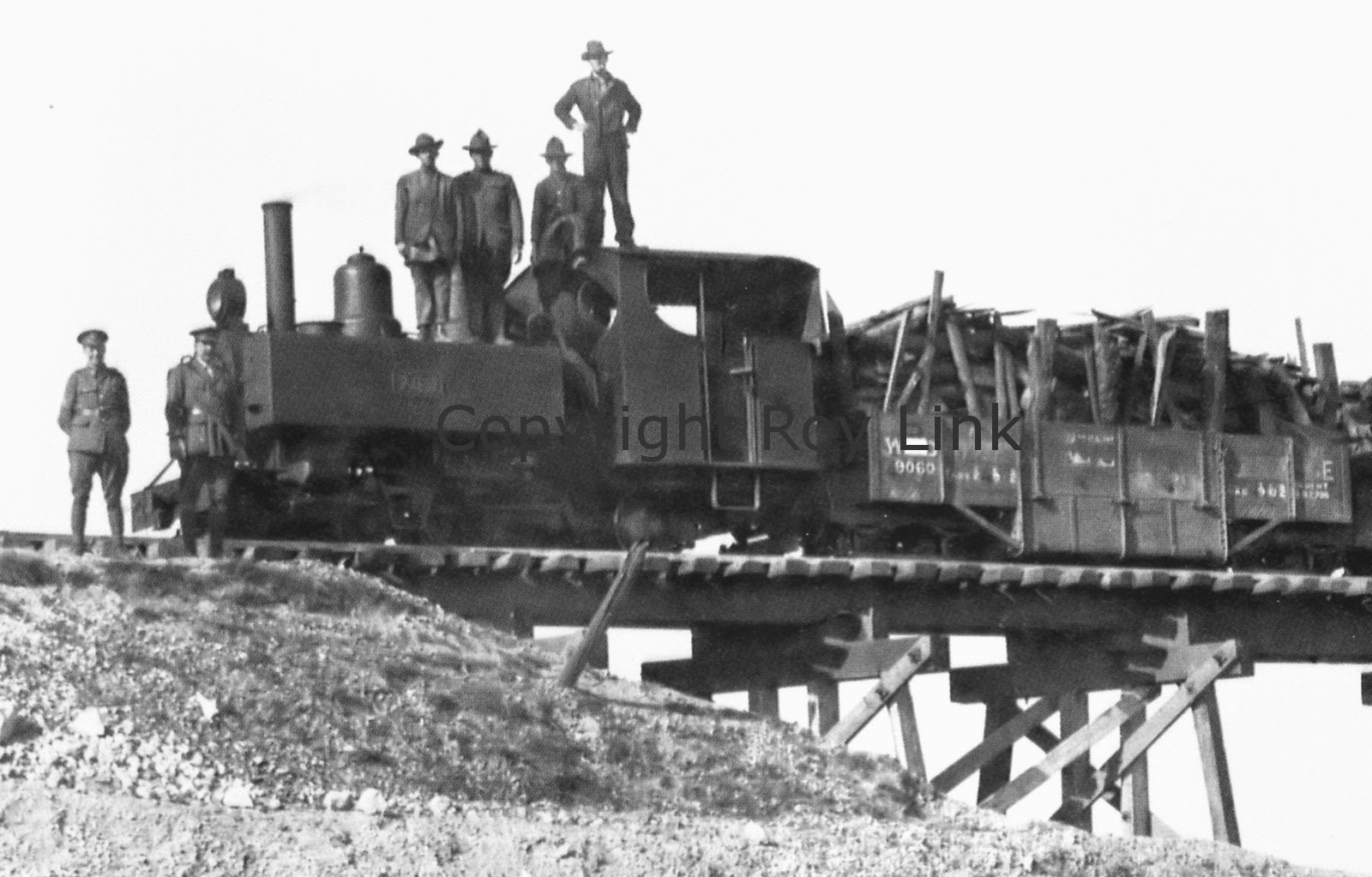
WD Baldwin 4-6-0T, laden E-class wagon and friends pose on a timber trestle bridge (detail of photo on page 36 of Album) Courtesy Roy Link
Modellers will grasp the potential of this treasury of images. The late Henry Holdsworth (mentioned in a previous blog) used these contemporary photographs to create scenes such as this in his Pont du Lyn layout. It is very good that Roy has put such photos out into the wider world so that more people can see it. The Henry Holdsworth model shows a WD Hunslet side tank 4-6-0 made by Henry himself crossing a bridge followed by a WD Baldwin 4-6-0T made by Wrightscale.

Pont du Lyn
The text is mostly taken from contemporary documents: an article which appeared in 'The Engineer' October 1918, a 'Short History' dated May 1919, a report by A.L. Stead ex Royal Engineers June 4th 1920, the Railway Gazette feature of 21st September 1920, Heeniker's History of Transport of the War and so on. Supported by re-rendering of diagrams and contemporary drawings, it steers us through the alphabet soup of Programmes and Classes, wagons, bogie wagons, steam locomotives and tractors.  We are able to find out about  the Ds, Es and much else beside.
A Dick Kerr diesel pulls a class F and class E wagon (March 17th 1918) Courtesy Roy Link

Built in the 1890s and pictured in 2004 this standard Péchot wagon was the inspiration for the WD wagons shown above
The sources used by the compilers of the WDLR Album mentions the French somewhat briefly and this can be misleading. For example, anyone reading the introduction of WDLR Album would think that it was the Germans who developed 60cm for military purposes. In fact, they got their best ideas from the French - Decauville in general and Péchot in particular.  Before 1914, there were over 500 km of French fortress railways in France itself, as against 385 km for the German military Swakopmund railway. Though the French started the War with very little portable track, by September 1914 they managed to cobble together 100 kilometres worth of 60cm to defend Paris. This was soon translated into trench supply, thanks to large orders at home and abroad. In September 1915, the freight moved in the Champagne sector varied between 700 and 1400 tonnes per day. In 1916, the British and their allies developed the WD system in reference to the French.

For any reader tantalised by Roy's reference to a Péchot Bourdon locomotive, here is some relief. Between pages 92 and 97, there is a fascinating sequence showing an F Class wagon being loaded with a 6" howitzer. Part of a Péchot Bourdon locomotive can be glimpsed at the extreme left of one of the pictures. Here is a complete Péchot Bourdon.
Why does the title of this blog post mention giant killing? As well as the contemporary album, it includes the archive of the late John Kimber, particularly enlightening in the section on rolling stock. John, like Colonel Ronald, rescued many a precious collection from the bonfire and saved them from posterity.The giant, Death, may have come for John, as it came for all those forgotten railway heroes, but their influence lives on in Roy's book.
In his introduction to the album, Colonel Ronald hints at another sinister giant, that of ignorance. The records, from which the book has been compiled, survived on the goodwill (and sense of history) of employees at various levels within the War Office. The original photo album, he wrote in his Introduction, 'was orphaned by many years of well-intentioned salvage drives, clear-outs and the like. .... The WDLR was not well served'
We all welcome this long overdue tribute to the WDLR system and its workers.


Thursday, 29 January 2015

Hi, well it is about six weeks since the Hunslet first batch reported progress.  Alas ten days over Xmas were lost, two days to festivities, eight days to flu.  January though has seen progress -  the back of the job is broken.
We now have eleven chassis mechanically complete and all running well forward and reverse on air.
Once the chassis run on air the course to the finish line is clear cut.  The next job is to make the gas tanks/burners/ pipework and control valve.  When this is fitted to the frames, the footplates can be assembled and fixed, followed by fettling the smookebox casting and fitting it too, then make the boilers, steam pipework, regulator and other boiler parts. I hope to have this done in the next couple of weeks.
Once the footplates and smokebox are on,  it is clear where we are heading.  They really do begin to look the business.
Sarah's book;  Colonel Péchot - Tracks to the Trenches, is selling well. It has been available now for a month.  I hope you have all been loyal and ordered your copy.  It has been favourably reviewed in Heritage Rail.  Roy Link (author of the exceptional and newly published WDLR Album) gave it a very generous review in the Narrow Gauge and Industrial Modelling Review too.
 

Tuesday, 13 January 2015

Colonel Péchot and quarry Hunslets: is there a connection?

We start with a report form the workshop.  After ten days or so lost to winter viruses, the first batch of Quarry Hunslets on the work-bench are once more making progress. Cylinders, slide-bars and crossheads are all erected, the valve-chests finished and covers made.
Where it's at 1: the Hunslet batch one chassis January 12th
I'm eager to get them running but there are one or two jobs yet to go. The slide-valves and valve rods are to be fitted then the valve timing can be adjusted. At that point, they should be ready to run on air. This is the great psychological moment for any builder. Once the model runs on air, it  has theoretically proved itself!
Where it's at 2: Colonel Péchot: Tracks to the Trenches. The books are in stock, with all good booksellers (including us - see the book page on the website if you want to order one!)
Could Prosper Péchot, an officer in the French Army, 1880 to 1917, and the quarry railways of North Wales be connected? For a start, both are remembered because they used 60 cm  gauge railways, or the very close Imperial equivalent, one foot eleven and a half inches. The Péchot system was adopted by the French Army in 1888, and used in their frontier defenses of the time. During the First World War, thousands of kilometres of railway networks based on the Péchot original were used.
 The quarry railways of North Wales numbered perhaps a couple of  hundred miles. They came into use earlier and survived longer than the Péchot system. The Festiniog Railway, linking Blaenau Ffestiniog with Porthmadog, was opened in 1836 and took delivery of its first steam engine in 1863. The first locomotive built to Robert Fairlie's patent appeared in 1869. The Dinorwic Quarry (lying north of Mount Snowdon) ordered its first steam locomotive in 1848, the year of Péchot's birth. This was Fire Queen - their names were quite poetic! The quarry ordered a few locomotives from de Winton but then  moved on to be a faithful customer of the Hunslet Engine Company of Leeds. The most celebrated of these Hunslets were the 'Alice' and 'Port' class locomotives.
In the meantime, Prosper Péchot had grown up and joined the Ecole Polytechnique with a view to joining the French Army. In 1870-71, he underwent the most significant experience of his life, the Franco-Prussian War. His proud country, France, was defeated in a matter of months by the upstart Prussians. Their king, Wilhelm. was consecrated Emperor of all Germans on French soil, just to increase the humiliation. Many observers thought that the French defeat had been inevitable, but Péchot learned better. At times, the celebrated victory of the Prussians had hung on the slenderest of margins. They could have been defeated. One of these Prussian weaknesses had been military supply. Péchot determined to concentrate on improving French supply techniques - one way to ensure that they would win the next round! By 1882, he had submitted a Memorandum to his boss of bosses, the Minister in Paris. In it, he showed how portable railways could take war to the doorstep of the enemy. his superiors were not sufficiently impressed and, between 1882 and 1888, Péchot struggled to convince them to adopt his system. Between 1888 and the early 20th century, amazing military networks were built up, in Europe, Namibia and Morocco.
At Dinorwic in 1886, Velinheli was delivered. She was the first 'Alice' class 0-4-0T Hunslet. It is interesting to note that though Péchot freely acknowledged his debt to Festiniog Railway practice (see below,) he doesn't mention other Welsh railways. These Hunslets were in one important respect closer to French railway practice than were the Festiniog locomotives - they had outside frames and consequently better running qualities.
The overall length of Velinheli was 13 foot, and 7'3" above the rail at her highest point, the chimney - 3.9mm and 2.175 respectively. She could almost turn on a sixpence - well 21' radius (6.3m). Regular purchases of Alice class Hunslets went on until 1900. 'Port' class locomotives were also bought from Hunslet, the most obvious difference being the cab. These locomotives carried on until the 1960s, the last being sold off in 1969.
These Welsh railways had dates in common with the Péchot system as well as an equivalent gauge. There were further strong links. Prosper Péchot acknowledged his debts. His first was to Paul Decauville and his second to Wales. His Memorandum to the Ministry (1882) makes a highly significant reference to the Festiniog railway. After a brief introduction, the Memorandum goes on to explain why 60cm was the only gauge which could be quickly laid and yet sustain the traffic.  He arrived at this gauge 'by data from trials' but also from evidence - the performance of the Festiniog Railway. (Memorandum appendix 6.)
Early print of a Péchot-Bourdon locomotive. This has points of resemblance with Little Wonder below, but it has outside frames - photo courtesy Raymond Duton
Péchot had learned about Wales from various sources, through publications, but most significantly through Paul Decauville and other railway engineers,who paid visits between 1875 and 1885. Paul Decauville saw the drawings for the first 'Fairlie' - Little Wonder - probably at Festiniog.
Little Wonder, in some important respects an inspiration for Prosper Péchot

In 1886 Péchot's sceptical superiors were forced to consider the merits of his system.  The French Press, and the media of other countries observed that the defenses of France were highly vulnerable to high explosive. Not only did they authorise trials of railways and wagons, but they also encouraged him to develop a locomotive. This, in the words of Péchot himself (patent application 1887) was to be of the 'Fairlie' type.
He had another inspiration, surely, in the locomotive with the outside frames and a neat wheelbase - in the Alice class locomotives. In 1885-6 some French engineer would have seen these drawings and communicated them to Péchot, who read widely. He must have seen in the 'Alice' class qualities that he wanted for his own locomotive.