Thursday, 20 June 2019

16mm models and First World War Railways


Strangely enough, modelling wartime railways can be a beautiful activity.
Recently, I wrote about the military modellers’ society and how we wished them all well at their latest open meeting (June 1st). Just this month, we have been reading about the 4mm scale railway built by Callum Willcox (British Railway Modelling June 2019 pp 66 to 71). The layout is set in the Amiens area in July 1918 ie during the First World War. The author remarks ‘I always knew that recreating a scene set in such an iconic yet awful point in history was going to be a challenge’
In August 1914, German troops march on to the esplanade of the Gare du Nord in Amiens, northern France. Picture from Illustration magazine collection MD Wright
The city was indeed an icon of the struggle. There were three battles of Amiens.
In late summer 1914, the high tide of the Schlieffen assault on northern France brought troops to the city. They arrived on August 31st and took a few hostages to ensure good behaviour. As the tide withdrew, so did the troops. On September 9th, they marched out again.
In September 1914, German troops march out of Amiens, Picture Illustration magazine, collection MD Wright
Roughly 500 miles of Western Front were set up, running through the Upper Somme valley. There was a Battle of the Somme in 1916, another tragic affair.
The second battle for Amiens took place in March/April 1918. The German Spring offensive was aimed at the weakest part of the Front, where the French had just withdrawn to be relieved by a novice British force. On March 21st, a total of 14 British divisions were attacked by 47 German ones. The defenders, thinly spread along the Front were no match for a vast and concentrated German force, led by storm-troopers armed with flame-throwers.
The Germans advanced, probing for weakness. Philippe Pétain, alive to the danger, rushed in French reinforcements from the south. The Germans turned their attack towards Amiens. As an important transport node, it must have been on their list anyway. The assault was stopped, heroically, at Villers-Bretonneux, less than 10 miles from Amiens centre. Honours must go to the Australians who took over a rag-tag band of gunners, signallers, engineers and the catering corps who had retreated from the rout. On the 26th March, they faced down the Germans at the small village of Proyart just east of Villers-Bretoneux. This gave reinforcements, especially the French time  to dig in at Villers itself. A last furious wave broke on the area on April 4. Soon after, Amiens was considered out of danger and the German attacks turned elsewhere.
Here come the horses! In March 1918, the British hastily set up their defences. In a few minutes, they will have to be on the move again. From Illustration magazine collection MD Wright
Gradually, German offensives petered out and the Allies gained the initiative. The Third Battle of Amiens, July/August 1918, has also been called the Second Battle of the Marne. (The Marne, a tributary of the Seine is rather to the south).
The Germans were now on the back foot. The 78 fresh divisions which Ludendorf commanded at the start of his Spring Offensive had been whittled down to 31. This is according to French figures and is probably an exaggeration; the Germans, too, were flexible in their counting. But it does show that casualties and prisoners were numerous. The mighty American Expeditionary Force, grouped well to the south had swung into action. The French  and the British, to the north around Amiens sensed their opportunity and started their advance.

This fine 16mm model set in summer 1918 shows four examples of the Simplex locotractor, open, weather-protected and armoured - built by the late Henry Holdsworth. To the left is a Wrightscale Baldwin 50h.p. locotractor, as used by the French Army. Photo courtesy Jim Hawkesworth
On July 18th, the French attacked. In one day, they gained 150 square kilometres of territory and 12,000 prisoners. The British joined in and the Second Battle of the Marne/Third Battle of Amiens was under way.
French official sources grudgingly admit that, after the reverses of the first day, the Germans put up a good fight. There are various possible reasons. To their High Command, defeat was unthinkable because they knew that their bankers would withdraw financial support and the victors would demand crushing reparations. (They were quite correct ). It was simple for the German soldier. He had the choice of sticking with his comrades and facing known evils - or of risking the punishment for desertion. We are justly indignant about the free use of firing squads on the Allied side. It is fairly certain that something similar went on for the Germans. Being taken prisoner was possibly another matter and there were many.
In July 1918, the French are on the offensive. Their tank is pulling a captured German gun. Photo from Illustration magazine, collection MD Wright
Throughout 1914-18, armies on both sides relied on portable 60cm railways to supply them. The French had a head start thanks to Prosper Péchot, then a Captain in the French artillerie. His système Péchot was adopted in 1888. 560 kilometres of 60cm track, 50 locomotives and about 200 wagons in all were ordered – unfortunately, the Army then rested on its laurels. The Germans, who knew a good thing when they saw it, adopted 60cm gauge and spent the years between 1890 and 1914 improving it and training their pioniere – railway troops. The British, never ones to ape a mere foreigner, started the war with about two miles of portable track – 2’6” gauge (about 63cm). In 1916, embarrassed by failures at the Battle of the Somme, they initiated the War Department Light Railways, running on 60cm track.
This close-up of the French soldiers in the photo from Illustration shows a narrow-gauge railway track in the grass. Collection MD Wright
The complete story told in Sarah Wright’s 'Colonel Péchot: Tracks to the trenches.
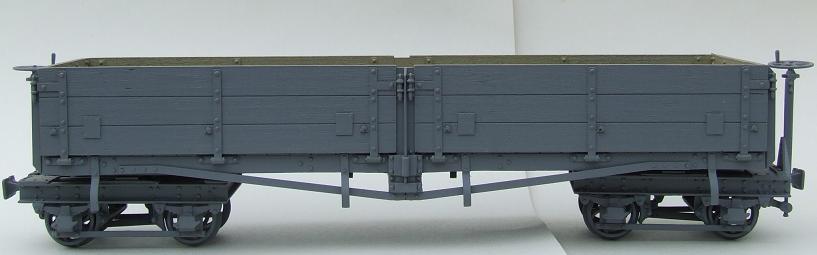
Two WDLR Class E wagons, a covered wagon plus a WDLR Class F in the foreground, all in 16mm gauge. These were built by Henry Holdsworth using Wrightscale bogies. Photo Jim Hawkesworth
Should this tragedy be a subject for the railway modeller? Yes, I believe. Yes again!
This Wrightscale Péchot wagon is clearly the design inspiration for the WD F-class in the picture above
Sometimes, there is a need to keep issues before the public. Although conflict is not constructive on its own, it creates an opportunity for debate, discussion and exploring new approaches. We can open our hearts. A situation which we’d rather avoid can be a chance for reflection, for the modeller and spectator. Why do we resort to violence to settle our differences? Why do we fight instead of using words! Why oh WHY!
The various Battle of Amiens provide opportunities for thought, scenarios for reflection and, dare I suggest, a chance to use some very cute rolling stock.
A captured German 0-8-0 Brigadelok with tender is being used alongside WDLR rolling stock - Class D and covered wagon. The wagons were built by Henry Holdsworth using Wrightscale bogies. Photo Jim Hawkesworth
Contemporary with the First Battle of Amiens are, firstly, on the French side, the locomotives and rolling stock of the système Péchot. There are also the D-loks used by the Germans. During the Battle of the Somme, War Department Light Railway locomotives and wagons appeared. During the Second Battle of Amiens, much WDLR material was destroyed to stop it falling into enemy hands. During the Third Battle, captured locomotives and wagons were used by both sides, along with their own. This makes for interesting modelling, both in 16mm scale and others, such as 4mm.

Saturday, 18 May 2019

16mm scale crane model


It all started with the the Péchot system. This was designed to supply the artillery of the 1880s in the field. In 1888, it was adopted by the French Army for defensive uses. Over the next 25 years, military firepower increased, as did the guns.  Even carrying their monster shells became a problem. In the 1890s, special 60cm rail-mounted cranes/grues were developed to handle these massive but delicate weights. These cranes were absorbed into the existing Péchot system.
This drawing by Henri Cheffer was made, probably from a photograph. It shows a Péchot system grue roulante carrying a 700kg shell. Picture from 'Illustration' courtesy M.D. Wright
The system he had created anticipated the standard problems for a portable, temporary railway. The track his bogies ran on might well be uneven. Their springing was superb for the time. The solidity of the bogies was unequalled; though well over a century old, examples survive in good condition. Best of all, the brakes were reliable and could be screwed down securely. Such basic reliability was appreciated by the squaddies charged with moving vast and sensitive loads in deplorable conditions.
A Wrightscale 16mm model of a Péchot system crane
We first noticed the cranes when reading through Dr Cénac’s  excellent ‘60cm pour ravitailler l’Armée francaise’ (60cm railways used for supplying the French Army during the First World War) They are also mentioned in Voie Etroite issue number 84 pages 30 and 31. Our thanks go to both these experts. I devote some pages to the 5-tonne bogie and the crane in ‘Col Péchot: Tracks To The Trenches’ chapter 8.
A smallish crane, often called the grue roulante - the moving crane - was developed. It ran on a single bogie and was held in position by the brake-wheel, assisted when necessary by chocs. It carried shells for the big guns when they operated out in the field; the weight of a shell designed for the 370mm Schneider gun was 700 kg, not including the bagged charge.
A mobile crane, stabilised by a counterweight, which could be operated by one man was much appreciated. A number were built to service the Schneider 370 towards the end of the First World War. One can be seen in the photograph on page 31 of VE no 84. Pictures also appeared in the album produced by Illustration magazine between the wars.
Exploded diagram of the instructions for a Wrightscale 16mm model of a Péchotbogie. Even at 16mm scale, the sturdinessand massive springs of the original can be appreciated
It was a challenge to create the kit for a model crane. Malcolm was keen to have one which would rotate on its bogie, like the prototype. He wanted the cable drum to work. There is no use having a handle if it doesn’t operate something. Most of all, he wanted a functioning counterweight.
The crane must rotate, the pulleys must work, the cable drum must rotate, the gears must mesh in good order and the counter-weight must run correctly.
The crane is mounted on a base-plate above a sub-base which is secured to the bogie by a nut, enabling it to rotate. The assembly must be well balanced. The jib, and load, must be in equilibrium with the counter-weight and track. The instructions, therefore, repeat what cannot be said often enough. ‘Become familiar with the parts before beginning’ ‘Fit twice, glue once’ ‘Trial assembly will result in a working model’ ‘Repeat trial assembly if necessary’
The model makes use of various materials, each fit for purpose. White metal provides sufficient strength for jib, pulleys, gears and other working parts. Pivots, pins and bolts are made of steel or brass as necessary. Malcolm and Adrian Swain worked out the white metal bits over a year of friendly argy-bargy. When Adrian retired, Sarum Castings were able to take over.
Wrightscale 16mm model of a Péchot system crane, showing the counter-eweight on its track and the pulleys
Sourcing the cable was quite a story as a working model needs something flexible, with adequate tensile strength and which could generate some friction.
This being Deeside, we started with fishing twine; many Wrightscale cranes operate well on this ‘cable’ Unfortunately, our source, Alan Brodie, a well-respected local character died. We then went on to button twine, bought at our local general store. This served well but unfortunately, the local store burnt down (look for ‘Strachan’s fire’ on U-tube). As well as sewing notions, they sold everything from paints to fine spirits. One day, the paraffin stove, a necessity in the Scottish winter, got a little too friendly with the White Spirit – hence the conflagration. They restocked, but not, alas, with button twine. We seemed to be stuck, but then the distaff side of the family came to the rescue. Someone wanted her bead necklace restrung and Malcolm discovered Tiger Wire. It comes in various colours, handy for representing fresh steel, rust, or mould. It has high tensile strength, is flexible and creates an acceptable degree of friction. Our wheels were in motion once more.
The model delights and intrigues. What a shame that we do not know of any extant versions! The fate of the originals was sad. After World War 1, the French Army kept its Péchot material, including the cranes. For its own reasons, the government and Press did not want to celebrate the role of 60cm, and so the public were encouraged to forget that the trenches were fed, armed and housed by the little portable railways. One example is the picture by Henri Cheffer of the 370mm gun being supplied by a Péchot system crane.
370 mm mortar being supplied by a crane. This is clearly a Péchot system crane and the lines of two 60cm railway tracks can be made out though the artist, Henri Cheffer has seen fit to erase the actual rail. Collection MD Wright
Although the crane is there, and a trail of material stretches along the line which could best be described as a railway track, the 60cm railway has been removed.
In World War 2, almost all Army material fell into hands of the Nazis. By the end of the War, it was being scrapped to keep their fearsome war machine in operation.  We are proud that our little model is keeping this intriguing machine alive, at least to the imagination.

Wednesday, 8 May 2019

Wrightscale and 16mm military models


We are delighted to support the 16mm Narrow Gauge Military Modellers Group. On June 1st they are having a running day at Woodseaves Miniature Railway Sydnall Lane near Market Drayton TF9 2AS. The group now has more than 480 members, which is an excellent reflection on the potential of this interest.
16mm gauge translates to 2’ or 60 cm gauge prototypes, the vast majority of which were for military use in the First World War. Yes, there were railways of this gauge in Britain long before then. Unlike the coal mines of England and South Wales, the small slate railways of North Wales realised the advantages of 2’ gauge.
The Festiniog Railway of North Wales was a pioneer in many respects. Between the slate quarries in the mountains and the sea, there were several miles of rough country.  As the journey was downhill overall, the advantages of railway over packhorse were clear. On the other hand, standard gauge would cost too much to construct. 2’ was chosen and 2’ thrived. At first, loaded wagons just ran downhill and the empties were towed back by horses. Then locomotives were introduced. In other places, other narrow-gauges were tried, but natural selection favoured the fittest – 2’ gauge.
The French came to the same gauge another way. In the 1870s, Paul Decauville introduced prefabricated agricultural railways of an even smaller gauge – 40cm, roughly 1’4”.  These became known as porteur Decauville and were very successful.
Contemporary print of the Pechot-Bourdon locomotive, a neat yet powerful developent of the Fairlie with remarkable track-holding powers. Print courtesy Raymond Duton
A young army officer, Prosper Péchot used these railways on a military base and decided there was room for improvement. By dint of careful calculation and experiment, he devised a 60cm gauge portable railway. Its components were robust enough to carry remarkable loads yet light enough to be carried by a small human team. He was encouraged by Paul Decauville who allowed him to experiment at his headquarters in Evry, just south of Paris.
You can read the full story in my book, ‘Colonel Tracks Péchot: Tracks To The Trenches’ The French Army adopted the system in 1888, calling it artillerie 88. Almost immediately, the Germans adopted it and started improving on his good work. They did their work so well thatGermany started the First World War ahead of the Allies.
Wrightscale 16mm model of a Pechot-designed wagon artillerie 88. It was innovative in many ways, running on well-sprung bogies and virtually indestructible
The good Péchot paid a heavy personal cost for introducing such a successful system to the French military, among other things, his relationship with Paul Decauville. The two gentlemen were concurrents. This useful French word can mean they co-operated or alternatively, they were rivals. At different times in their relationship, both words were true..
It is a pity. Péchot was a just man who acknowledged his debt to Decauville in France and to the Festiniog Railway – Spooner in particula - in Britain. Some (mentioning no names, but you know who you are) have accused him of plagiarism, but any careful examination of his rail, wagons and locomotives proves that he made introductions and improvements to them all. The Fairlie family of locomotives are splendid, but for sheer compact power and innovations to ensure heavy haulage on rough track, nothing beats the elegant little Péchot Bourdon locomotive.
16mm scale Wrightscale WD bogie. The prototype design owed much to Col Pechot's pioneering work
The ability to transport huge tonnage into the field made a huge difference to trench warfare. If the soldiers had not been plentifully supplied with food, water, the wherewithal to build and fortify their trenches and most of all, guns and ammunition, the war really would have been over by Christmas (1914!)  As it was, the combattants were able, just, to stay in their trenches and bombard each other for more than fifty gruelling months.
The bogie of a prototypical British War Department wagon photographed at Apedale. The design depended heavily on innovations first suggested by Colonel Pechot. Photo courtesy Jim Hawkesworth
After the War, German railway equipment was eagerly seized by the Allies. Among the spoils of war was a vast 60cm network in Namibia. British material was also sold off as War surplus as was some from the US. The victorious French Army closely guarded its artillerie 88 rolling stock and the Decauville 15 wagons which were also used during the War. These were walled up in their Army bases, safe from prying eyes.
The net effect of all this was that the ground-breaking French equipment faded from view. A myth has grown up that the Germans invented 60cm military narrow gauge and that the Allies played catch-up in this area as with so many others. I could quote authorities who make this claim but I’ll spare their blushes.
The whole WD wagon, designed to carry a gun snapped at Apedale in 2018 by Jim Hawkesworth.
In any case, soon after the War, the internal combustion engine came into its own. Journeys which hitherto were only possible by rail moved onto a growing road network. Historians who were never there proclaim the value of War Horse rather than War Wagon. It was easy to forget the enormous contribution made by the small portable railways. They seemed to have been folded up and placed at the back of the cupboard of history.
Prototype WD Baldwin 4-6-0 locomotive snapped at Apedale by Jim Hawkesworth in 2018
So … thank you to groups such as the Moseley Railway Society who run events at the 2’ gauge railway at Apedale, Staffs. They regularly run trains using material preserved from the First World War, and regularly educate the public. Thank you also to the 16mm scale Society. Models based on preserved 2' prototypes which could run on widely available (o gauge) track became mainstream. And thank you to the 16mm military modellers. If you can get to Woodseaves TF9 2AS on June 1st , so much the better!
This is the model! 16mm Wrightscale Baldwin 4-6-0 loco. You can see the similarity to the 16mm NG Military logo

Tuesday, 30 April 2019

Workshop Wren


A room of one's own is a well-loved cliche. Virginia Woolf wanted a generous space. Jane Austen made do with a desk in a passageway.  So it goes with a workshop. David X. Manners was a 20th century editor of a craft and diy magazine for 20 years before he wrote ‘How to plan and build your workshop’ He admitted that as a general rule the more space the better but there were important qualifications.  Natural daylight, music, easy access, headroom and storage are far more important. Wonders have been done in a cupboard if it is the right sort of cupboard. In the era of ingenuity, it was possible to get the Shopsmith (a wood-working all-in-one) which fitted along the side of a garage accompanied by a workbench cabinet which folded against the garage wall. Even more ingenious was the folding Dorbak which could be hung on a cupboard door.
Little house in the big woods. A spacious yet cosy workshop has long been Malcolm's dream
All these starter workshops have their merits but they have left Malcolm even keener on purpose-built premises. His creative life began in a generously proportioned meter cupboard and progressed to my grandfather’s ‘shack’. Though not ideal, they gave him an idea of what he wanted. He wanted brightness and airyness, space round the machine tools and a clear floor. Anything dropped could then be retrieved by a couple of sweeps of a broom. Sarah in tuirn wanted it to be warm. Otherwise, any space would be unusable for half the year. Unless a certain temperature was maintained, anything stored would rot and anyone capable of movement would migrate somewhere warmer.   Space and temperature were among the luxuries which on reflection turn out to be wise investments.
Being parked. This is one vehicle you will find in the new garage. Wrightscale 16mm Wren
Thanks to cooperative neighbours, the workshop is large. This should give space for the range of machine tools which have overlapping uses. Malcolm could make do with one large and one small turning lathe, for example, both working at the very limits of their design capacity, but better and more efficient to have several, each working at its optimum.
There is another condition the workshop has to satisfy. It has to take a car.   So the garage has a clear space and suitable access for a car. When the space is needed for an assembly project, the car simply lives outside. Unlike the usual garage door, these doors are fully glazed, letting in precious daylight.

Vehicke ready to leave its garage. Wrightscale 16mm Wren
Unlike the neighbours, the planners do not admit to the existence of the soul. They were willing to grant permission for a garage-workshop, but not a workshop as we already have one.
Daylight is the greatest indulgence. We promised to concentrate the windows away from our neighbours and towards the view. Platitudes have been uttered about natural light lifting the spirits. They hide a greater truth. We perish without light and a view on to greenery. 
Here comes the paradox. Malcolm needed storage. Storage requires space, insurance and heating – the enemy, you might think, of light and room to move. Many have argiued that keeping stuff for repair and reuse makes little sense in the world of Amazon, Gumtree and ebay when new or second-hand possessions are only a mouse-click away.  Possessions generate negative income and anxiety, not to mention trip-hazards. 
But Malcolm is getting his storage. Even before the shed was built, he had acquired cupboards and display-shelves, massive items which are themselves a pain to store. His own collection of models will be going there, including items which have no value to anyone else. More than just mess and traps for dust, they add up to an expression of identity. What goes on in the mind is more than just a series of brain-waves, interesting as those may be. If they don’t involve hand and eye, not to mention sharing, memories gradually flatten out and cease to be. Life is incomplete otherwise.
Are you sure you have enough light? The folding garage doors double as windows.
The same applies to adequate headroom. Hours spent in claustrophobic conditions cramp the spirit. The same applies to music and a suitable chair for thinking through a problem.  Action may be possible in soul-destroying conditions but anything creative is not.
The workshop was erected from a kit on Monday 15th April. On that  day, the cathedral of Notre Dame burned. We are among the many who feel an affinity with that gracious cathedral so we are calling our own little place the Notre Dame Works - our own small tribute.

Why two Wrens? The answer is the answer any enthusiast will give 'I can't bear to part with either'
Of course, if Malcolm gets his stuff out of the house, Sarah will have more room for hers inside.
Another view of a pair of Wrightscale Wrens

Wednesday, 3 April 2019

Wrightscale Wrens in the box

We look forward to seeing friends old and new at the AGM, Peterborough this Saturday 6th April. We'll be bringing along kits for signals, WD bogies, Pechot wagons and cranes. We'll also have examples of Wrightscale locomotives.
We are also delighted to say that we'll be showing off some newly finished Kerr Stuart 0-4-0 Wren  tank locomotives. A big thank you to everyone who has patiently encouraged us along the winding road! Various things, family and professional, have been hampering us but at last our little beauties have seen the light.
16mm Kerr Stuart Wren models made by Malcolm Wright. He has painted them in a livery standard for the prototype. Green pigment was resistant to the heat and weather. Red buffer beams were important for safety and black the best colour for parts exposed to coal and lubricant.
Malcolm's affection for the Wren goes back many years. It was the first design he created after being drawn into the world of 16mm, then as an enthusiastic amateur. As they say, first love never dies!
There were many moments of perplexity. What is the true Wren and what the pale imitation? There are many adaptaions that were made, over the years and two families which both proudly bore the badge. These were 'old' type and 'new'.  Needless to say, some 'old' types were being produced after the new were introduced ... but that just adds to the colour.
We just love the history and so, here, once again, is a little bit of history to explain why the locomotive was the way it was. The Engineering company, Kerr Stuart Ltd of Stoke on Trent, realised that a new market had grown up for small industrial and military locomotives which could be easily moved to temporary works. If and when they were no longer needed, they could be moved on.
Continental manufacturers such as Jung, Henschel and Decauville were already supplying the market. Decauville, for example, was supplying small locomotives to Australian sugar plantations, in the British backyard. Another significant market were the French and German armies which had realised the potential of 60cm (the Continental equivalent of 2' gauge) for military supply. This is a whole other story!
A closer view of the rear. Wrightscale Wren in 16mm scale
Kerr, Stuart already had an 0-4-0 Buya class locomotive design which was adapted for 2' gauge. The design was streamlined for easier manufacture. It included advanced features for the time. Typical of these were the round connecting and coupling rods with marine style big ends. The narrow gauge forced other adaptations. The firebox had to be waisted to fit between the frames which in turn were increased in height above the axes. It had a very low centre of gravity - both a good and bad thing on rough contractor's track. A low centre of gravity has obvious advantages but when the boiler and cylinders are so close to the rail, damage inevitably ensues. Soon, a steel firebox was fitted as standard though a copper inner firebox could be supplied on request. As the locomotive was so light, the rear wheels tended to 'dig in' when it started, causing excessive wear to the back two wheels. Soon steel tyres were fitted as standard.
In 1915, the 'new' type Wren was introduced. This was now fitted with Hackworth valve gear, rather than the Stephenson's link. This made a number of modifications possible. The reversing shaft was moved to a place above the axle and the boiler barrel was raised. The cylinders were inclined which allowed greater clearance between them and the track; proper cylinder drain cocks were fitted. The frame was strengthened by a substantial angle riveted along its top length. I should like to think that we could tell old and new apart because of all these technical improvements but probably what everyone notices first is that, in spite of the reinforced frames, 'new' is lighter and more airy in appearance.
Light and airy, the Wrightscale 16mm Wren

Given all these improvements it is surprising to note that 'old' type models continued to be requested. Presumably the boss of these concerns had not directly experienced draining a cylinder straight through the front cover.Steam and water get everywhere to the detriment of human and machine. One thing was not improved. The cab remained so light as to be almost ethereal, and not much protection from the weather. The ingenious drivers lashed up home-made cabs from wood and corrugated iron.
The Wren was a standard contractor's cab for many years. 58 examples of the old type were made and 104 of the new type before Kerr, Stuart closed its doors in 1930. The majority were 2' gauge with some metric. Two locomotives with enclosed gear were made for a steam tramway in Brazil, to 915 mm gauge. Further 'new' types were made by the Hunslet Engine Co of Leeds between 1930 and 1941 and the story is not over yet. Statfold Barn has taken over the design and there are two on the stocks there.
We hope you understand why Malcolm loves this model so much. He has, in fact, produced more 16mm models  than Kerr, Stuart did 2' gauge. He will have one or two on the stand ready to chuff away to their new homes.

Monday, 11 March 2019

The Wrightscale signal kit


We look forward to seeing friends old and new at the Garden Railway Show in Peterborough on April 6th.
Thanks to our new white-metal caster - Sarum Castings - we should have some signal kits in stock. Every enthusiast’s line should have a few of these semaphore signals, lending character and authenticity. Such signals have always had line-side appeal but they are genuinely important aspects of railway working.
Every branch-line needs one! Wrightscale 16mm Mckenzie and Holland home signal
As railways spread, ‘line of sight working’ became obsolete and dangerous. Yes! we all know and love that scene in ‘The Railway Children’ where Jenny Agutter and the others wave red flannel petticoats to stop a train, but, alas, Jenny Agutter isn’t always available! To warn and control traffic, semaphore signals were introduced in the early 1840s. The message each signal sent could be seen both by day and night; the message sent by the signal arm was automatically reinforced by its companion, the signal light. Highly visual and practical, they were soon adopted everywhere. Mckenzie and Holland introduced the version shown in the 1880s. Many lingered on branch-lines for years.
Each semaphore signal arm consists of a blade, usually painted red on the business side to render it more conspicuous and striped to provide contrast. The second vital component is a 'spectacle' holding coloured lenses. A quick look at the drawing below shows why it was called a spectacle! For a simple Home signal, the spectacle colours would be red and green. In early days, when the lamp was lit by oil, emitting a warm yellow hue, the lens in the spectacle would be blue; if a green lens was used, the overall effect would be too yellow, therefore confusing. Depending on the position of the arm, the appropriate coloured lens covers the lamp indicating red for stop, yellow for caution, green for clear.
Signal blade and two-colour spectacle on Wrightscale 16mm signal kit
 On modern railways, the semaphore signal has largely been replaced by electric or by radio signalling in the driver’s cab. Thus the picturesque semaphore is rarely seen these days..
In my experience of railways in the Sixties, control was never provided elecrically. Passing tokens were used on the Deeside Line which ran up to Ballater, Aberdeenshire. Apart from the short trip between Aberdeen Joint Station and Ferryhill, the railway was a simple branch-line with passing loops. Passengers would try and sit on the side of ‘The Sputnik’ with a view of the station. If we were lucky, we’d draw up alongside the Sputnik’s waiting twin (actually a diesel-driven Craven two-car unit) and see the token passing from one to the other. Ah! Happy days, ruined by Dr Beeching! The line closed in early 1966. The Sputnik, a.k.a. battery railcar, still exists at Crathes, on a short length of the original Deeside Line which has been reopened as a tourist railway.
For Malcolm, the fondest memory is of semaphore signals, such as the one used on the Festiniog Railway. Almost the first model he made was a Home Signal. He chose a Mckenzie and Holland prototype – many were found in the LNER region, strong in his home town, and also the ‘classic’ signal on the Festiniog Line. These Mckenzie and Holland are ‘lower quadrant’ signals – the business is done between the nine o’clock and six o’clock positions. Bernard Wright and J.H. Wright (no relation) produced a series of articles in Model Railways magazine 1988, which were helpful.
Lamp and ladder on 16mm Wrightscale signal kit
16mm is an unforgiving scale. Metal should be represented by metal, wood by wood and so on, so all the kits require components in white metal, wood, wire, gel in at least two colours and so on. The signals can be electrified so even more components can be needed. The lenses (supplied) are made of red or green gel; a modern LED or grain-of-wheat bulb doesn’t have the yellowish hue of the original oil lamp.
The shoe at the base and the lower end of the connecting rod; Wrightscale 16mm signal kit
As well as signal blade and spectacle, the vital components are post, ladder and rail, lamp, balance and bearing plate. On railways such as the old Southern, signal posts could be improvised from old lengths of rail. Mckenzie and Holland preferred wood. This was crowned with a finial, not just for aesthetic reasons but also to protect the top of the post from the elements. The post was slipped into a metal shoe to help protect the wood from the damp ground. The balance and bearing plate ensure a smooth arc of movement. The ladder and crow’s nest made it possible for the lamp to be serviced. Brackets reinforced load-bearing parts. The rod made it possible to control the signal…. You knew all this anyway!
The view of the signal as it recedes into the distance. Made from a 16mm Wrightscale kit
Malcolm did produce a bracket signal and offer a number of options – long and short finials, spectacles ancient and modern and so on. Unfortunately, as any supplier knows, the customer will always ask for a short finial when there is only a long finial in stock or new-style spectacles when the only ones available are old-style. We’ll have to let you know what our caster can come up with in time for the Show.

Friday, 8 March 2019

Wren and friends


Thank you to all our customers who buy a Wren, or, come to think of it, other 16mm models on the market.
16mm model Kerr Stuart Wren 0-4-0 built by Malcolm Wright
Do not listen (too much) to puritanical folk who look with disgust at homes and workshops with overflowing shelves. They regard books and 16mm models as mess. Their advice goes this way: ‘If you haven’t read it, why keep it? If you have read it, why keep it? Throw it away! ’
Much the same would apply to models and layouts. Miniature locomotives are particularly disliked by those obsessed by tidiness. ‘If it spends its life on a shelf, throw it out. If it is well-worn and dirty, throw it out!’ It is true that an enthusiast’s house is rarely a tidy house.
But is this a bad thing? Control-freakery tips over into madness. Mild obsession speaks of a sad failure to come to terms with a relentless and insecure existence.
Wrens in progress. The Wrightscale workshop is a place of much activity.
One of life’s great pleasures is meaningful clutter. We are curious creatures, and a happy person is one who can have several interests. Such a one loves to come back to half-forgotten favourites, to enjoy that little spark of rediscovery. Clutter tells a personal story. There is no substitute for the object to which happy memories already belong or which mark the place where we are going next.
A locomotive is a three dimensional symbol of something we used to know or would like to know. Yes, the Wren is a summary of a vanished way of life. At one time, before tracked vehicles, the Wren could move across a remote landscape on flimsy rails. Before heavy-duty internal combustion, the only way to move mountains was one tipper wagon at a time.
A model wagon could be a token of a railway we intend to create, big with promise of landscaping and time-tabling. Its presence brings subliminal joy and momentrs of expectation.
The envelope of things can send out important messages. It can make or break relationships. In the popular book ‘The Guernsey Literary and Potato Peel Society’ a promising romance ends abruptly. The guy who throws out his fiancée’s dog-eared books, genuinely thinking that his sporting trophies are preferable, simply has to GO. In like manner, in our society where we have the privilege of possessions, possessions help to shape us and signal our character to others.
More is more. 16mm model 'Wrens' under construction in the Wrightscale workshop
In contrast, the perfectly tidy house is best for Instagram or for furnished accommodation. The only items permitted in such an establishment (apart from two sets of clothing) are those possessions which can justify their existence in a snappy sound-bite. If the obsessive goes visiting, he/she will find much to offend. To the question ‘Does this spark joy?’ the answer might well be ‘Yes, but you won’t stick around long enough to hear why. You would risk learning too much about me’ In short if this acquaintance can’t stand the clutter, is the relationship worth pursuing? If an acquaintance can’t see the clutter for the mess, can she/he really get to like me?
Reducing mess is important, naturally, or ere long, the doors and windows of existence would disappear.
By happy accident, we came upon the prototype Dolbadarn 0-4-0 Quarry Hunslet in her native habitat of north Wales. Photo MD Wright
A completely tidy house could also be the sign of a tourist, a more human type than the obsessive, but one who is in danger of missing out. A tourist takes a guided tour through life. No stop is without purpose. Every route is taken as efficiently as possible. No time is wasted in this regimented ‘free’ time. If such a person were to be a modeller, virtual tours of computer-generated railways would be the hobby of choice.
The obsessive type does have possessions, but only strictly ordered ones. There might be nothing in the house but Great Western Railway locomotives, wagons and scenery. The topics covered by the books on the shelves would be likewise limited. Or the offer may be restricted to every model turned out by a particular manufacturer. Visiting friends may wonder what insecurity is signalled by these strict limits to a person's interests.
16mm model of 0-4-0 Quarry Hunslet, inspired by the meeting with the real thing. Model built by MD Wright
The sweet spot, when it comes to possessions, is the attitude of the flaneur. In dictionaries for children and students, this useful French word is usually translated as dawdler or idler. The synonym is given as paresseux – lazy.
The grown-up French take a more relaxed view. Every town used to have its café des flaneurs. This does not mean that service is slow and the catering sloppy. It meant that clients come for jolly parties, friends come for a ‘catch-up’ and others just for a spot of people-watching. These are not travels to a particular end. This is just enjoying the journey.
The flaneur has been better described than I can by NN Taleb – who gave us the ideas of ‘black swan’ and ‘anti-fragile.’ The flaneur realises that we don’t know exactly where we are going nor can we articulate in detail the script we are born to act out. The flaneur should have a plan but is humble, and rational, enough to keep modifying it. The flaneur realises that others, too, change their plans if they are sensible. The flaneur keeps options open and respects that in others.
Fun with a trusted mate. Photo of restored prototype WD Baldwin 4-6-0 courtesy of Jim Hawkesworth
The flaneur might seem an opportunistic beast but the true flaneur is intuitive. Intuition – the knowledge we don’t know we know (sorry Mr Rumsfeld) – is actually rather moral. Playing fair with fair folk is the best of life investments. The flaneur is wise enough to know who to invest in.
The flaneur is more likely to be found outdoors. I’m not sentimental about nature. Nature can be cruel, unpredictable, rough and destructive. The ability to cope with nature requires a blend of resilience, humour, ingenuity, empathy and solidarity.
16mm model of a WD Baldwin 4-6-0 built by Wrightscale. It is travelling over a bridge which has to be constantly remade because of the weather. Photo MD Wright
There is something fine about a group of ‘16 millers’ or the members of the Scottish Model Engineering Trust, SMET, spending an afternoon together. One group gathers around a garden railway. The others get together on a purpose-built line on a hill above Methven.
One sign that this is a group of flaneurs sharing a happy occasion is the presence of ‘plus-ones’ The group is mixed. The ‘plus-ones’ will have their own little ‘catch-up’. Another good sign is trust. It is a few years since someone tried to use the 16mm society members’ list for Multi-Level-Marketing. The reaction showed that this behaviour could not be tolerated. The other good sign is the presence of a repair shop. When something breaks, it is mended. Fellow enthusiasts offer help rather than starting a blame game.

16mm Wrightscale WD bogie wagon kit using a D-wagon body provided by a fellow manufacturer. We try to cooperate and complement other manufacturers. Photo MD Wright
You will see that Wrightscale and all who sail in her belong to the class of flaneurs. The first sign is our guaranteed lifetime support for our products. We undertake repairs, whether the locomotive was recently purchased or not. We trust our supporters to treat our locomotives and kits with respect. Often we don’t charge for the repair; often the customer insists on paying!  
The Wrightscale catalogue has never been completely tidy. Yes, the rolling stock on offer reflects the history of World War One trench transport. The Péchot  system was developed for the French Army. From it sprang the highly significant French artillerie 88 and German feldbahn , introduced 1888 to 1900. Wrightscale 16mm Péchot wagons and crane reflect part of this story. The British War Department Light Railways were introduced during the War itself. But, we admit, our offer, WD bogie and bolster kits, does not reflect the whole WD story. Colleagues developed 16mm scale WD wagons, so we did not tread on their toes.
This atmospheric shot of a prototype WD wagon was taken at Amberley Quarry. We came, we saw, we created. Photo by MD Wright
The locomotives represent a history of interest. We fixed on our first model locomotive, the 0-4-0 Wren because one was operating on the 2’ gauge railway at Leighton Buzzard. We visited Wales and Malcolm created the Hunslet Quarry locomotive.
We worked backwards to the WD wagons as so often they appeared on preserved railways. Working backwards from WD, we arrived at Péchot, a fascinating story behind wonderful prototypes.
Then we worked forwards. War surplus WD wagons and the WD Baldwin 4-6-0 were used at Ashover and the Lynton and Barnstaple Light Railway. Before he knew it, Malcolm was designing the Bagnall Excelsior.  The byways of 2’ narrow gauge led to the Kerr Stuart Tattoo and Corris version. We have brought out slate wagons. We have been to India, in spirit at least, and returned with the Maharajah’s coach, as it ran on the Gwalior Light Railway.
16mm model of the Maharaja's private coach, Gwalior Light Railway, India. The prototype was adapted for shade and coolness. Created by MD Wright
Long may the wanderings continue.