Wednesday, 22 June 2016

What a difference a century makes

The Somme between Bray and Peronne is a tranquil river cutting through chalk hills. Running roughly in parallel is the dreamy Somme canal.  In June, the harvest is being gathered. On Sundays, families go for expeditions in the wood and waters beside the river, or seek shade in the trees which crown the hills. Many take a ride on the little railway of the Upper Somme, the Chemin de fer Froissy-Dompierre CFCD. Green and rural as it is now, it was a theatre of war in 1916.
Place André Audinot, Péronne, dominated by its old fort. This town, defending the Upper Somme was the primary objective of the Somme offensive. Ironically, it was taken without bloodshed in 1917 when Hindenburg shortened teh German line.
In 1916, the Allies faced the Central Powers across a Front stretching from Switzerland to the Channel with the territ. The Somme river was the boundary between the British and French sectors while the Front ran west of Dompierre on the plateau of Santerre. My geography teacher would have called the Santerre a dip slope, declining gently from an escarpment.  She might also have added 'anyone trying to attack from the west would be struggling up a hill, in full view of the enemy' The enemy would also have a grandstand view of any preparations for a battle so it would be hard to keep the element of surprise.
The Allies, in short had rather stumbled into this battle. The British wanted a position north of the Somme because that kept them in touch with the Channel ports. The French therefore had to be where they were. The British had agreed that their large new army of volunteers would be battle-ready by mid 1916. The French were only too keen to let them share the fighting. In the winter of 1915, the two chiefs of staff had decided on an offensive in the Somme area in late summer 1916. The greatest strategic target of the area was Péronne; the real hope was for a breakthrough at the front. The Allies could then encircle the enemy and move into undefended territory.
The situation then became complicated. In late February 1916, the Germans launched a massive attack on Verdun (a more important target than Péronne) and the French were keen to provide a distraction. Therefore you could say that the choice of the Somme as a battleground was a product of hope and fear - fear of being cut off from home, fear of losing a strategic target nearly 300 km away and the vague hope of a breakthrough.
In our article in May's edition of Continental Modeller, and in our book 'Colonel Péchot: tracks to the trenches' there are some helpful maps.
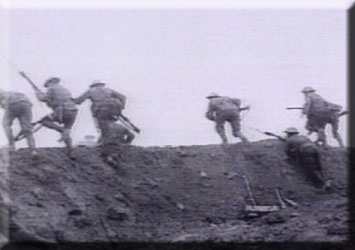
South bank of the Somme July 1916 looking towards Curlu, one agonising kilometre east of Cappy. Illustration from 'Illustration' courtesy M. D. Wright

We should have the greatest respect for the soldiers and support staff who had this impossible task - also for the smaller force of Germans who suffered too but gave a good account of themselves. 
For the British, the Battle of the Somme began on July 1st. For the French, it began earlier. They had been committed in depth since August 1914. Among other things, the two years between 1914 and 16  had taught them the value of transport. The small nucleus of 60cm supply railways designed by Prosper Péchot was expanded and updated.
To recognise the campaign, ongoing over two years, APPEVA, the organisation behind the CFCD, held a centenary commemoration from 5th to 8th May this year. It was an atmospheric recreation, with locomotives of the time and people in period costume. Train rides took the public up to the plateau; a short and pleasant ride in 2016 though the journey for the infantry of 1916 seemed neither short nor pleasant.
A Péchot 'wagon-plat' waits by the Somme canal, CFCD May 2016. It is in remarkably good condition considering its 110-odd years. The brake operating wheels have been removed; the brakesman has to apply and release the brakes using an operating thread on the bogie. Just seen, a pair of bogie-bolsters are carrying lengths of prefabricated track.

The Battle of the Somme only recaptured a small area, and left a heavy toll. Many go to visit the extensive cemeteries with a mix of sadness and wonder. Over this and the subsequent years of the war, gradually lessons were learned, some more quickly than others.
Baldwin Gas Mechanical 50hp locotractor with admiring British officers! Versions appeared served French and US front-lines. The design was one of a new breed; unlike a steam locomotive which advertised its presence with smoke and sparks, the BGM was relatively discreet. The original locomotive would have had a fuel tank balanced on its 'nose' and  large lamps front and rear.

Modern warfare could not be sustained by gallantry and discipline alone. Initially reluctant to use trench railways the British started their War Department Light Railways WDLR) programme. More use was made of internal combustion engines. Tracked vehicles - tanks - were introduced to sweep away barbed wire and to cross trenches. The French introduced new techniques of attack - meticulously planned bombardment and suitably trained troops.  The Germans too were learning fast so that for a while there was a real arms race; the entry of the USA into the War eventually swung it for the Allies.
Thanks to commemorative events such as this, the British public are finding out about the vast 60cm network of the WDLR which was built to service the Front. Books such as Roy Link's WDLR Album and my biography of Péchot are also contributing to general awareness.

Tuesday, 7 June 2016

Hunslet Quarry Tanks - Nearly finished!

Hi, after a holiday I have finally had a fortnight without interuption to get on with the second batch of Hunslets.  The end is in sight.  The photo shows where the eleven locos are at.  All the chassis run on air, all the platework is now finished and most of the boiler and burner parts are made.

6th June. The stage the second batch is at.
What is left is to fit the gas valve pipe and burner to the boiler, then finish the boiler by fitting the regulator, make the steam pipe and complete the steam circuit by fitting the lubricator. After that, make and fit the safety valve and pressure gauge,  make and fit the water-feed clack and fill pipework,  assemble the firebox, safety valve and bonnet castings, steam test the loco,  re-fit all the platework and pin the cranks to the axles,  strip, prime, and paint - FINISH.
How long will this take, about a month?  So next week I will e-mail  the interested and see if they still want a loco.
Do look at our last post some rather atmospheric pictures from the Somme.

Thursday, 2 June 2016

Somme Centennial

The Battle of the Somme needs no introduction but unlike the British, the French commemorate the beginning of the battle in May rather than July. This explains why we were at the Chemin de Fer Froissy-Dompierre from May 5th to 8th this year. The celebration at the CFCD was a double annuiversary; the centenary of the battle of the Somme and the 45th anniversary of the resurrection of this unique 60cm railway.
The railway was rescued by Jacques Pradayroil and others who formed APPEVA and the Blondin family who for two generations (and counting) have driven the railway to the success that it is today. It is a major site for those interested in the history of the 'Soixante' with an emphasis on military equipment. Even more interestingly, parts of the railway are still on the original alignment set down in the First World War.
We first encountered the railway in the early Eighties before it became so familiar. Luckily, in spite of major investment in a modern museum the railway still holds a lot of its essential character. It was built to move material from the canal de Somme up the steep valley side on to the plain above. To do this it utilises two-stage zigzags and a tunnel (added in the Twenties). When we think that a single mile of Front when quiet required at least 80 tonnes of basic stores a day, (plus engineering supplies) we begin to see how busy such a railway would have been.
May morning 2016 at the CFCD, Somme canal to one side, locomotives including in steam to the other. Photo Malcolm Wright
The atmosphere of this photo captures something of the supply end of a trench railway. Barges on the Somme canal would bring up supplies which were transhipped here before being moved up to forward supply dumps. From there, trains would move at night by petrol power to the Front. 60cm gauge at this, safer, end of the line tended to be properly engineered. At the forward end, rail was laid, relaid and often repaired in a matter of hours.
Kerr Stuart Joffre 0-6-0T  from the West Lancashire Railway visiting the CFCD in May 2016. Photograph Malcolm Wright
Although, thanks to Prosper Péchot, the French had a lead in siege train technology in the 1890s, the Germans as second adopters overtook them. It was the Germans who started the war ready with 1000 miles of track and corresponding material.. The scramble to defend Paris and then the needs of trench warfare had them hurrying to update. In the autumn of 1914, they placed large orders. To the existing Péchot system bogies and wagons were added a simplified Decauville design. As the advance of the central powers threatened their own industrial areas, many orders had to be placed abroad.
The design of 0-6-0 tank engine in the photo above was made both in France (Decauville) and by Kerr Stuart in England. Two differences are obvious even to the non-specialist. The English cousin has a spark arrestor chimney and the platework over the tanks results in a 'three-stepped' side view. Its French relation had a straight chimney and more angular platework, for all the world looking like four 'steps'.
For another chance to see this little darling, the West Lancashire Railway PR4 6SP lies between Southport and Preston and is open on Sundays and special occasions between Easter to October.

The British sector of the Front lay to the north, on the far side of the Somme river. In spring and summer of 1916, they had almost no trench railways, apart from heroic improvisations by the 'boots on the ground' and a system they had inherited from the French. During the battle of the Somme, the War Department Light Railways were formed. The new Directorate of Light Railways placed vast orders. As British engineering firms had their hands full of French orders, they immediately looked overseas to the great Baldwin Works of Philadelphia, USA, among others.
Baldwin 4-6-0T from the Leighton Buzzard Light Railway pictured at the CFCD in May 2016. Photo Malcolm Wright
A total of 486 of these Baldwin 4-6-0T locomotives were supplied to the WDLR during the war.  As with human combatants, many were irreparably damaged by the long and horrific conflict. The survivors were sold off during the years of peace and served in fields, mines and quarries, many abroad. If only this restored locomotive could talk!
If you missed a chance to take a train at Froissy, she will be back at the Leighton Buzzard light railway this summer.
During the celebrations, Malcolm took his model Baldwin 4-6-0 and photographed it beside her big sister, much to the credit of both.

We much enjoyed our days at the CFCD commemoration. Malcolm had brought along an exhibition of 16mm scale locomotives and rolling stock, as used during the First World War, both British and French. We have mentioned the Baldwin steam locomotive. He also took along his Baldwin locotractor, developed to slip unseen to forward areas. Those wreaths of smoke, though atmospheric, made steam locomotives a prime target for enemy guns! He brought along a variety of wagons, both French military and WDLR, made from Wrightscale kits. He had come along with what he thought was a life-time supply of Péchot wagon kits; visitors were so delighted to see the models appearing beside the prototypes that Malcolm sold out! He has had to order more.
The photo below is a homage to the Péchot System. Sarah was beside Malcolm with her book 'Colonel Péchot: Tracks to the trenches' and was delighted with the many opportunities to discuss his work with people who could actually see examples outside! 
A Baldwin 4-6-0T in steam heads up a train outside the CFCD engine shed. Wreathed in drifting smoke,can just be seen a pair of Péchot bogies carrying portable track. Behind again is a Péchot flat wagon with its distinctive  stanchions and behind that is a Péchot wagon carrying a newly built reconstruction of an inspection vehicle built in the 1890s. May 1016. Photo Malcolm Wright
Outside the exhibition area can be seen a true homage to Péchot's work. When a French army base closed its 60cm gauge network, the CFCD was given a number of Péchot wagons and other material, dating back to the 1890s! It is a tribute to the resilience of the design that it could be put back to use. Bogie bolsters still carry 10m lengths of portable track as they would originally. The ten-tonne Péchot wagon in the photograph still looks good for its age. Just to prove its load-bearing capacity, the Péchot wagon behind has been rebuilt to a Belle Epoque design as an  Inspection Coach as used by the French high command and President. This was just finished for the May commemorations and we were able to watch this train leave the station and proceed up the line with Sarah onboard (a real priviledge). She was able to watch the original wheel brakes being screwed down as originally designed. It may have been a slightly rough ride for the President of France, but he was truly safe!
Come to Froissy to see this historic material . If you are in the west of France, you can see Péchot wagons in service at the chemin de fer de lac de Rillé, another place worth visiting. It has been mentioned in previous blogs.
CFCD May 2016. In authentic French costumes of the 1916 period, a re-enactment society pose beside a model of Etampes station commemorating its contribution to the War. Photo Malcolm Wright
This photo gives an idea of the hall devoted to models. We are just off to the right, in a good position to catch the re-enactment society in its pose beside the TEE exhibition. At the left were exhibits from the Confrerie des Amateurs de Vapeur Vive which put steam of the first world war period into historic context.  The poilus and  NCO in the photograph represent the infantry and Alpine troops as well as the soldiers who contested the area. As you can see, the French army greatcoat is pinned up during the day for ease of movement but at night could be opened out to provide a blanket for the legs. The coats are French horizon grey, similar to trench railway liveries of the period.The soldier far left wears a 1916 uniform, far right the uniform is a modern reconstruction (not the brighter blue) The bright red trousers have been abandoned in favour of sober grey - for obvious reasons.
Though uniforms and conditions improved during the war, French losses, not to mention other Allies and Central Powers, were terrible. When visiting the Little Railway of the Upper Somme, (one of the names of the CFCD) there are a number of memorials to the fallen which should be visited.All in all, this was quite an experience.

Friday, 22 April 2016

The Froissy Centenary 5th to 8th May

The Petit Train of La Haute Somme is having a centenary commemoration from Thursday to Sunday 5th to 8th May. There will be steam locomotives running beside the Somme canal,  train rides up to Dompierre on the plateau above, costumed re-enactments and models galore. Wrightscale will be at the party with an exhibition of First World War models.
Wrightscale Baldwin 4-6-0 The British army (War Department) prototype did not appear at the battle of the Somme but it was conceived at the time. Photo M.D. Wright
60cm gauge railways were used at the battle of the Somme and throughout the rest of the First World War. Over the years that followed, these narrow-narrow gauge railways were put to one use and then another until they became the Chenmins de fer Froissy-Dompierre CFCD. Come to enjoy an atmospheric train ride!
To the British, used to the claim that the battle of the Somme started in July 1916, the question may be 'why are the French commemorating the battle in May?'
French and Joffre at a meeting of the Allied generals. Three such took place on the 6,7 and 8th December 1915. From Illustration magazine
There is a good reason. The battle of the Somme was planned late in 1915, and the French did a great deal of preparation before July 1916. The French spent the winter and spring preparing transport in the Somme area. After February 1916, they were also fighting a desperate battle to hold Verdun, but they wanted this 'diversionary' front opened and kept pressing the British for support.
In my book Colonel Péchot: Tracks To The Trenches, I described how an artillery officer, Prosper Péchot had devised a system of portable 60cm railways for supplying their Army (and Navy). An updated version of the système Péchot was used to supply the French fronts while the German Army had their own Feldbahn system.


Why was the Somme chosen for a joint British/French offensive?
It was a relatively quiet area. The British intended to have their volunteer army fully operational by late summer 1916. They would be to the north of the river Somme, the French more-or-less to the south. The original purpose, as stated by Joffre in December 1915, was to paralyse German communications east of St Quentin. When Verdun was attacked in February 1916, the French purpose changed. An attack in the Somme area would provide a much-needed diversion for the hard-pressed garrison, and the sooner the better. The British went along with them.
Map of the river Somme and canal east of Amiens (where railways top and bottom left converge), showing communications. The hatched line shows the Front in autumn 1916. Bray and Froissy were almost at the node of the action. Péronne is to the east of the Front, where the two railway lines (top and bottom right) converge. 60 cm rilways have been laid, especially to the south of the Somme in the French sector. From a contemporary map, courtesy Terry van Winkle
The French 6th Army (Nord) was responsible for the southern sector ie from the Somme river to the standard gauge Amiens-Chaulnes railway line. Their objective was Péronne, held by the Germans.
French preparations were thorough. Their 6th Army (Nord) was being supplied by three 60cm gauge systems X, C and B and a fourth, A, under construction. Their Line B ran by the Somme canal and through Cappy and then north over the Somme towards Hem-Monacu. 
The 6th Army (Sud) from Chaulnes to Montdidier had systems D, E, F, G and H. The 10th Army, south of Montdidier down to the department of Oise, ran I, J, K, L and M. They are described as systems; as well as running from a viable standard gauge or metre gauge line to the frontline area, they had laterals and escape routes connecting them. 
Until the battle was well underway, the British had almost no 60cm trench railways. It was still the era of Kitchener and a robust belief in road transport. The grand plan, worked out in 1914-15, involved building standard gauge railways and canals to supply the Army. Indeed, these were built and were ready by .... 1918, long after the War was supposed to be over! In short the British had one completed 60cm line, running towards Thiepval, basically a legacy from the French Army.

When you come to Froissy, there are a number of other sites in the Somme that would interest.
The Thiepval Memorial. Photo courtesy of Pierre's Western Front, New Zealand.
This is a cemetery, so worthy of respect. You may notice its dramatic situation. This was itself part of the tragedy. Our soldiers  were fighting uphill. What a splendid, if short-lived sight they must have made! You will notice that this picture was taken by a New Zealander. One century ago, many ANZACs were fighting for the Mother Country.
The British left flank was held by Newfoundland Canadians at Beaumont Hamel. 
Beaumont Hamel July 1916 Photo courtesy of Newfoundland and the Somme, an organisation commemorating the sacrifice of so many Canadians
The Canadians have loyalties both to Britain and France, and so a relatively large number joined, in comparison with the population. 
Photo Courtesy of NFLD - Beaumont Hamel Memorial
Beaumont Hamel, then and now - a chance to pause and reflect.


Wednesday, 6 April 2016

Packing for the 16mm AGM Show

This is just a short post to show you all that now I am back in the workshop some progress is being made. In my last post, I told you how the chassis were all running on air. Well now they are finished.
They are done! The batch of Wrightscale Hunslet chassis are ready for painting.
This brings me to the Show. Hopefully, we'll have the opportunity to meet our customers, past, present and to come. We are bringing with us a good supply of kits, Péchot cranes and wagons and WD bogies, most complete with wheels.
I am sure you will have noticed the nice resin WD wagon body kits available from Swift Sixteen. Finishing them with our WD bogies being made of white metal makes a good wagon kit into a superb one!
We will also be bringing a few of Sarah's books, Colonel Péchot: Tracks To The Trenches. We thought we'd take the opportunity of marking our 25th anniversary of being in Scotland and coming down for the AGMs by offering 16 Millers a good, 25% discount ie £27.50 at the Show. The end is in sight. The book will soon be out of print so take advantage of this opportunity.

Friday, 1 April 2016

Workshop - getting there.

Since the last workshop post at the New Year a lot has been happening in our day to day lives.  We have had to spend far more time looking after the affairs of my 97 year old mum.  Most weekends and a couple of weeks we have been away working on her old house and/or waiting in for estimators.  I am sure a lot of you will know the amount of time this all takes.  Beside this we try to see her every week so not as much time as I had intended has been spent in the workshop trying to reduce our ever lengthening interest lists.
1st April 2016  The stage all 11 Hunslets of the second batch are at.

Any time I have found has gone into the second batch of Hunslet quarry tanks.  I had hoped when I last wrote to have them finished by the AGM next weekend.  Well the photo shows where I have got to. They are not finished.  All the 11 chassis in the batch run beautifully on air and most of the platework is finished. 
Next week I will get the slide bars and motion plates on complete the chassis.  Still to do are the boilers, burners, valves and fittings, fit the smoke box and firebox castings, finish assemble, test and paint.
I hope this will all be done next month.  It sounds a lot.  However it is not as time consuming as the stage just finished. Each chassis involves making a lot of parts, drilling and tapping 60 or more holes. Fitting all the nuts and bolts ......... The only way to do this economically is by batch building. The downside is if anything goes wrong - say a broken tap, the problem has to be sorted before you go on. Hopefully we will get to the end soon.
The end point!

Wednesday, 30 March 2016

See you at the 16mm Society AGM Peterborough April 9th

As you know, we love all things 2' or 60cm gauge. Malcolm is coming with 16mm bogie kits for  WD wagons and French Péchot system wagons. He will have examples of his WD Baldwin 4-6-0 live steam locomotive and best of all, you will be able to see progress on his latest batch.  (of Quarry Hunslets)
Wrightscale WD Baldwin 16mm model

Sarah will come with copies of  her biography of Colonel Péchot. If you are mean, you can browse the inspection copy, and come away with information about the man who changed history. If you already have a copy, please come anyway and record your reactions, and any new information. She will bring along her notebook and you'll find your views on tour blog in due course. If you haven't already got a copy of Colonel Péchot: Tracks To The Trenches, buy one at our special Show discount.
Colonel Pechot: Tracks To The Trenches Hardback, 259 pages, about 300 illustrations including drawings and contemporary photographs RRP £36.75 Discount at Show
What is the link between Malcolm's and Sarah's interest?
Malcolm was the first to be hooked. Survivors from the First World War ended up on small rural and industrial lines in Britain. Ancient rolling stock and locomotives could be found when we were young, holed up in Penryn, the Great Little Trains of Wales, Amberley or across the Channel at Froissy. These were tiny kingdoms of track, remote and romantic. How could a fellow resist?
The romance of 2' gauge Photo MD Wright

16mm quarry Hunslet model. Come to the Wrightscale stand at Peterborough and see how it has progressed since January!
Sarah' first reaction was: 'Why?' Why did an idea born on the Festiniog Railway in Wales get taken up in France? Why and how did 60cm gauge become so important? Who was Prosper Péchot, and how did he manage to persuade the entire French Army and Navy to adopt his Péchot System?  
The celebrated Péchot-Bourdon lococmotive. Photo courtesy of Raymond Duton

Why did all the combatants on the Western Front develop their own versions of 60cm field railways? Why did networks rivalling in scale the trans-siberian railway just all disappear?
What could she do but embark on a book! We hope that it helps to answer some of the questions you may have.