In this blog, we find a connection between a campaigning
Daily Mail Journalist and the War Department Light Railways.
16mm model of a War Department Class D wagon built by MD Wright using Wrightscale bogies
A standard War Department class D wagon rated
at 9 tons 18 cwt (hundred weight) could carry as much as 120 mules (assuming
the standard loading for an equine of 70 kilos.) A railway wagon could be left outside, shot
at, be tipped over and of course it did not need regular food and water. Liz
Jones, formerly fashion editor at the Daily Mail campaigns for the welfare of
what she calls ‘equines’ ie horses, donkeys and mules. She doesn’t seem to know
it, but she should regard the War department Light Railways as a great leap
forward in horse welfare.
As stated in previous blogs, the WDLR was an arm of the Army
Transport Corps. It was commissioned in September 1916 as the Directorate of
Light Railways, headed by Sir Eric Geddes. There was already a Railway
Operating Division, but it was small, lacking in prestige and funding. It was
absorbed into the new organisation which had the backing of Lloyd George
himself.
Thanks to its powerful backers and no doubt to the chagrin
of the Quartermaster General, the WDLR was able to put in huge orders for track, rolling stock and
locomotives, all in 60 cm gauge. Some might have questioned the use of dodgy
foreign measurements for a good British railway – weren’t feet and inches good
enough?
This German gun was clearly designed to be towed to the Front by a horse, poor thing. Photograph of a captured gun from 'Illustration' Magazine; image courtesy of MD Wright
For two years, politicians and ‘top brass’ at the
British army tried to ignore the fact that the French had a comparatively efficient way of
supplying their trenches. in 1916, as we see below, they were forced to find an efficient way to transport supplies. It was important a/ to borrow any good ideas and b/
to use a system compatible with the French one. Thus 60cm gauge was chosen for
the new portable railways. It was light enough and adaptable enough to be laid
quickly with comparatively little groundwork. Conventional railways took years
to build. These could be pushed out in weeks. Prefabricated lengths of rail could be laid down, almost like toy Hornby
track.
What had the original British plan been? The war envisaged
by the generals had never included trenches. True, a trenching tool was part of
each foot soldier’s kit, to be used to dig in while consolidating a position
before an advance. This advance was to be supplied by lorries on the road and
equine transport elsewhere.
Lord Kitchener, Chief at British HQ insisted on leaving a 2’6” railway system
in Britain,
though the Royal Engineers suggested it would be useful. It is said that he
told a manufacturer of light railways ‘This is not our way of doing things’. It
is not a coincidence that the War Department Light Railways were formed soon
after he went missing, presumed dead.
But we return to the situation in autumn 1914.
Allied troops are digging in. The photo was taken in spring 1918 when the German advance nearly broke through Allied lines. Image from Illustration magazine; courtesy MD Wright
The temporary trenches became permanent. At first, it was
the enemy, then the French, then the British Expeditionary Force. It was called
the race to the sea. Soon a trench system stretched from the Channel just in the north to Switzerland
in the south with few gaps. The Germans in fact took the initiative and chose the best
ground! British stories about trench warfare are all about mud whereas
captured German positions tended to be snug and well-drained.
Suddenly, almost a million soldiers on each side needed
everything, but everything, brought to them. This included spares and ammunition
of course, but also food and drinking water, not to forget the rum ration. In
addition, to stave off death from mud, rats, disease and exposure, serious
quantities of timber etc had to be brought in.
The French soon had a relatively satisfactory trench supply. They adapted a portable railway system, first officially
adopted in 1888. The official name was système artillerie 88 but it was always
popularly known as système Péchot after Prosper Péchot, an officer in the
French artillery. It was a bit old-fashioned and neglected, but with a huge
effort, they increased and modernised their stock.
16mm scale model of a Péchot-Bourdon locomotive. The prototype was designed by Prosper Péchot for his system. The model was built by Henry Holdsworth and the photograph taken by Jim Hawkesworth
The Germans were the best prepared. They had a thousand
miles of 60cm gauge rail and rolling stock to match. To run their military railways they had a regiment or so of
Eisenbahnpioniere/ railway engineers, ready trained. They saw what the French
were doing and between 1888 and 1914 had been developing and improving their
system. During the War, they refined and improved their system.
This phtograph taken by Eric Fresné in the 1960s shows a German 0-8-0 tank Dlok and the remains of a Brigadewagen, boith used in the First World War. The decay is a sad sight, but better than seeing the remains of once-live horses. Image is courtesy of Eric Fresné
Between 1914 and 15, the
situation in the British sector of the Western Front was wretched, but not so bad that Top Brass needed to take notice. With heavy reliance on equine power, matters at the Front were disgraceful. Because the British trenches tended to be
overlooked by the Germans, mule trains and General Service wagons could only be
moved by night. My grandpa, then a junior officer in the Royal Engineers,
recalled that it took about four hours to move a wagon, pulled by four mules
and two human attendants the two miles to the trenches. The roads were in a
dreadful state, so everyone was soaked and muddy. Then an equally perilous
return journey had to be made by daybreak, all to transport 30 hundred weight
of stores (roughly 1.5 metric tonnes).
Ms Jones reports that 1.36 MILLION horses and mules were taken from Britain, Canada and other parts of the
Empire to provide the labour. She is indignant; perhaps
not indignant enough. The horse has been trained up by evolution to live on its
nerves. When a member of its kinship group senses danger, it uses its fabled
speed to run away. It is thus, even in the best circumstances, only easy if it
has horsey companions. Conditions as a working animal are very different from
the open steppe and each horse has to be ‘broken’ to fit into human society.
Ideally, this breaking in should be humane, but of the 1.36 million equines
dumped into the Western Front area, we can’t be sure that this was so for them
all.

This picture by Georges Scott shows what could be expected of horses on the Western Front, though highly romanticised. Horses towing a gun carriage are charging the enemy. As a matter of prosaic fact, horses or mules were usually put to work hauling supplies. Image from Illustration magazine courtesy MD Wright
There may well have been many horses which were forced to undergo further
‘training’ for the specialist conditions at the Front; the motorised traffic,
gunfire, even being confined for days on end in stables. Bad though being confined indoors might be, it was preferable to working conditions.
When my grandpa mentioned mud on each side of the road,
‘mud’ was a euphemism for the slurry generated by rotting corpses. He recalled passing
dead horses on the journey. It happens that the horse family is particularly sensitive to the stink of death. Horse
lovers tell each other stories about horses seeing ghosts. I can well believe
that they smell them. It is reasonable to suppose that evolution selected them to be wary of corpses. Animal remains were a warning that predators were around. I
wouldn’t like to speculate about the feelings of the mules edging their way
through darkness, passing rotting corpses, but it is fair to empathise in their
feelings of distress.
The horses were correct to feel fear, the worst sort of
fear, helplessness where neither fight nor flight were an option. In the German
trenches nearby, there were snipers. They were skilled enough to ‘get the
range’ of a target when the wagoneers made a first noise and to get in a
surprisingly accurate shot when they made a second. The humans knew that whatever happened, they must not make a sound. This gave them an element of control and therefore lessened their stress. A horse or mule could not be expected to understand this and their stress was increased.
Ms Jones remarks that of the equine survivors after the
Armistice 1918 ‘most were left behind’. Some, especially beloved cavalry horses
such as War Horse, were shipped back . Ms Jones would not be
reassured to learn that left-over horses and mules were comparatively rare.
Most added to the questionable mud at the Front.
This painting by Georges Scott shows a French 155mm 'long' gun being towed by a lorry. A lorry was good for occasional use but it was thirsty for fuel and chewed up the roads. Image from Illustration magazine, courstesy MD Wright
All through 1915, a vast army of volunteers was training in Britain.
If the comparatively small British Expeditionary Force had gobbled up a million
mules, how were all these new soldiers to be supplied? The British looked at
their French neighbours and German opponents to see the answer. Top Brass were
still obstinate. They demanded more lorries. The only trouble was, the lorries
needed fuel. The buses taking munition workers to the factories back home
needed fuel. There wasn’t enough for both.
David Lloyd George, who had characterised himself as Mr
Fixit, called in Sir Eric Geddes. When Geddes proposed a British version of 60cm railways, the politicians were at last receptive and the WDLR was born
When the First World War ended, 60cm gauge was so widespread
that thousands of surplus locomotives and rolling stock remained at or near the
Front. They were sold off and used for agricultural and industrial work.When they were worn out, they were abandoned. This picture taken at 'tacot des lacs,' a former sand extraction plant in 2010, shows a 60cm gauge diesel gently rotting away.
As we reflect that what was good for people was also good
for animals, we might spare a thought for the machines used to replace the animals.
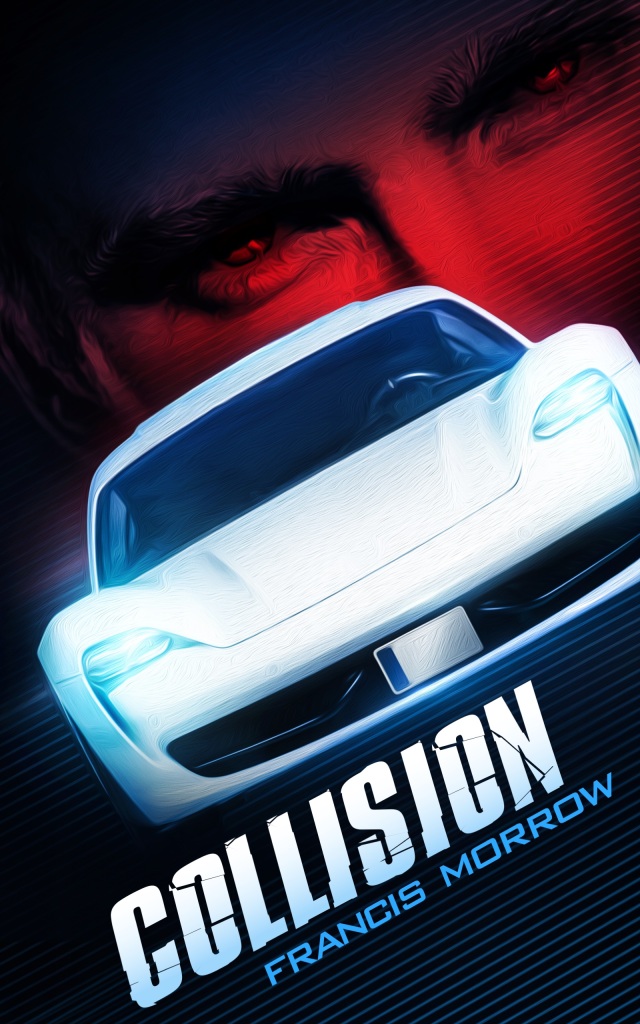
What if they have feelings too? We mentioned ‘Collision’ in our last blog. In the story, an
autonomous vehicle is faced with moral dilemmas. When a machine has
sensibilities, is it moral to destroy that machine, or even to subject it to
the IT-equivalent of a lobotomy? Is the next stage after Animal Rights, the
Rights of Machines?
You might be interested in these.
For the story of military narrow gauge: Sarah Wright Colonel
Péchot: Tracks To The Trenches Birse
Press 2014
If you are interested in the fate of war surplus 60cm
material, Eric Fresné has written the book for you: Eric Fresné 70 ans de lignes betteravières en France LR Presse 2007 (French Language)
For the horsey aspect: Liz Jones The Exmoor Files: How I lost a husband and
nearly found rural bliss Phoenix/Orion 2010
Jones lists a number of good horse-orientated charities.
Francis Morrow Collision 2020 Amazon Editions