Friday, 21 April 2017

News from the 16mm AGM


We had a good day at the 16mm AGM. We had a chance to display our wares and talk to old friends and new. Most importantly we had a chance for feedback – the information and suggestions which are the life-blood of our partnership. So here is some feedback.
One of our sharp-eyed customers noticed that we gave contradictory emails in our catalogue. Well spotted! There are two emails which will reach us:
The safest one to use is our gmail address. We apologise to anyone who used any other address. Please try again with the aboyne.workwright@gmail.com.
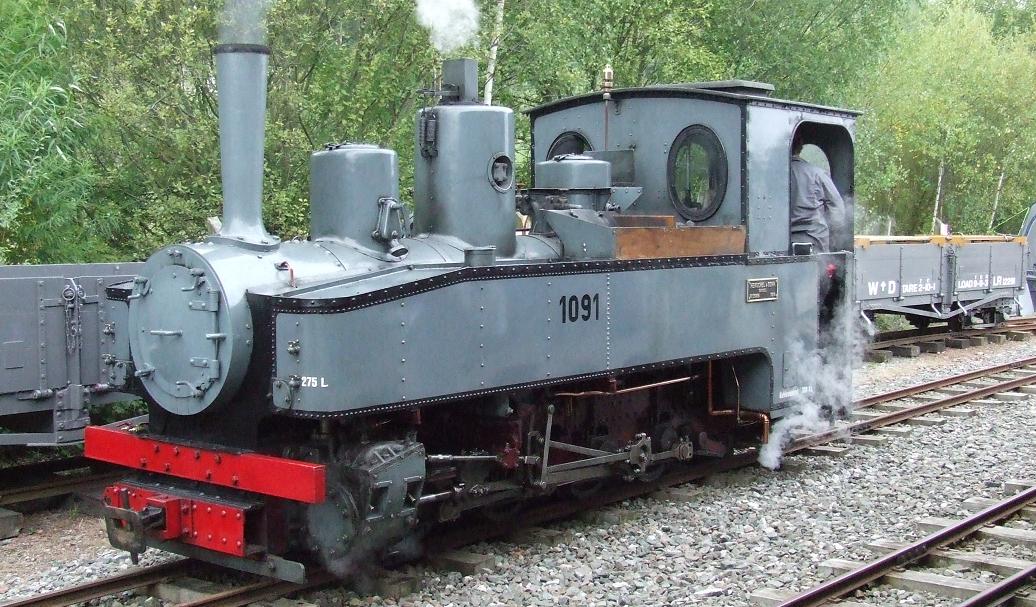
A preserved Péchot bogie wagon. In recent years, these have been released by the French army to preserved railways around France. Malcolm's 16mm models have therefore become very popular. 
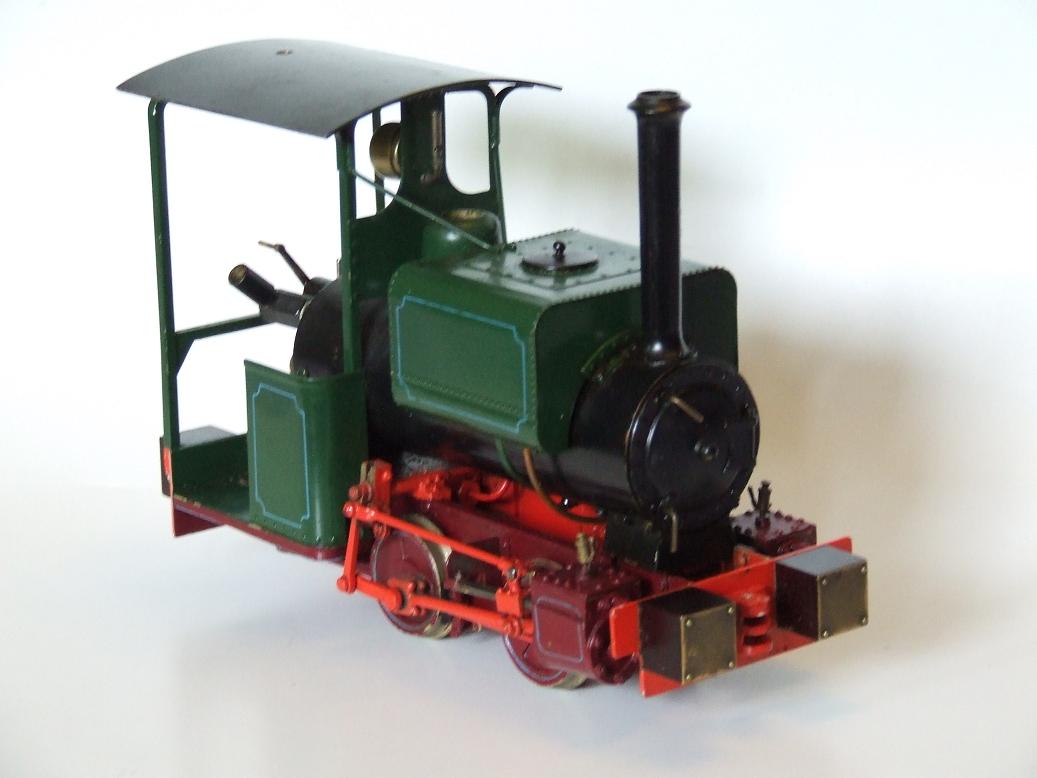
 Other feedback concerned our War Department and Péchot (French military) bogies and wagons. These have proved to be very popular and have been the subject of many enquiries. Unfortunately, Adrian Swain who was the source of high quality castings, has definitively retired. We wish him many long and happy years.
Malcolm has been looking for new ways to fulfil demand. There are WD bogie kits available from other manufacturers, though not in white metal. As ever, we heartily recommend Binnie glass-fibre resin wheels for your WD bogies.
Swift Sixteen are producing Péchot wagon bodies in resin.  Malcolm and Mr Bushell of Swift Sixteen are going to collaborate to make Péchot bogies available in a combination of resin and laser-cut parts. We are going to collaborate with South East Finecast to produce bogie parts. Watch this space!
We have released a 16mm scale slab truck kit, based on the ones which were used in the salte quarries above the Talyllyn railway. Price £18 Components are laser cut Perspex, metal and wheels in glass-fibre resin.

New for the show! Slab truck 16mm kit. Photo Malcolm Wright
A number of customers asked us about progress on our 'Wrens' These are going ahead, though there has been a hitch. Our original supplier of etches is moving out of the enthusiasts' market and we have to transfer the phototools to a new supplier and update the technology. Since Malcolm always has something on the go, he is producng a small 'catch-crop' of Bagnall 'Excelsior' locomotives.
A Wrightscale Bagnall 'Excelsior'. Malcolm is producing a small batch of these. Photo Malcolm Wright
We made a new friend, Pauline Hazelwood of Saddletank Books.  Her aim is to introduce a new generation of young people to narrow gauge steam. Rev Awdry with his ‘Thomas’ series still sells well, but Pauline concentrates exclusively on locomotives which have been rescued and appear on preserved railways. She has written about Peter Pan (Kerr Stuart Wren 0-4-0T) and Alice (open cabbed Hunslet  0-4-0T), to name but a few. Perhaps one day, she will write a book about the 'Excelsior' story.
Pauline Hazelwood has written five books for the younger enthusiast. The 'Alice' class quarry Hunslet  features in two of them. By kind permission of the author
In her career, Pauline moved from portraits to commission to book illustration and then to writing and illustrating her own books. www.saddletankbooks.com  Each story in the Saddletank series is based on a narrow gauge locomotive – its original purpose, the rescue once the line closed and its new purpose on a preserved line or as a museum exhibit. There has to be a ‘happy ending’ to attract children. Her aim is to educate as well as to entertain; her motto is ‘if you draw, you see more’. She is particularly keen for girls to get involved. Who knows where a mechanical bent could lead them?
A 16mm Wrightscale cabbed Hunslet pushes a slab truck, as was used in the slate quarries served by the Talyllyn railway. Photo Malcolm Wright
I can’t tell the story of the Talyllyn railway with the charm of Pauline or the Rev Awdry, but it is an interesting one. The railway ran from 1866 until 1951, the purpose being to transport slate out of Bryneglwys quarry down to the port of Tywyn (Towyn as it was then called). It was 6 miles 50.75 chains long (6 5/8 miles/10.4km approx) with heroic gradients and bends. It survived closure several times but at last in 1951, all seemed lost. Then a group of volunteers took it over as the first preserved railway in the British Isles. Its original locomotives, Dolgoch and Talyllyn, were joined by two from the Corris railway, Sir Haydn and Edward Thomas. They can still be seen today.  
"Dolgoch" 0-4-0 T was built in 1866 by Fletcher, Jennings & Co., but to a very different design to that of "Talyllyn". Photo courtesy Talyllyn Railway
The scenic little railway provides a delightful prototype for the 16mm modeller. Alright! I know! Dead-scale models would not, strictly speaking, run on 16mm scale track because the gauge of the Talyllyn is 2’3” rather than 2’.When it comes to modelling, people are happy to stretch a point. (For example 2’ gauge is used almost interchangeably with 60cm though it is ½” wider.) So Malcolm has produced a slab wagon which would be an addition of character to your 32mm gauge railway, especially if it runs through a scenic rockery.
 Edward Thomas, 0-4-2ST, was built in 1921 by Kerr, Stuart & Co. Ltd. for use on the Corris Railway. It was transferred to the Talyllyn when the Corris closed. Photo courtesy Tallllyn Railway.

Monday, 27 March 2017

Wrightscale at Peterborough 8th April


Malcolm and Sarah are looking forward to the 16mm Association AGM. As well as discussing progress on the latest batch of locomotives, we are unveiling our new design, a slab wagon kit.
A 16mm Wrightscale quarry Hunslet poses beside a quarry slab truck which will be available at the 16mm AGM on 8th April 2017
We are totally committed to putting more wagons on to your layouts! All too often, enthusiasts, whether in 16mm scale or another, concentrate on the locomotive. They boast about its head-shunts, its zigzag doubles and its American triangles. Yet all this locomotive activity, this showing off even, is quite meaningless without rolling stock, which I see as the female yin to the locomotive yang. One complements the other.  Running a locomotive around the track makes no sense if it is not ‘on the pull’ so to speak. No wagons and carriages, no sense.
In spite of this common-sense observation, most books concentrate on locomotives. Rather typical is the comment on an Ivo Peters photograph taken at Dinorwic (Dinorwig) quarry in 1956. A Quarry Hunslet 0-4-0T built 1889 is pulling at least seven four wheel ‘three a side’ wagons, filled with quarry waste. They are coming out of a tunnel with a neat ‘locomotive chimney’ cut out of the rock. The caption (by Cliff Thomas) tells us all about the locomotive, nothing about the train of wagons.
Even Thomas the tank engine knew that his trips were in vain if he were not accompanied by Annie, Clarabel and the rest. J.I.C. Boyd is an enlightened commentator. ‘Wagons carried supplies not only to ensure the survival and well-being’ of inhabitants of remote communities but their ‘overall purpose was to carry away the products’. The Talyllyn Railway WSP Oxford 1988. The book even describes such wagons as a ‘shy, coy species’. So let’s say it for rolling stock! A world that consists only of locomotives will last as about as long as one inhabited solely by men.
For years, Malcolm has been known for locomotives on the lines of Peter Pan, Guy, Hummy and King of the Scarlets. But his very first project was the WD bogie, that versatile base for the thousands of wagons which supplied troops in the trenches of the Western Front 1916-18. Some of these War Department Light Railway bogie wagons did return to Britain to be used on narrow gauge lines such as the Ashover but there were already thousands of wagons in Britain, already working on 2’ nominal 60cm gauge track.
A Wrightscale 0-4-0 Quarry Hunslet pushes a train of slate wagon. The pattern of 'three bar' slate wagons and 'flats' were seen in various quarries. Photo by Malcolm Wright on a slate quarry layout he created.
The slate quarries of North Wales were early in using narrow gauge as an economical way of transporting heavy materials. Indeed, they were using wagons long before locomotives were available. Like the coal mines of North-East England, they were situated conveniently above the sea. Once rails were in place, trains of wagons could run down to a port using gravity. A horse was merely required to pull the ‘empties’ back up. That was the theory anyway. Obstacles lay between the slate and the sea. Locomotives were needed so that loads could be pulled uphill. As these were commissioned, the world came to admire. Paul Decauville for example visited the Festiniog (Ffestiniog) Railway more than once in the 1870s. Although Prosper Péchot 1849-1928 never came in person, he used ideas from Festiniog in his Péchot system. Years later, this French field railway system inspired the WDLR mentioned above.
Thus the narrow gauge quarry railways of Wales cast a long shadow over world history.
Bryneglwys slate workings, situated above the Talyllyn Railway, have a historythat is typical of slate quarries. There had been some quarrying for local needs, but in 1847, advertisements appeared in The Mining Journal for subscribers to a company which would extract ‘beautiful light blue slate’. Engines for truck haulage and a mill for dressing slate would be powered by two local streams. A road would transport the slate to the river Dovey thence to the port of Aberdovey’.
When the Tallyllyn Railway was proposed in 1864, it made more sense to use it to transport freight. (Confusingly for the anglophone, there is a Brynglas Halt well below the Bryneglwys workings. The Welsh would not be confused. Brynglas means Blue Hill. Bryne-yr-Eglwys means Church Hill.)  Another ‘health warning’: the Talyllyn Railway was built to 2’3” gauge compared to the 2’ gauge of many other quarry railways.
They say that a mine is a hole with a liar at the top but John Pughe the promoter of Bryneglwys uttered one truth. The ‘mine’ had the potential to produce £15,000 worth of slate for the next 15 years. The only trouble was, it required much capital, both for the workings themselves and the ingenious series of inclines taking material down to the railway. Boyd in ‘The Talyllyn Railway’ has an excellent account.
Originally, there were over 100 slab-wagons used in Bryneglwys Quarry - by the time the workings closed only about 8 remained.  They were also known as bogies, cradles or sleds. They were mainly used within the workings to bring out slate as far as the mill where it was split, sawn and dressed. The slab trucks were therefore mostly to be seen emerging from the slate workings, waiting at the mill or around the upper sidings of the Talyllyn Railway. A few cheeky escapees might hitch a ride down the valley or ‘peep shyly’ from sidings along the way.
Small but mighty! 16mm scale slab wagon from the front, made to a pattern used on the Bryneglwys Quarry /Tallyllyn Railway. Though tiny in comparison with the compact Quarry Hunslet, it could carry nearly two tons of slate.
The slab truck itself consisted of a wooden frame on four wheels, with coupling hook. Frame members were extended beyond the stretchers to form rudimentary buffers. On top were four cross-bearers, also protected by iron strips. The bolt heads on the bearers of the model in the photo show how the protecting strips were fixed. The wagons were very small, length 6’ x 3’6” (1.8 by 1.05 m) and the wheelbase only 2’ (60cm). They carried 1.8 Imperial tons (about 1.7 tonnes).
Historians have struggled with lack of information, but it is believed that, unlike the carriages, these slab wagons were built on the site, using standard parts eg wheels, axle boxes and coupling hooks. There was a saw-mill on site which could supply finished timber. It is just possible that some were originally fitted with hand-operated brake, like the slate wagons that were used on the Talyllyn railway itself. If such hand-brake slab-trucks ever existed, they had all perished by the 1940s.  On page 297 of the Boyd book is a photo of slate wagon - it shows how a brake might have appeared. Contemporary accounts are also silent about colour. When asked, people who remembered the railway tended to say ‘Oh, red!’ Further research suggests iron-red undercoat for the slate truck with, perhaps a top coat of the cheapest and most durable pigment – black – certainly for wooden under as they served remote communities. A train coming up-valley might carry flour and beer for human consumption, engineering supplies and timber. Down trains would certainly carry slate but also ‘empties’. People, on varying errands often hitched rides on freight trains. The wagons are half the fun and all the story of one of these little railways.

Saturday, 11 March 2017

Colonel Péchot, a melancholy centenary


One hundred years ago this month, Prosper Péchot retired. This was for the second and last time he returned to his civilian home in Paris.
1917 is full of melancholy anniversaries – Passchendaele, the Chemin des Dames, Caporetto, Russia. Why should the retirement of a French artillery Colonel matter?
We believe that although his youth was behind him and he served for only part of the War, he was a significant figure in a hugely important war. Without the ideas that he had promoted back in 1882, the ‘industrial’ scale of warfare 1914-18 was not possible.
Prosper Péchot in 1907 with his Légion d'Honneur. Photo courtesy Raymond Péchot
While still a junior officer in the Franco-Prussian War, 1870-1, he realised that a modern army needed vastly updated transport. The Prussian breech-loading gun, with a range of up to 2.5 kilometres and its percussion-cap shells, was generally considered a war-winner. In fact, it was only as good as the supply of such ammunition. Getting guns within range of the enemy meant that they were usually at a distance from railways and canals. Transporting ammunition by road was a problem. In the days before metalled roads and tracked vehicles, those last few kilometres were a real headache.
The Prussian gun 1870-1, manufactured by Krupps of Essen. This took 4 kilogram shells and could fire at the rate of two per minute. It was superior to the equivalent French 4 kg gun because it had a longer range and a percussion cap rather than a fuse. Firing at the rate of twice a minute, it required 480 kg of ammunition a hour! Photo courtesy Hachette/SM Wright
At Staff College, Péchot had come up with his system of 60cm portable track and special rolling stock. These could be rapidly laid and take large volumes of freight. Between 1882 and 1888, he fought hard, at the expense of his career, to have it accepted. It was, to be known as artillerie 88. For the next 26 years, there was little further investment. In 1910, Colonel Péchot was retired.
Before 1888, the Germans had been flirting with other gauges. In that year, they suddenly adopted 60cm gauge portable track and very similar rolling stock. In fact, by constant practice and training, they improved their feldbahn system. Portable track, for example, was only used in initial stages. They produced the splendid 0-8-0 D-Lok. In 1914, these were more modern and more numerous by far than the French artillerie 88 locomotives.
D-lok Built in thousands. In 1914, the French had a maximum of 60 ageing locomotives for their equivalent system. Photo courtesy MD Wright - taken at Apedale Staffs.
In August and September 1914, the German invaders streaked through northern France. Paris itself was under threat. In the general mobilisation, Prosper Péchot was recalled. General Gallieni had been impressed by his work - in 1896, he had designed a 60cm railway for Madagascar. Though never built, Gallieni remembered the earnest artillery officer and invited him to help modernise the defences of Paris, the camp retranché. Forts and guns were all very well, but the defenders needed supplies in vast quantities. The Péchot system could help.
In fact, by October/November, the German army was withdrawing. Both sides dug in and the Western Front was formed, stretching from Belgium, through northern France as far as Switzerland. Millions of soldiers, entrenched at an average of ten kilometres from the nearest railway station, needed supply. The Germans started the War with a large Feldbahn system. The Allies had to create their own.
Hundreds pf steam locomotives were ordered, but under trench conditions, internal combustion engines were safer. The Baldwin works of Philadelphia produced 600 of these 50hp locotractors for front-line duty. A smaller 35hp version was also produced for the AEF. Photo taken at the museum at Froissy, courtesy Jim Hawkesworth.
Orders were placed for more equipment but there was a need for trained staff. A school was requested on 15th December 1914 and formed early in the new year. Prosper Péchot was to be its director, the school being at Jouy en Josas, south-west of Paris. In fact, by January, two were actually started, one specialising in construction of 60cm railways, the other in how to run them. The construction school was to be directed by acting-major Marcel Prévost, the other by Péchot. Unfortunately, though they had staff and students of several hundred, there was no equipment!
Somehow Péchot got the blame and as early as February 1915, his place was taken by his second-in-commend Lt Col Tricon. The new school of railway management opened in March 1915 at Boissy St Léger south-east of Paris but gradually extended towards Sucy.
Ever eager to justify themselves, Péchot’s seniors – especially General Miquel-Dalton claimed that he did not appreciate the big picture. ‘He did not understand that above all else, he should be satisfying the needs of the army. He followed routines as if it were peacetime.’
Were such comments justified? No; in quick succession, Prévost, the director of the school at Jouy en Josas was fired and then Péchot's successor, Tricon.  Tricon was described as ‘good with reinforced concrete and nothing else’, Prévost as a ‘brilliant writer and academic but…’ (Source Alain Meignier 'Vie et oevre du Colonel Péchot' Do Bentzinger Colmar 2007) Prosper Péchot was reemployed as a Technical adviser – the others, so far as we know, were put to different duties. A cynic would note that as material and rolling stock were gradually supplied by manufacturers, so the service life of the staff at the Schools increased.
In June 1915, Péchot set about re-editing the old cahiers – instruction books – which he had written more than 20 years previously. By July 1916, he was completely rewriting the vital section on tracklaying. To take the traffic required by a modern army, some ballast was required, especially when staff cars and lorries developed the tiresome habit of using the track. He checked this with careful experiments.
The voie sacrée, the road link to Verdun 1916/17. There seem to be as many road-menders as troops. Parallel to the road ran a metre gauge railway, carrying at least half of all supplies. Photo courtesy MD Wright
To carry freight by road, an army of workers was in constant employment, plus a quarter of all the tonnage the lorries carried. To ballast railway track, one cubic metre of gravel was required per five metres, plus occasional maintenance.
Most tellingly, it was Prosper Péchot that the politicians consulted. Abel Ferry, a député (member of the French parliament) recognised his unique skill and took him on his tours of inspection. The French Senate (upper house) asked his advice. He reported to them on December 15th 1916. In 1919, Marshal Franchet d’Esperey, hero of the Bulgarian campaign, sent Péchot a special letter of thanks.
But Péchot had already returned to civilian life. He was informed that he had reached the definitive age of retirement on 4th February 1917 a couple of days before his 68th birthday.

The Péchot System at work in 1890, transporting 32 tonnes of gun across a field. Prosper Péchot is just to the ;eft of the gun barrel. Photo courtesy Raymond Péchot


Thursday, 26 January 2017

Trans-Namibia, the forgotten Railway


We know that thousands of kilometres of 60cm railways were used on the Western Front during 14-18. There was a far-away war which also involved a 60cm railway.
German South West Africa was colonised in the late 19th century, against the better judgement of the then administration, though once Wilhelm II became Kaiser, he was gung-ho for expansion even in this far and unpromising land.
Southern Africa in 1920 showing rivers (including wadis) but not railways. In 1902, a railway 382 km long was built to connect Windhoek to the coast. Courtesy Times Publishing
 GSWA, or, as we now know it, Namibia, is on the western side of Africa, lying between the Orange river - border with South Africa - and (Portuguese) Angola to the north (marked by the Cunene river). The west is a fearsome desert.  Windhuk now Windhoek, the capital of GSWA, is sited on a comparatively fertile plateau, with the Bechuanaland Protectorate (now Botswana) to its east. Before 1914, the only link between Windhuk and the outside world lay either through British or Portuguese colonies/allies or through the Namibian desert. What is more, Walfish or Walvis Bay on the coast, the only good harbour, had been claimed for Britain.
In the teeth of all commonsense, the German colonists determined to use Swakopmund, a small and rather poor harbour just north of Walvis Bay as their port. The link with the interior would be by ox-cart! Oxen were duly used, struggling up a dry river–bed, using water from the irregular rainfall. The territory was that of the fierce Herrera who, for a time tolerated the struggling settlers. Then rinderpest killed off the oxen and the Germans turned to technology. Wilhelm II took a pride in his small colonies and sent a major in his Pioneer Corps to GSWA. A 60cm gauge railway, it was hoped, could be quickly built to link Windhuk with the coast.
Cover design by James Albon
The origin of the Feldbahn (German military railways) is interesting and described in more detail in my book. In 1888, Prosper Péchot had persuaded the French Army to adopt a 60cm gauge system of portable military railways. Indeed, since 1886, exercises and experiments had been taking place around the frontier town of Toul. The Germans were also looking at military railways. In 1888, they abandoned their flirtation with other gauges and adopted 60cm gauge.
Péchot-Bourdon 0-4-4-0 locomotive, first built in 1888. Its weight, evn when loaded with water and fuel was under 14 tonnes so that it could run on portable track. Image courtesy Raymond Duton
In 1889, Péchot’s elaborate bogie wagons and his Péchot-Bourdon locomotive caused a sensation at the Great Exhibition in Paris. At that time, the Germans abandoned their experiments with 2 and 5 tonne locomotives and standardised on the Zwilling 2 x 7 tonnes unladen.
Drawing of Zwilling courtesy Old Steam Locomotives of South Africa Website

In 1897, work started on the Namibian railway. Zwilling locomotives were sent to provide motive power and the first track was portable - a German answer to portable Péchot track. In the fearsome desert conditions, battling sand, dirty water and angry locals, the lifetime of a locomotive was short, but at any one time, 40 or so Zwillingwere at work. The railway Swakopmund-Windhuk was officially opened in June 1902, length 382 km.
The military turned the railway over to civilians to run – as the Staatsbahn – but continued to use it as a testing ground. They learned to use prefabricated track for the first phase of construction, then rapidly to replace it with track laid on sleepers. The German Brigadewagen, maid-of-all-work bogie wagon (originally based on a Péchot wagon) was proved and improved in the hostile conditions. Locomotive tenders were used for supply on long, hot, desert runs and precipitous gradients. The most admired, numerous and successful of all military locomotives, the Dlok 0-4-0 was developed.
By 1914, the German Feldbahn led the way in quantity, quality and number of operators. The French on the other hand had retired Prosper Péchot and their 60cm système Péchot was stuck in a time-warp.
A restored 0-8-0 T Dlok in German Army colours simmers gently on the track at Apedale Staffs. Photo Malcolm Wright
In 1892, rich deposits of copper were found in Tsumeb, Damaraland. The Otavi line (to be run by the Otavi-Minen-und-Eisenbahn-Gesellschaft OMEG) was begun in 1903 but delayed by the Herero war 1904. This was an unequal fight. No-one at the time counted the number of Herero dead, but we can sure that there were many. The survivors later returned as railway workers. Brenda Bravenboer in her book 100 years of State Railways in Namibia p 65 describes them as ‘willing labourers who had endurance’. Tsumeb was 570 kilometres from the sea; this incredible narrow gauge railway was opened to traffic in November 1906.
A particularly interesting new departure was the HD class 2-8-2 tender locomotive (58 tonnes with tender). Three were ordered from Henschel und Sohn in 1912, for the Otavi Railway. This class was to feature in the Great War Namibian Campaign. Many more examples were later ordered from Henschel though they were now known as the South African Railways NG5 class. The last were ordered after the Second World War and continued in use for a total of 50 years!
Botha and Seitz. Henshel 2-8-2 with tender July 1915. Photo from Illustration magazine
Pic Never mind the human drama in the foreground! Behind them is a fine example of a Henschel 2-8-2 tender locomotive. There are lights to the front and rear. The characteristic safety valve with cross bonnet shows up well, but skirts have been added to tender and locomotive, decorously veiling their wheels from sight. The sandbox also is an addition.
In 1910, the process began of converting the Swakopmund-Windhuk line to standard gauge. 60cm material was transferred to replace worn-out stock on remaining narrow gauge lines.
The German administration may have hoped that South Africa with its substantial Boer population would stay out of the First World War. They were disappointed. On 4th Aug 1914, General Louis Botha, Prime Minister of the Union of South Africa, pledged support to Britain on behalf of his country. On 8th August Doctor Seitz, Governor of GSWA, mobilised his small force of 5000. There was deliberate destruction of infrastructure to delay the enemy, which was successful for a time.
In January 1915, an invasion force occupied Swakopmund on the coast. Repairs were required both to the port and the railway.
Dr Seitz, Governor of GSWA July 1915 From Illustration magazine
General Smuts joined the Union Defence Forces on 30th April 1915. The Germans retreated northwards. Windhuk was taken on 12th May – the name was changed to Windhoek.
The Germans requested an armistice, but to the indignation of the Allies, they made use of this as a breathing space and started their retreat up the Otavi section of the line. During June, SA troops advanced and Otavi was captured on July 1st. German forces continued their withdrawal.
More Union Defence Forces were coming from the north and east. The Germans were surrounded. Governor Seitz and Lt Col Franke agreed to surrender. The ‘peace of Khorab’ was signed on 9th July at Khorab farm near Otavi.
Botha and his staff coming to take the German surrender Namibia 1915
The war showed the flexibility of narrow gauge. In spite of ‘strategic destruction’ by the retreating Germans, 358km of 60 cm railway were repaired within 26 days, greatly strengthening the Union advance.
After the treaty of Versailles, GSWA was mandated to the Union of South Africa effective from 17th Dec 1920. Gradually the railways were integrated into the SAR system and official 60cm disappeared. Its last flowering was on private lines supplying the diamond mines in the south.
Namibia became an independent country on March 21st 1990. My belated congratulations to this wonderful country!.

Sunday, 1 January 2017

Holiday in the workshop

Before the current batch of Wrens can be built, the parts have to be gathered in, the castings and the etchings. Whilst waiting for my suppliers, I have been busy doing a little model-making for myself and making new masters for a Wren part.
Wrightscale 16mm Wren with the original version cylinders fitted
This task was to make masters for the Wren cylinders. Since 1988, Wrightscale Wrens and Tattoos have been fitted with models of cylinders that were similar to those fitted to the early versions of both classes ie the locomotives with inside Stephensons valve gear. See previous blog. Finally, the Hackworth valve geared locomotives will have the correct cylinders.
The new masters with the valve centre line off-set outboard of the cylinder centre line. Kerr Stuart Wren and Tattoo in 16mm scale. Wrightscale
The defect was really only noticeable on the Corris No 4 loco model in that the valve chest was too close to the smoke box. Another advantage is that the valve drive rod will no longer require a 'set' in it since all is now in line.
 I have had a month or so in the workshop to pursue my own interests.  Returning north, recently, we stopped to visit an old friend. He very sensibly has decided to thin out his large collection of 16mm scale steam engines.
There is one in particular that he has owned for many years that had long taken my fancy. This 4-6-0 tender locomotive was constructed in 1909 by Kerr, Stuart in Stoke-on-Trent for the Gwalior Light Railway - no 16. Maharaja Madhav Roa II decided that the development of his province was hindered by the lack of good transport. Being an Anglophile he had followed with interest the development of the rail system in India and so naturally he chose British engineers and the Kerr, Stuart Co in particular to supply him with a system. At its peak, the system had well over 300 km track. To make construction cheap and speedy, it followed the trend of the 1890s for such railways to be built to narrow gauge. The gauge chosen was 2' but the length of the railway demanded large tender locomotives. The construction, therefore of the line plus all the rolling stock must have been an interesting challenge for the Kerr, Stuart designers. Their solution, in GLR no 16, is a very elegant and purposeful-looking engine.
Kerr Stuart Gwalior Light Railway 4-6-0 No 16 Copyright J. Hawkesworth

The model of the locomotive was built by Cyril Clarke and Peter Brookbank, in the late 1980s. They always built two locomotives at a time, (one each) and sometimes three. They were unusual models for the time, being good scale models with quite a high level of detail. Some years ago, Mr Clarke decided to give up his garden railway and sell his models off. My friend purchased no 16.
The model is largely as built. Both my friend and I suspect that at some point it had full working valve gear and an axle-driven water pump. Some day I might replace these but it works well, has a very large gas tank under the cab floor and the boiler is refillable using an Enots coupling. The tender is used to house R/C with one server on the locomotive operating the regulator. The large sandbox houses a very effective mechanical lubricator.
GLR no 16 built by Cyril Clarke and Peter Brookbank 16mm scale
Once the model was in the workshop, I decided to tidy it up a bit, repainting the cab roof which slides on and off and repairing some of the worst of the chips and scratches in the paintwork.
 I decided next to build a train for it to pull and ordered kits for some Darjeeling 6-wheel passenger stock from IP Engineering. I have never built a laser-cut kit before. What a revelation! Everything fitted perfectly. With the aid of set-squares and heavy weights and a bottle of super-glue, they went together really well.
Starting the build, checking everything is square
I don't know whether these coaches actually existed on the DHR since there seems to be little if any photographic evidence, as IP admit in their excellent instructions. Certainly the DHR had  Cleminson  coaches for a very short time.
Adding the prepainted overlays
Due to the designer's error, the prototype coaches spent most of the time derailed. Although the Cleminson system did steer the axles through a curve, because the centre axle could not move from side to side, and 's' shaped bend of sharp radius, all too common on the DHR, would cause one end of the coach to be turning the centre axle left while the axle at the far end of the coach would try to turn it right. The models do not suffer from this defect since the centre axle has the necessary side-to-side movement.
In my opinion, the only problem in building these laser cut kits is to achieve a high quality surface finish on the plywood from which they are cut.
The finished 16mm DHR coach before footboards and kick-plates below the doors
I read what is available on the web about how to do this but in the end, went my own way. I gave the sheets of ply several coats of grey Halfords primer, rubbing down between coats with a proper sanding block. After three coats, and rubbing down with increasingly fine grit, the ply sheets looked quite good. The inside of the coach was going to be varnished wood. This has all been stained and Halfords clear lacquer was used to seal the grain and allow the wood surface to be brought to a high finish. The parts were then taken from the sheets and assembled. The detail overlay parts were left on the sheet until they had been completely finished. The last was to glaze the coaches.
The rather attractive luggage, guard?? 3rd class coach. I haven't built this to the instructions.
It is so much simpler with these kits since the glazing accurately fits into the window apertures and is retained with canopy glue, piped into the aperture using a syringe with a fine needle. The roofs, made from ply rather than the material supplied, were applied to the bodies using rapid epoxy and an IP-supplied roof-fitting jig. To finish the coaches, I made a simple bending jig and set up the lathe to produce (96!) small thick rounded edge washers. Using another jig, these were assembled on to the hand-rails to give reasonably detailed grab-rails and door pulls. (The doors in these coaches probably slid to save space in the small compartments.) I also fitted contiunuous foot-steps to the coaches since they seemed a bit odd without. Waste laser-cut from the windows provided a simple representation of the under-step supports.
The almost finished 16mm DHR-style train for the GLR loco to pull
Encouraged by the coaches, a van kit was built. On  this, the engraved padlock and hasp were replaced by working metal details. (IP say that their 6-wheel stock works best if the end vehicle is pulling a four-wheel wagon.)
Back to the engine. Encouraged by the look of the train, I decided over Christmas to give the locomotive  a voice! Accordingly, on day one, a whistle was produced which provided some interesting machining challenges, but, produced a nice clear very shrill note on compressed air. Then, after some thought, a lever-operated whistle valve was made. Then finally, there had to be a dummy whistle that would release a plume of steam when the real below-the-footplate whistle squealed.
The dummy working whistle installed. The working whistle is under this footplate and is 70mm long.
The whole shebang had to be worked by a new micro-servo. It all looked so simple on paper! In fact it took five days and about 30 hours to make and fit. If anybody wants to follow suit, I have since discovered that for the very reasonable sum of £90,  DJB Engineering produces all the bits ready to mount on your loco. (A nice chime-whistle on its own - without control valves and piping - 70mm long and 17mm in diameter with ME pipe fittings can be purchased from ebay for £21, delivered.) So, when this arrives, if it is any good, I'll fit that to another one of my engines.
 

Saturday, 24 December 2016

About the Wren - as we start to build some.


History of the Wren
We have always loved this dainty 0-4-0 saddle tank locomotive. It was the first 16mm model offered by Wrightscale; 190 models later we are about to produce a new batch. Creating these has always been a learning experience. The current batch is the 4th iteration,  we are not afraid to modify and improve as we go along. The new batch will feature a revised cylinder block. The model is now that bit closer to an accurate minature of the real thing. Working steam models of the Wren have been offered in various scales. Experienced constructors in the smaller scales, though, have always regarded it as a difficult engine and have modified their models to make costruction easier, to the point where the 'model' becomes a 'pastiche' - no harm in such, but when they depart too far from the original, something is lost.   

16mm model 0-4-0 Wren made by Wrightscale based on Kerr Stuart No 4560. It incorporates a number of improvements which were made after an initial batch of models.
 Kerr, Stuart and Co Ltd
The Wren was just one of the classes of narrow gauge locomotive produced by Kerr, Stuart and Co Ltd of Stoke on Trent, Staffs. With their good Scots names, you will not be surprised to learn that the company, then a partnership, originated in Glasgow. James Kerr and John Stuart acted as agents for other manufacturers. In 1892, they took over the California Works in Stoke and went into manufacture. Their ‘unique sales proposition’ was narrow gauge, built partly off-the-shelf and then customised to order. Kerr Stuart also produced rolling stock. Until then, if users wanted speedy delivery of narrow gauge locomotives, they had to buy what was available second-hand. 
Another view of the Wrightscale Wren (new type) The most common livery for the prototype was black or green
 The Wren class shows many typical Kerr Stuart design features. It was a company habit to incorporate features from one class in another, and so, for example, side tank locomotives often had variants with saddle tank or tenders. Other classes included Midge and Skylark and the more military sounding Tattoo and Waterloo, not to mention the Darwin and Brazil classes. After World War 1, the company produced standard gauge locomotives. See below.
More Wrens were sold than any other model. Although it was not the smallest locomotive Kerr Stuart built, with a weight of only 4 tons (Imperial) 3 hundred weight in steam, it deserved the name of ‘Wren’.
Wren Development
Kerr Stuart No 850 was an 0-4-0 saddle tank built to the gauge of 2’ 1 ¾ “ It was constructed in 1903 for the Southend Gas Company. She appears to have been the prototype for the ‘Buya’ class – which was usually 3’/75cm. She was also the pattern for a ‘standard type of engine to be called Wren’ (Instructions from the London Office to Stoke on Trent on 1st February 1905.) No 850 was, thus, also a fore-runner of the Wren.
Kerr Stuart No 888 was Wren no 1, delivered to the Admiralty in March 1905. It was gauged at 2’6”. For Wrens of a more narrow gauge, modifications were needed. In order to fit the firebox within the frames of a 2’ gauge locomotive, the boiler and firebox, as used on no 888 had to be redesigned. In all, 132 were built to 2’ gauge and eleven to 60cm gauge. Although I often write as if 2’ (60.1cm) gauge and 60cm are interchangeable, some modification was necessary if one were to be used on the other track. 2’ gauge wheels would be a ‘tight fit’ on 60cm.
Maker's photograph of No 2462 'new type' Copyright Courtesy of Armley Museum, Leeds. It has Hackworth valve gear, and it is on the 'new type' that our models are based. The batch of models on the Wrightscale stocks will include a more accurate cylinder block, closer to the original
Early locomotives had Stephenson’s links – and are known as ‘old’ type. After K,S 2423 the ‘new’ type was introduced with outside Hackworth valve gear (and attendant modifications) although some old types continued to be ordered. KS No 2458 of 1915 appears to have been the first of this kind. The boiler had to be raised slightly to accommodate the reversing shaft in its new position.
To my mind, though this is personal, I think that the ‘new type’ Wren has a lighter and more elegant appearance.
Very early Wrens had one-piece cast steel wheels. There are obvious advantages to supplying the locomotives with tyres and so most ‘old’ and ‘new’ types went over to cast iron wheel centres with steel tyres.
AnotherWrightscale model construction number 256
 
There were usually a few ‘Wrens’ on the stocks in the factory – typically, they were built in batches of six but were not finished until the gauge the customer required was known. Some orders were for a gauge as small as 1’6 1/8” and the firebox had to be raised (among other alterations). Others were for 915mm gauge (36 ½”). 
'Indaya' Kerr Stuart No 1041. Copyright Courtesy Armley Industrial Museum This 'old type' Wren has been modified for oil-burning and for tramway running. It has Stephenson's links.

Coal was the standard fuel for these little steam engines, but not invariably. Kerr Stuart no 909 (1905) had steel trellis fitted to the bunkers for holding wood. In 1908, nos 1041 and 1042 were supplied to South America as oil burners. They had extra water capacity as well as oil burning equipment. They were supplied with a special small additional boiler for turning over the engine to start it. They were required for a steam tramway, and so wheels and motion were enclosed. There is a fine maker’s photograph of No 1041 INDAYA.
Wrens were exported to quarries and mines over the world.
The First World War
From 1914-18, Wrens did ‘War Service’ though mainly for construction works, and almost always in 2’ gauge. Three went to the Falkland Islands, then a Naval Coaling station and no 2462 was sent to Archangel, Russia. The ‘new type’ Wren had just been introduced; it is fair to suggest that the War Office encouraged the introduction of the cheaper design feature.
Another KS introduction of the time was the ‘Joffre’ 0-3-0T locomotive, ordered early in the War and built to French specifications in 60cm gauge.

As the author of Colonel Péchot: Tracks To The Trenches, I have always believed that the French military railways – designed in the 19th century by Prosper Péchot – heavily influenced subsequent military railways of friend and foe.  Before the First World War, British ‘siege railways’ (ie portable railways for field duties) were all 2’6” gauge. As early as 1915, the Army became alive to the merits of 2’/60cm gauge, and when the War Department Light Railways were brought into official being in 1916, 60cm was the uncontroversial choice of gauge. In 1915, Wrens were being sent to Ripon and Catterick for construction work at Army sites.
No 3105 – 2’ gauge – was despatched in February 1918 and was used in constructing Kidbrooke Aerodrome near Birmingham. Circa 1935 it was purchased by the Leighton Buzzard Brick Co and photographs of the time show that it bore the HAIG nameplate.
Post War
After WW1, K,S & Co went into standard gauge manufacture. The trade received a boost from the grouping of British railways, receiving (for them) large orders from the GWR and LMS. From the late 20s, K,S went into the manufacture of diesel locomotives, though development was stopped when the company went into receivership.
PIXIE no 4560 photographed at the Leighton Buzzard Light Railway by Malcolm Wright in 1980
Narrow gauge was not forgotten. Between 1922 and 23, a number of Wrens were delivered to R.H. Neal and Co for sewage construction works (we believe). Several were sold to Devon County Council for similar construction duties eg at the Wilminstone quarry. Some have survived. No 4250 – known these days as LORNA DOONE – was preserved by Birmingham Museum and Art Gallery. No 4560 – PIXIE – was preserved by the Industrial Railway Society and then passed to the Leighton Buzzard Light Railway to be brought back into working order.  From 1969 she has been a well-loved fixture. Another Wren, No 3114, was rescued by Alan Maund in 1959.
Hunslet took over the ‘goodwill’ of Kerr, Stuart when it closed in 1930. Hunslet based their range of diesel locomotives on K,S originals. In addition, four more Wrens were made – also to 2’ gauge. 
PIXIE, also photographed at Leighton Buzzard by Malcolm Wright

If you like your Wrens ‘stuffed and mounted’, the National Railway Museum, York has one, as does Birmingham.  This is how Malcolm prefers his National Treasures – safe from wear and tear. If, like me, you prefer to see them at work, PIXIE and PETER PAN still come out in steam on occasion. See below. Don’t intervene in arguments between man and wife, but perhaps a compromise position is best. The originals should be preserved, but good replicas should be put into steam as has been done with K,S Tattoo class  no 4047. A replica was created to work on the preserved Corris railway.
A Wren abroad
There is, nothing to compare with the delight of snapping a Wren survival in far-flung parts. In 1971, Basil Roberts saw a Wren, among other locomotives at the Srimaharacha timber works at Si (Sri) Racha, Thailand, about two hours from Bangkok. It was also seen by C.M. Jackson in 1984. He made the short walk through the port to the mill. By this time, the locomotives, including a Wren, a Brush 0-6-0, a Hudswell Clarke 0-4-2 and an Orenstein and Koppel 0-6-0, were laid up behind a fence and were clearly in retirement. The line had been built from the mill into the forest, in 1906, as Jackson was told. The gauge was 759mm gauge. No-one was quite sure when the locomotives were last used; before the date of the visit by Basil Roberts – we believe.
At the time of Jackson’s visit, timber was brought to the mill by lorries but he did see railways being used onsite.  Some diesel locomotives were at work within the factory, and small rolling stock, both trolley-type and slat-sided vehicles. Subsequent research showed the old railway line on an old Admiralty chart, running at least 10 miles/16 km into the hills. Wilf Simms also visited Srimaharacha that year and did some more rooting around.
All visitors have been told ‘Yes, you may look, but no, the locomotives are not for sale’
Kerr, Stuart nameplate courtesy of Armley Industrial Museum. This Wren, maker's number 2462 was destined for Archangel. This batch, nos 2458 to 2465 was among the most far-travelled of the Wrens, another going to Burma. This batch was also notable for being the first of the 'new' type.

Wrens at home
We had our own encounter with a Wren. This was PIXIE at Leighton Buzzard in 1980. The line is based at Page’s Park, Leighton Buzzard, and roughly 3 ½ miles long, taking in both urban and rural running. It had been originally opened as a quarry railway At the time it was possible to savour the a semi-industrial landscape as a sand pit still existed. In a little train headed by a PIXIE, we started out of Pages Park and then up a hill. Then steeply down and past modern industrial Leighton Buzzard. Past a certain celebrated roof-tile factory, there is a steep run up Marley’s Bank and then into Bedfordshire countryside, now housing. More fields, then a factory, then sand-pit workings marked the limit of the line.
Another 16mm Wrightscale model Wren, in red. 

Another Wren at work is PETER PAN at the North of England Open Air Museum, Beamish, Stanley, Co Durham. If you can’t get there, some nice u-tube shots show him at work doing what a Wren does best -  hauling skips!
Armley Industrial Museum, now known as the Leeds Industrial Museum, holds a treasury of Kerr Stuart records. Worth a visit!
Further reading: INDUSTRIAL RAILWAY RECORD no 5. This was published by the Birmingham Locomotive Club, now known as the Industrial Railway Society.
INDUSTRIAL RAILWAY RECORD no 104 (among others)
CONTINENTAL RAILWAY JOURNALs for 1996
Leighton Buzzard Light Railway Guide Book
Grace’s Guide