Tuesday, 13 January 2015

Colonel Péchot and quarry Hunslets: is there a connection?

We start with a report form the workshop.  After ten days or so lost to winter viruses, the first batch of Quarry Hunslets on the work-bench are once more making progress. Cylinders, slide-bars and crossheads are all erected, the valve-chests finished and covers made.
Where it's at 1: the Hunslet batch one chassis January 12th
I'm eager to get them running but there are one or two jobs yet to go. The slide-valves and valve rods are to be fitted then the valve timing can be adjusted. At that point, they should be ready to run on air. This is the great psychological moment for any builder. Once the model runs on air, it  has theoretically proved itself!
Where it's at 2: Colonel Péchot: Tracks to the Trenches. The books are in stock, with all good booksellers (including us - see the book page on the website if you want to order one!)
Could Prosper Péchot, an officer in the French Army, 1880 to 1917, and the quarry railways of North Wales be connected? For a start, both are remembered because they used 60 cm  gauge railways, or the very close Imperial equivalent, one foot eleven and a half inches. The Péchot system was adopted by the French Army in 1888, and used in their frontier defenses of the time. During the First World War, thousands of kilometres of railway networks based on the Péchot original were used.
 The quarry railways of North Wales numbered perhaps a couple of  hundred miles. They came into use earlier and survived longer than the Péchot system. The Festiniog Railway, linking Blaenau Ffestiniog with Porthmadog, was opened in 1836 and took delivery of its first steam engine in 1863. The first locomotive built to Robert Fairlie's patent appeared in 1869. The Dinorwic Quarry (lying north of Mount Snowdon) ordered its first steam locomotive in 1848, the year of Péchot's birth. This was Fire Queen - their names were quite poetic! The quarry ordered a few locomotives from de Winton but then  moved on to be a faithful customer of the Hunslet Engine Company of Leeds. The most celebrated of these Hunslets were the 'Alice' and 'Port' class locomotives.
In the meantime, Prosper Péchot had grown up and joined the Ecole Polytechnique with a view to joining the French Army. In 1870-71, he underwent the most significant experience of his life, the Franco-Prussian War. His proud country, France, was defeated in a matter of months by the upstart Prussians. Their king, Wilhelm. was consecrated Emperor of all Germans on French soil, just to increase the humiliation. Many observers thought that the French defeat had been inevitable, but Péchot learned better. At times, the celebrated victory of the Prussians had hung on the slenderest of margins. They could have been defeated. One of these Prussian weaknesses had been military supply. Péchot determined to concentrate on improving French supply techniques - one way to ensure that they would win the next round! By 1882, he had submitted a Memorandum to his boss of bosses, the Minister in Paris. In it, he showed how portable railways could take war to the doorstep of the enemy. his superiors were not sufficiently impressed and, between 1882 and 1888, Péchot struggled to convince them to adopt his system. Between 1888 and the early 20th century, amazing military networks were built up, in Europe, Namibia and Morocco.
At Dinorwic in 1886, Velinheli was delivered. She was the first 'Alice' class 0-4-0T Hunslet. It is interesting to note that though Péchot freely acknowledged his debt to Festiniog Railway practice (see below,) he doesn't mention other Welsh railways. These Hunslets were in one important respect closer to French railway practice than were the Festiniog locomotives - they had outside frames and consequently better running qualities.
The overall length of Velinheli was 13 foot, and 7'3" above the rail at her highest point, the chimney - 3.9mm and 2.175 respectively. She could almost turn on a sixpence - well 21' radius (6.3m). Regular purchases of Alice class Hunslets went on until 1900. 'Port' class locomotives were also bought from Hunslet, the most obvious difference being the cab. These locomotives carried on until the 1960s, the last being sold off in 1969.
These Welsh railways had dates in common with the Péchot system as well as an equivalent gauge. There were further strong links. Prosper Péchot acknowledged his debts. His first was to Paul Decauville and his second to Wales. His Memorandum to the Ministry (1882) makes a highly significant reference to the Festiniog railway. After a brief introduction, the Memorandum goes on to explain why 60cm was the only gauge which could be quickly laid and yet sustain the traffic.  He arrived at this gauge 'by data from trials' but also from evidence - the performance of the Festiniog Railway. (Memorandum appendix 6.)
Early print of a Péchot-Bourdon locomotive. This has points of resemblance with Little Wonder below, but it has outside frames - photo courtesy Raymond Duton
Péchot had learned about Wales from various sources, through publications, but most significantly through Paul Decauville and other railway engineers,who paid visits between 1875 and 1885. Paul Decauville saw the drawings for the first 'Fairlie' - Little Wonder - probably at Festiniog.
Little Wonder, in some important respects an inspiration for Prosper Péchot

In 1886 Péchot's sceptical superiors were forced to consider the merits of his system.  The French Press, and the media of other countries observed that the defenses of France were highly vulnerable to high explosive. Not only did they authorise trials of railways and wagons, but they also encouraged him to develop a locomotive. This, in the words of Péchot himself (patent application 1887) was to be of the 'Fairlie' type.
He had another inspiration, surely, in the locomotive with the outside frames and a neat wheelbase - in the Alice class locomotives. In 1885-6 some French engineer would have seen these drawings and communicated them to Péchot, who read widely. He must have seen in the 'Alice' class qualities that he wanted for his own locomotive.


Saturday, 29 November 2014

But is it art?

Do models really count as art? The idea of art is a slippery one, varying as it does from a symphony to a sculpture, taking in such diverse productions as popular music and films. Many have tried to extract what it is that makes art. At the very least, it has to be possible to share it although you mustn't confuse the materials used with the art itself. It has to have a human input. Some art is better than others. Strange but true, most people can agree on what is better though, often as not, they can't agree why.

16mm model of a Bridagelok 0-8-0 with tender. Photo courtesy Jim  Hawkesworth
 So why do I like this view taken on Pont du Lyn, a 16mm/foot (1:19 scale) layout created by the late Henry Holdsworth? It is 'just' a model of a Brigadelok, a German 0-8-0 locomotive which ran on 60 centimetre gauge. It is not wildly 'creative'. It is an adroit combination of World War 1 photographs taken in the Amiens area in March 1918 and then rendered in three dimensions. Henry was well-known - and respected for reanimating a photo; no-one has ever said 'where's the originality in that?' His gift was to take a photo and breathe into it a back-story, just as a good actor brings a script to life. This photo tells a story. The loco and tender are setting out to pick up the first train of the shift. The body language of the brakesman announces 'Heigh-ho, work again. When is the next break?' They are rumbling over a trestle bridge, typical of the period. The fog is gently rising - convenient for hiding the edges of the layout, it is true - but so typical of the beginning of a working night. Most movement had to be under cover of darkness. The model and the bridge are built to the same standard. The materials are authentic, and they are built with understanding of how a loco moves and a bridge supports loading. Why is it that the amateur puts plastic into a period model? Here, brass is brass and wood is wood.
The paint finish, that shell into which we pour our interpretation of the scene, is true art. It was applied with care. The effect would be spoiled by big thick paint runs (that 'Dulux finish' which betrays the amateur.) The bridge and locomotive are dirty, just as real-life is dirty, oil stains and rust streaks just where you would expect them. Yet, if you look closely, this is not a miniaturisation of real life. Here, again, is real artistry. The grey is not exactly Heeresfeldbahn standard grey as specified by the German Army. You can compare it with our photos taken at the Apedale gathering which appear in a previous post. The grey Henry used is actually slightly lighter. A small coloured object must be a few tones lighter if it is to have the same impact as a large one. Further, like a tiny Parthenon, where nothing is quite as it seems, the highlights and shadows are intensified so as to provide the impact that relief would have in life size. But with the art that hides art, you won't register these effects.
We are involved and delighted with the scene - well, at least, I hope you are! We can therefore tolerate the weaknesses. The track itself isn't to the same standard as bridge and model. The colour and texture haven't been worked on. The sad fact is that Henry didn't have a chance to finish the layout.  Yet, having the strong, almost alien line, taking the eye into the heart of the composition, works. It was in just the right place. 
Further, if you have been following our blog, you will also notice that the buffer beams are not the right colour. The locomotives actually sported a glowing red, presumably for safety reasons. The enemy couldn't see down to the level of the buffer beams, but their own people could. But, the observer would argue, there could be an explanation for the buffer beams. Pont du Lyn is supposed to be on the Allied side of the Front and because both sides used the same gauge, it was quite common, as war ebbed and flowed, to have stock from both sides on one railway. The Allies may have acquired this locomotive during an advance and put it to work. They would have thought the red a trifle too bright and slapped a coat of British Standard Grey over it. There we are; we are so delighted with the presentation, that we find excuses and reasons for the little weaknesses. The mark of good art is a willing suspension of disbelief.

16mm model of a Péchot-Bourdon 0-4-4-0T locomotive. Photo courtesy Jim Hawkesworth
  Here a Péchot- Bourdon locomotive makes its way out of Pont du Lyn station into the shadows. The night shift is under way. Behind the loco, the leading wagon is a box car, with a sliding door, carried on standard WD bogies. The locomotive was a special commission, and the wagon superstructure was made by Henry himself. He put it on  Wrightscale bogies. The same goes for the WD 'E' and 'F' class wagons in the sidings beyond.  The wise artist knows where to concentrate his efforts and when to call in other people. Titian expected his apprentice to painstakingly grind up pigments. In the same way, calling in other people or judicious use of proprietory kits gave Henry time to for his real love and skill - planning, painting, scenicking, the figures in the foreground and the station building behind.
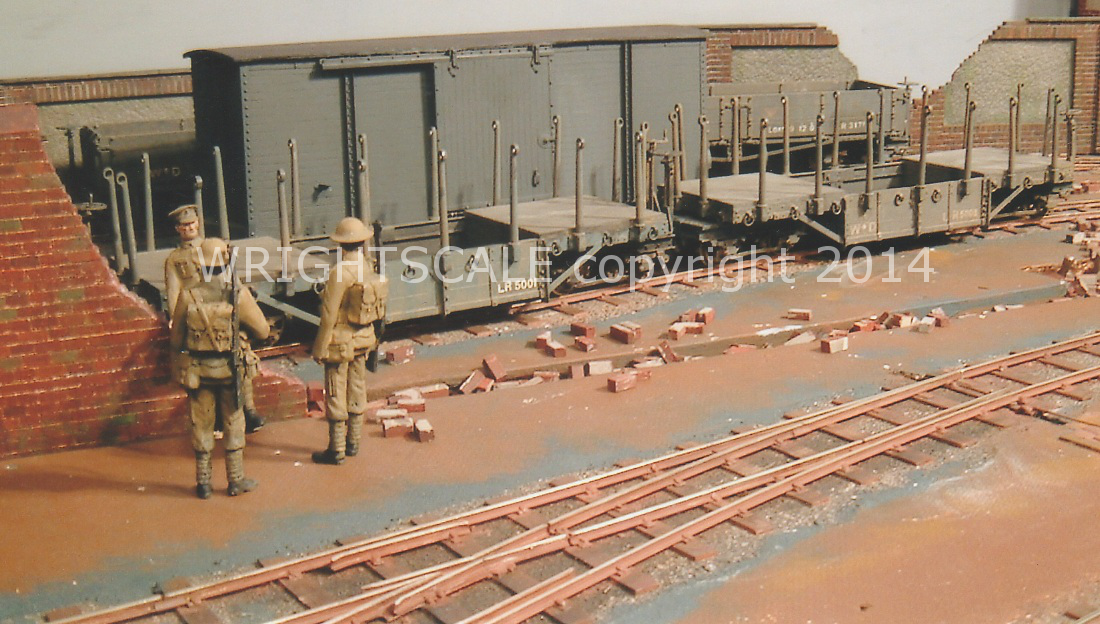
Ah! The figures. Absence of the human form can render any artwork, especially a layout, pointless. All too often a clumsy figure spoils it. These model people all have point. One group are standing deedily in front of the F-class wagon, seeming to be in deep discussion, but probably trying to work out where best to go for a meal. Rule number 1 for a soldier is: look busy, rule 2: locate the cookhouse.
The fireman on the Péchot-Bourdon is just looking but do not under-estimate the importance of looking. He is checking down the train. If something is wrong at this stage, it will be ten times worse down the track and in the darkness. You can see the tension in that arm. There may be something slightly cartoon-like in these little figures but it actually suits the scale. The contradictory effect is to make them more human. Art can be more life-like by being less faithful to life. The remarks above about a pale colour palette, applied highlights and shadows apply even more to figures on a layout.
Here are some more favourite views.
16mm models of a Baldwin Gas Mechanical 50 horse power locotractor (right - a Wrightscale model built by Henry Holdsworth) and a Dick Kerr 45 h.p. Photo courtesy Jim Hawkesworth
 A Baldwin 50h.p. locotractor probably 'liberated' from the AEF is followed by a 45 h.p. locotractor built by Dick Kerr Ltd for the British War Department. Pershing discouraged the U.S. army from cooperating with the British, but the boys on the ground have done things their own way. The jaunty chap in the driving seat is wearing British Army khaki. Is the angle of his hat cocking a snook at all generals, or did he just hit the canopy when getting in? You make up the story. The Baldwin locomotive he is driving has had an eventful life. The rough-and-ready undercoating the metal had in the factory has almost worn off to be replaced by the unique patina of front-line life.
The Baldwin 50h.p. model is a Wrightscale production and the Dick Kerr is a special commission. Both have louvred side panels - a Westinghouse version of the 45 h.p. did not have louvres. The two locotractors were weathered by Henry. They look lovely together, part heavy carapace and part ethereal.

Some debris to clear. Wagons on Wrightscale bogies. Photo J Hawkesworth


Wednesday, 26 November 2014

Hunslet Quarry Tank Progress.

Hi, this month has seen some real progress in the workshop.  Days spent machining up parts has finally reached a stage where assembly can start.  The chassis are getting near the end  of the assembly process.
Progress mid- November, frame interior and wheels painted, chassis quartered.
They are all now erected and the internal parts finish painted.  The cylinder blocks have had their covers fitted, a lot of work since each cover is retained by five 12BA bolts.
All the slip eccentric valve gear in place.

By the end of the month the first chassis will be running on air. The only job left is to fit the valve chests, valves and valve rods to the cylinder blocks, add the pistons, rods and slide bars.  Then a squirt of oil and connnect up the air!  Hopefully they will all run well.  If they do, the first eleven names on the interest list will be contacted and given a delivery date.

Friday, 14 November 2014

Not among Péchot's babies

 Progress on the book is steady. The printer says that it will be ready for delivery 'in the week beginning November 24th' That probably means November 28th.

Jacket design by James Albon
It is hard to imagine the experience of the trenches, 1914-18. My grandfather wrote: 'We march up daily to work and it is rather like having the sea in front of you, that funny no-man's-land. One doesn't think of it as enemy country. It's just a kind of  "this far and no further" sort of place that one sees on the maps, almost wondering if it is for real. Of course you realise that you mustn't put your head up or march over the open in daylight but then again the impersonal feeling comes in and you accept it as a dispensation of Providence that this particular atmosphere should be full of bullets just as another is full of rain'

Over the period of the War, there was a significant change in British trench life. In the early stages of the Great War, the British were supposed to rely on the existing standard gauge and metre gauge railways to get them to within, say, 5 miles of the Front. The rest of the journey had to be achieved on foot, by horse or bicycle. My grandpa did acquire a bike. Provisions had to be lugged up by General Service wagons, pulled by teams of horses or mules, under cover of darkness on unmade roads which all seemed to share one characteristic - the ditch, invariably filled with freezing water.
Grand-pa and horse. Behind can be seen two General Service wagons
 'Top brass' considered trench railways a distractor, though they did sanction improvements to standard gauge lines.  Here and there, unofficial proprietory prefabricated rail was in use, often using material scrounged from the French. Early in 1916, the British took over a French Army sector. It had 'official' trench railways - three short 60cm lines linking the Front with the standard gauge network. Official eyes were half opened and 'Programme A' was born - mainly small wagons to be pushed by humans were supplied to run on 60cm gauge rail. During 1916. 'top brass' had more reason to look at the Péchot system proper. In the build-up to the Somme offensive, summer 1916, the attention of the British Establishment was focussed on shell production. The many problems of converting the peacetime economy and manufacturing of Britain began to be addressed but by July, it was clear that ammunition was not reaching the Front in sufficient quanities.  Eric Geddes, largely credited with solving the Munitions Crisis, was authorised to solve the crisis of Forward Transportation. The Directorate of Light Railways was formed and the seeds of the War Department Light Railways were sown. A thousand miles of track were ordered, and locomotives and wagons in proportion.
The British adopted many characteristics of the French, especially in the design of rail - though there were Bristish quirks. The gauge adopted was the French one, 60cm. The little push trucks 'Programme A' were rapidly superseded by 10 tonne bogie wagons which echoed the Péchot pattern.
One of the ways in which the British showed originality was in their Prime Movers. The four-wheeled petrol mechanical tractor built by the Motor Rail and Tramcar Company Ltd, better known as the Simplex, was completely British. In 1914, as the machines of war rumbled into action, Mr Abbott of the MR & TC  approached Lord Kitchener with his ideas. No doubt, he expected his design to be constructed to 2'6" (75cm) gauge which was then the British Army norm. Lord Kitchener himself dismissed him with 'This is not our way of working'
England doesn't need you! In 1914, Lord Kitchener turned down the offer of a rail tractor. Picture courtesy of the Moseley Railway Trust/Common Source
 It was a pity that the Army didn't look a little closer. Over the next couple of years, the French discovered the merits of internal combustion on the battlefield. A picturesque plume of steam during the day or glowing cinders at night were a delight for enemy gunners, less so for engine drivers, and thus petrol and later diesel rail tractors were used for forward working. In 1916, as the British began to adopt French ideas, the first order for a 20h.p. version of the Simplex was received - in 60cm gauge. By April, the prototypes were being field-tested. They were rugged and simple; by the end of the War, about 600 had been delivered. The two-cylinder petrol engine sat in the middle of the loco frame, the radiator at one end and the driver and controls at the other.  The seat faced sideways so that the driver could see both ways. What is more, the Dixon Abbott gearbox had three speeds in both directions. When a quick sharp exit was called for, and no turntable was available, the Simplex was your machine!
This 20h.p. Simplex tractor can be seen at the Welsh Highland Heriatge Centre. Photo courtesy of Steve Currin
 The War Office invited a design for a larger machine that could carry armour, useful for Front-line work. The MR & TC submitted a design which weighed six tonnes and had a 40h.p. engine which was immediately approved. Like the 20h.p. version, the driver sat sideways and the tractor could go equally fast in both directions. Unlike on the smaller one, the driver sat in the middle with the radiator to one side, the engine and transmission to the other. Three versions of the 'Tin Turtle' were produced: open; weather-protected; and the true tin turtle, the fully armoured model. 200 of these 40hp petrol tractors were delivered to the WDLR. There was another order for 112 but WJK Davies (Light Railways of the First World War) was not certain how many were delivered.
This bonny rake of 40 h.p. Simplexes were snapped at the Moseley Tracks to the Trenches event, September 2014. The middle one has the roof at the original height, the rear most has an altered roof  - taller and additionally supported.
The Simplex was truly British.What more can we say?


Saturday, 8 November 2014

More of Péchot's little ones: various designs of rail

You have already heard about the Tracks to the trenches event at Apedale, Staffs, 12th-14th September this year.We had a lot of fun admiring the many locomotives and wagons running on 60cm track. Once they had been on different sides during the Great War, now they could all run together. A sleek German D-lok, a Péchot wagon and various khaki-clad British locomotives could all travel over the same track because they were all the same gauge.
Yet a few years before 1914, this would not have been possible.
Henschel 15968 built in 1918 It can usually be seen at Toddington, on the North Gloucestershire Railway. After the Great War it passed into civilian use but was bought by the preserved line in 1985. Photo M.D.Wright
Just before I get down to the level of the track, here, courtesy of the North Gloucestershire railway, is German No 1091 0-8-0T, D-lok for short. Don't offend her by remarking on her dazzling red buffer beams. We know just how she looked in the sad days of war. Admittedly, most people and machines of 1914-18 were all black, white or shades of grey - film and photographs of the period prove this. The Germans were different. Tell them that something is colour no 208 and they will immmediately see magenta, colour 106 and they will see burnt umber und so weiter.
I'm making this up, but the Germans did have precise colour charts - a sort of precursor of pantone. With these charts, the good people of the North Gloucs. Railway were therefore able to match the colours precisely and so are confident that the D-lok appeared just as shown.
It could all have turned out differently. The trench railways of the various nations could have run on varied gauges. Before 1888, the French military were seriously considering metre gauge for military supply. At the same time, they were already using Decauville 40/50cm gauge industrial railways in some of their military bases. 75cm track was available in Germany. The Austrians tended  to 70mm. For Germans and Austrians there  was plenty available as it was a commercial design, available from Arthur Koppel of Berlin. Zezula, in his contemporary account of narrow gauge in central Europe mentions Kopppel by name as a track supplier.
Although this rail is stamped Decauville, photographs of the time show that Koppel produced prefabricated rail to this pattern which was put to military use. It was sturdier than some. The sleepers are corrugated to give extra rigidity and project slightly beyond the rails themselves giving a wider and more stable  'footprint'. Courtesy JIm Hawkesworth
The British flirted with 15" gauge, but settled for a very small stock of 2'6" gauge. It is a complicated story, and I say more in "Colonel Péchot: Tracks to the Trenches"
The Book! Published December 2014

Someone changed this outlook and this exuberant variety of gauges. That person was Prosper Péchot. In 1882, he sent his Memorandum to the Ministry, explaining that a system based on 60cm gauge could answer the needs of an army. For the rest of his career, he struggled to convince his superiors that prefabricated 60cm track was the way to bring the battle to the enemy's doorstep. Carefully he designed the right sort of track to ensure that his railways could be quickly rolled out. He realised that there was a trade-off between axle load, durability and portability and so he settled on 9kg/metre rails, and eight sleepers per 5 metre length. The sleepers were of 'box-lid' shape, to prevent the substrate from slipping away. They extended well beyond the rails and were set closer together than commercial prefabricated track of the period.
Track to the Péchot design. It appears in catalogue 130, being marketed commercially by the Decauville company. Courtesy Jim Hawkesworth

 By 1887, a 60cm test track was set up at Toul, north-east France.  In 1888, there were serious trials - 60cm against metre gauge. We know that since 1886, the world's Press had been watching French military developments. In June 1888, the Ministry decided in favour of his system. 'Artillerie 88' ie the Péchot system became the one in official use.
Quite suddenly, the Prussians and in due course all the other Germans adopted 60cm gauge. We have to remember that the Press had been invited and reported on the French trials. Records mention 60cm gauge being used in Prussia for the first time in spring 1888. By 1889, the strange little locomotives that the Germans used had been superseded by locomotives that looked suspiciously French.
Péchot track was and wasn't copied. The Germans tended to use prefabricated track sparingly, moving on to rail conventionally laid on wooden sleepers as soon as possible. A reserve was kept for quick repairs, as can be seen in photographs of the period. Photographs taken on German lines in the Great War show that the 'corrugated-sleeper' commercial pattern was still sometimes used.
Yet although the commercial design was convenient the Germans copied the Péchot sleeper, though not completely. Fach and Krall in their book on Heeresfeldbahn - German military narrow gauge show the new standard in prefabricated railways. The military pattern was pressed, like the French ones. For ease of manufacture, there was an obvious 'fold' which did the job of gripping the substrate.
This metre length of  prefabricated track is as used by the German Army. Something very similar was used by the British. Although it is a much simpler pressing, the track exhibits most of the essentials oif the Péchot design. The sleepers extend well beyond the rail, they are set close together and have a box-lid shape. Courtesy MD Wright

The British came very late to 60cm gauge - officially not until 1916. Though they were suspicious of Johnny Foreigner's Metric system, they saw the merits of standardising. They mixed prefabricated and conventionally laid track - in the proportion 60%:40%. They had great difficulty imitating the beautiful pressed steel Péchot sleepers and so theirs also have a 'folded' look, with corners. The rail was in 20lb/yard weight (the nearest Imperial equivalent to 9kg/metre) though supplied in metric lengths! The prefabricated track had nine, rather than eight sleepers per 5 metre length - super for durability, but a greater weight to carry by squaddies labouring in battle conditions.  People such as the author of 'Colonel Péchot: Tracks to the Trenches' can easily confuse the German and British designs.

Monday, 27 October 2014

HUNSLETS, first batch progress

Hi, it has been a few weeks since the last workshop report.  I have not been sitting doing nothing. Three weeks have gone by on a trip abroad, to France to see some friends; last Monday we were sitting having lunch at the Brasserie de la Gare in Agen 29' in the sun,  tidying up a garden with three days of bonfires, draining down the water before winter and seeing family on the way out.  Now back in Aboyne, we walked into a howling gale and horizontal rain. So it was unpack and get into the chill of the workshop. 
The Hunslets, the first batch of eleven locos, are taking shape with all the frames erected.

Two of the eleven frame sets of the first batch.
 I decided to review how I was going to detail the frames which led me to revise the etch.  I produced a nicely detailed overlay for the steel frames that avoids the time and money wasted on fitting 32 small rivets  and 16 very expensive hex headed bolts. Heavy cylinder flanges were added to the design.
The part completed frame showing the new detailed overlay and the cylinder bolting flange.
The other platework parts in place.  The additional etch parts are the detailed buffer beam overlays.

The last photos show where most of the time has gone, making the couple of hundred parts that eleven locos need for their valve gear, cranks and wheels.
Some of the machined parts needed for the valve gear and chassis (15 parts x 12 locos!)

The final push before the chassis will run on air is to machine the cylinder covers, pistons, rods and spindles, oh yes and machine up the slide valves. (The wheels, axles and bearings are already made)
There is, though, a good chance this might get done next month.  The most recent annoyance is that 1 1/2" by 20 gauge copper pipe is no longer made.  Since all my small locos use this for their boiler shells I have just had to pay out £1600 to have some drawn for me.   As a friend said "at least if you die before you use it all the price of copper is always going up......" Seriously it is getting harder to source a lot of materials. I suppose this is the consequence of two trends, one being a further contraction of manufacturing in the UK and so many folk purchasing their models from China, the other the trend towards metrication.


Friday, 3 October 2014

About the book and other babies

After twenty years, many travels together and much care, our baby is ready to leave home!
My Book ready to print.

It is easy to explain how our interest started. To people interested in trains anyway, the Great Little trains of Wales appealed greatly. Long before it was rebuilt, we paced the line of the Welsh Highland Line.We had happy afternoons at Leighton Buzzard and sneaked into old quarries. In France, we visited the 'petit train de la Haute Somme' All of these, and many others already closed had chosen 60cm/two foot for their gauge. All of them exuded atmosphere, quaintness and just a touch of melancholy, a hint of ghosts flitting left-of field.

When we investigated, we found that every one of these lines was indeed haunted. Moelwyn in Wales, Lion in Leighton Buzzard, and a host of relics at the Somme railway were left over form the First World War.

Some of the relics found at Froissy, Haute Somme.
They were survivors - people, animals, machines had all perished during fifty months of carnage. Much has been written about soldiers and horses, tanks and aeroplanes but nothing much about the railways.

To explain why we kept on with our research, you have to understand that we are born contrarians. Once we suspected that something was buried, we had to start digging. More than once, we have been called terriers - with some justice! We found out that there was a forgotten network of 60cm railways, used by both the Allies and the Central Powers during 1914-18. If laid end-to-end it would have stretched nearly ten thousand kilometres. Unlike the usual prewar agricultural or industrial railway, this network could manage tonnages normally associated  with properly laid and engineered standard gauge lines.

Yet all was forgotten.


Only last night on television, a respected historian trod the familiar dodgy ground. We all know that in Europe in 1914, there was a network of railways, standard gauge and metre gauge, serving the towns and villages of the time. Suddenly, the Western Front was constructed in this landscape, with very little regard for the railway network; each side was obsessed with denying as much territory as possible to the other. This meant that the Front was, on average, a good 5 miles (8 kms) from the nearest railhead. 
BEF troops entrai in France. It was march or take the narrow gauge to the Front.

Later in the War, the average distance from railhead to front increased to around ten miles (16 km) to keep loading stations out of the range of enemy artillery. Every five miles of three hundred plus miles of Front needed per day, in quiet times, at least 800 tonnes of supplies (including fresh water) and in the period leading up to an offensive about 3,600 tonnes. It was exactly as if a great belt of new towns, with all their requirements, had been suddenly dumped on open country. The respected historian explained that some horses were imported from America to provide transport from standard gauge railway line to front line.

Let us do the arithmetic. The very best equine transport, the mule, can carry up to 72kg with any sort of endurance. The ponies etc drafted in were simply not capable of that. Four mules hitched to a General Service Wagon can transport up to 2 tonnes. Remember, the unmetalled roads of the time were less than optimum. Transport had to be at night, because they were tempting targets. Looking at my grand father’s war letters, we see that, what with the dark, the mud and other obstacles, they could only manage 1000 yards an hour. In other words, a 10 mile round trip would, without mishap take all night. 11,500 mules plus muleteers were required to transport the supplies needed for every 5 miles of Front on quiet days.  Productivity would rise if wagons were used, but one’s imagination would be rather stretched; 2000 wagons coming and going daily on a few unmade country roads. On the other side of No-Man’s Land was the equally ponderous German front, the equivalent of another string of new towns whose industry was destruction and whose needs were equally great. The Germans of course could not import American horses and mules.

Ah! other respected historians interpose. The technology of the lorry was just coming into its own. A Thorneycroft J-type lorry, for instance, could transport 3.5 tonnes of supplies and move rather faster than a mule. The Voie Sacrée, supplying Verdun, is then cited. Every night, a procession of French lorries made its way from the station of Bar-le-duc up to the beleaguered citadel. What has been forgotten is that, parallel to the road ran a military-built multiple track narrow gauge rail way.

Given these problems, you may now be wondering why the war of 1914-18 went on for so long. There had been wars before. Since the American Civil War half way through the 19th century, conflict was either resolved in a few months, as in the Franco-Prussian War of 1870-1, or took the form of asymmetrical warfare, as in the Boer War 1899-1902. What the respected historians don’t seem to ask is how millions of combatants over hundreds of miles managed to exist in their trenches for four long years.

The difference was due to the life and work of Colonel Péchot. For years, without modern trucks, tanks and aircraft, supply in the field was limited. The standard gauge railway network was useful – up to a point. Vast armies could slug it out for a few weeks or a guerrilla force could harry a larger force for years. It was not possible for grand action on a long timescale, not until Péchot devised an efficient system of military 

A British built loco for the French Army.  A Kerr Stuart Joffre Class engine (Apedale- Tracks to the Trenches 2014)
transport. His superiors in the French Army grudgingly adopted it. The Germans copied his technology and made effective adaptations. By 1914, the Germans had almost perfected their system and the Allies, particularly the British, spent long years trying to catch up. More than one contemporary French general felt that victory needed a good narrow gauge network.

Our 'baby' tells you the story of this quiet man who had such a profound influence .